
Ikigai for Organization: The Four Questions
Organizational Ikigai - Week 2
By Rick Aman onStrategy without purpose is motion. Purpose without discipline is sentiment. — Roger Martin, adapted from Playing to Win
Ikigai has traditionally been used as a personal centering practice. It helps individuals clarify meaning, direction, and purpose in their lives. At its core, Ikigai answers a simple but profound question: Why do I do what I do? What is often overlooked is that colleges and nonprofit organizations need centering just as much as individuals do. Institutions drift when activity outpaces purpose. When applied at the organizational level, Ikigai becomes a disciplined way for boards and leadership teams to re-center on mission and clearly define their why before setting goals, approving initiatives, or reallocating resources.
In higher education today, the pressure to act is relentless. Demographics are shifting. Workforce demands are evolving. Technology is accelerating. Funding is tightening. In response, colleges often layer initiative upon initiative, believing momentum itself will produce relevance. But motion without meaning rarely delivers impact. The institutions that remain strong are not simply those that move quickly, but those that remain centered.
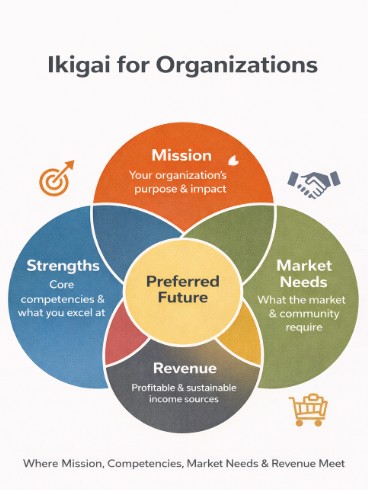
Ikigai offers a framework for that centering. Adapted for organizations, it invites boards and executives to examine four intersecting questions. None stand alone. Together, they form a powerful governance lens for clarity, alignment, and sustainability.
 What Do We Love to Do?
Mission energy versus mission drift
This first question is not about sentimentality or tradition. It is about energy. In organizations, love shows up where commitment is sustained over time. It is visible in faculty engagement, staff pride, and student success. It is present where people believe the work matters.
Mission drift often begins quietly. A new grant opportunity appears. A promising partnership emerges. A program is added to solve a short-term problem. Each decision may be reasonable on its own. Over time, however, the institution begins to feel stretched, fragmented, and fatigued. What once felt purposeful starts to feel heavy.
Boards play a critical role here. Trustees are uniquely positioned to step back from daily operations and notice where mission energy is strong and where it has dissipated. Programs aligned with the heart of the mission tend to generate momentum naturally. Programs that have drifted often require constant explanation, emergency funding, or heroic effort to sustain.
A useful board-level question is simple: Where do we see genuine energy, and where are we compensating for its absence? Protecting mission energy is not a soft governance issue. It is central to long-term effectiveness.
What Are We Truly Good At?
Distinctiveness, not aspiration
This question is frequently misunderstood. Many institutions answer it by listing what they hope to be good at rather than what evidence shows they already do well. Being good at something requires proof. Completion rates. Job placement. Transfer success. Employer confidence. Community reputation. Distinctiveness emerges where performance is consistent and visible, not where ambition is loud.
I often see boards and presidents tempted to approve initiatives designed to make their college resemble a peer institution across town or across the state. The risk is subtle but significant. When colleges imitate rather than differentiate, they dilute their identity and stretch resources thin. Aspiration replaces evidence, and focus erodes. Boards add real value when they insist on clarity. The question is not Could we do this? but Do we already demonstrate excellence here? Distinctiveness is an institutional asset. It deserves intentional protection.
What Does Our Region Need From Us?
Workforce, access, and regional trust
Colleges exist in relationship with place. Regional need is not static, and it extends well beyond workforce metrics alone. Yes, employers matter. Skills alignment matters. But so do access, affordability, and public trust. I often ask boards to imagine their community five years from now. What pressures will families face? Which industries will struggle to find talent? Where will opportunity gaps widen if no one intervenes?
Listening is not optional governance work. It is essential. Boards that remain insulated from regional voices risk approving strategies that make sense internally but miss the moment externally. Employer roundtables, civic partnerships, K–12 relationships, and community conversations are all sources of insight trustees should value.
A powerful test is this: If our college disappeared tomorrow, what would our region lose that could not be easily replaced? The answers often reveal the institution’s true role more clearly than any labor market dashboard.
The counter narrative is also worth considering. Just because a large employer or community segment wants something, such as sports, that may not be core to where the college mission rests or in alignment with mission focus. Saying “not now” can be prudent in times of financial pressure.
What Sustains Us Financially?
Financial sustainability without mission erosion
Financial sustainability is not the same as chasing revenue. Sustainable funding models reinforce mission rather than distort it.
In challenging environments, pressure builds to pursue any revenue that keeps the doors open. The danger is that short-term financial fixes can quietly pull institutions away from their core purpose. Programs launched solely for margin often struggle once initial enthusiasm fades.
Boards must consistently ask whether a revenue source strengthens who the institution is becoming or simply delays a harder conversation. Sustainability is about durability over time. It requires alignment between mission, capacity, and funding. One helpful governance question is: If this revenue disappeared in three years, would we still be glad we built the program? If the answer is no, the institution may be trading identity for cash.
The Intersection Is Where Strategy Lives
None of these questions stand alone. Institutional Ikigai exists only at the intersection of all four.
When a college does work it loves, does well, meets regional need, and is financially sustainable, momentum builds naturally. When one or more elements are missing, friction follows. Staff feel stretched. Students experience inconsistency. Boards sense confusion but struggle to name it.
This intersection test gives boards a shared language. It allows trustees to move beyond subjective debates and ask disciplined, mission-centered questions. It also helps CEOs explain why certain initiatives should move forward while others should pause or end.
I have seen this framework change trustee and president conversations. Instead of approving long lists of initiatives, boards begin asking which proposals truly belong at the center of the institution’s identity. Strategy becomes clearer because purpose is no longer assumed.
Ikigai as a Governance Discipline
Ikigai is not a replacement for strategic planning. It precedes it. It clarifies the why before leaders argue about the how.
For boards, this framework is especially useful in retreats, strategic visioning, and CEO evaluation. It provides a consistent lens for decision-making across time, not just during planning cycles. When trustees and presidents share a common understanding of institutional Ikigai, alignment improves and execution accelerates.
In uncertain times, colleges rarely suffer from a lack of activity. They suffer from a lack of centering. Ikigai offers a way back to purpose. Before asking what to build next, boards would be wise to pause and ask who they are and who they are becoming.
---
At Aman & Associates, we work with presidents, executive teams, and governing boards to help institutions re center on purpose before strategy, structure, or initiatives are set. Using an Ikigai based approach, we facilitate focused leadership sessions that clarify mission, strengthen decision making, and support long term sustainability. As one year closes and another begins, a board or leadership retreat can be a timely moment for organizational centering. Aman and Associates offers a short half day Zoom session focused on Ikigai alignment for institutions. If this framework would be helpful for your organization, DM me on LinkedIn for more details.
Rick Aman, PhD Aman & Associates
Futuring | Strategy | Board Development rick@rickaman.com | rickaman.com/articles