
Ikigai for Organizations: Why Purpose Must Precede Goals
Ikigai Week 1
By Rick Aman onInstitutions that thrive will be those that clearly understand who they are and why they exist. -- Arthur Levine (The Great Upheaval)
As the calendar turns toward a new year, college and nonprofit leaders and their boards feel a familiar pressure. Trustees approve goals. Presidents finalize plans. Executive teams line up initiatives. There is a quiet urgency to be ready for what comes next. Yet activity is not the same as purpose, and goals are not mission.
For generations, individuals have used Ikigai to align purpose, values, and daily work. The idea entered the modern conversation through Ikigai: The Japanese Secret to a Long and Happy Life by Héctor García and Francesc Miralles, whose work drew global attention to Okinawa and other Blue Zones where longevity is closely linked to clarity of purpose.
That same concept has something important to say to institutions, especially at a time when mission drift and reactive strategy are common. Centering is the discipline of returning to why the organization exists before deciding what it will do next. Ikigai, often translated as “reason for being,” offers boards and CEOs a practical lens for this work. It reinforces the board’s role as steward of mission and values, and the CEO’s responsibility to translate that purpose into coherent strategy and culture. When leadership is centered, decisions become clearer, tradeoffs more intentional, and strategy more durable.
 What stands out in this research is not longevity alone, but clarity of purpose. Individuals with a clear sense of Ikigai wake up knowing why their lives matter. They make decisions from a grounded sense of meaning rather than reacting to every external pressure. Their lives are not free from complexity, but they remain aligned. Ikigai was never intended to be a productivity hack or a self-help trend. It is a discipline of alignment.
Over time, I began to recognize something familiar in this idea. Institutions behave much like individuals. When they are centered, decisions feel coherent. When they are not, strategy becomes reactive, fragmented, and exhausting. This is especially true for community colleges navigating significant disruption.
Why Centering Matters Before Goal Setting
Most strategic plans do not fail because they are poorly written. They are ineffective because they start in the wrong place. They begin with goals instead of purpose. In my years as a community college president and now working with boards and CEOs, I have seen institutions work incredibly hard while slowly losing coherence. New initiatives launch. Metrics multiply. Committees stay busy. Yet beneath the activity is a persistent feeling that the organization is reacting rather than choosing a preferred future.
This is not a leadership failure. It is an alignment problem.
Community colleges are operating in an environment of constant pressure. Demographic shifts, workforce realignment, emergence of artificial intelligence, technology acceleration, political scrutiny, and financial constraint are no longer episodic challenges; they are the context. In response, institutions often expand programs, pursue new funding sources, connect with legislators and chase opportunities as they arise. Each decision may make sense on its own. Collectively, they can pull the institution away from its core.
Without a clear center, strategy becomes a list of responses instead of a set of choices. Ikigai offers a way to pause before planning. It does not replace strategic planning, budgeting, or accreditation processes. It precedes them. It asks leaders to clarify identity before direction.
From Ikigai for Individuals to Ikigai for Institutions
At the individual level, Ikigai is often described through four intersecting questions:
What do I love? What am I good at? What does the world need from me? What sustains me economically?
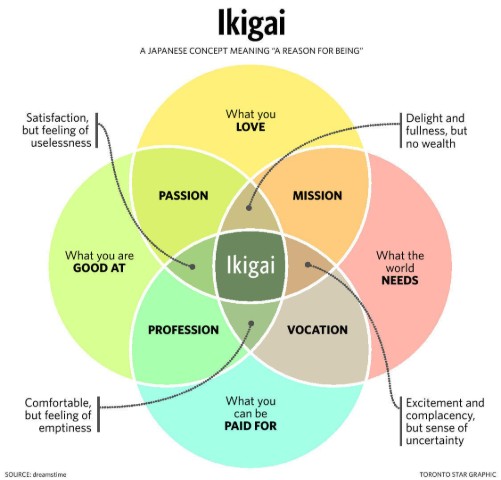 When these questions align, individuals experience clarity. When they do not, people feel stretched, unfocused, or disconnected from their work. The same dynamic exists inside institutions. Colleges and non-profits can drift into doing work they no longer love, offering programs they are not particularly strong at, misreading what their region truly needs, or relying on revenue models that quietly erode mission. None of this happens overnight. It happens gradually, often in response to well-intended decisions made without an anchoring framework.
Ikigai translates naturally into an institutional context, especially for community colleges. When adapted thoughtfully, it provides a language for purpose that boards and presidents can hold together.
Why Strategy So Often Misses the Mark
I often ask presidents and trustees a deceptively simple question: “Why does your college exist today, not ten years ago?” An alternative question is: “What does your degree mean to the student, employers and the community?”
The answers are thoughtful, but they are rarely crisp. Mission statements are recited. Values are referenced. Yet when we explore how those ideas shape actual decisions, gaps begin to appear. Goals are approved before identity is clarified. Initiatives are launched before alignment is tested. Strategy becomes additive rather than intentional.
This is where Ikigai becomes useful, not as a model to diagram, but as a discipline to practice. Ikigai does not ask, “What should we do next year?” -- It asks, “Who are we, and why does that matter now?” When that question is left unanswered, even strong leadership teams struggle to maintain focus.
Boards and Presidents as Stewards of Purpose
Ikigai resonates at the institutional level because it aligns naturally with the shared responsibility of boards and presidents. Presidents and CEOs lead the organization day to day. Boards govern with a longer horizon. Both are stewards of purpose. Boards, in particular, are positioned to hold the center. Their distance from operations is a strength. They are not meant to manage, but to ensure alignment between mission, strategy, and community need. Ikigai provides a language for that work.
Instead of beginning conversations with goals, boards can ask whether the institution remains centered on why it exists. Presidents benefit from this clarity as well. When purpose is clear, leadership decisions become more principled. Trade-offs feel less personal. Saying no becomes easier.
Four Questions Worth Considering at Year End
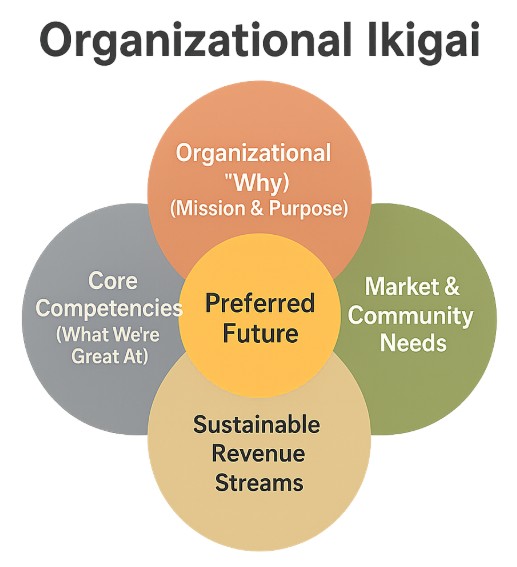
At the institutional level, Ikigai translates into four questions that boards and executive teams should be willing to sit with before approving goals or launching new initiatives.
What do we love? This is not sentimentality. It is about where the institution’s energy truly lives. Which students, programs, and outcomes draw genuine commitment? Where does the college show up at its best? What is the unique value your institution brings.
What are we genuinely good at? Not what we aspire to be good at, and not what peers are doing. This question requires honesty about distinctive strengths. Institutions that try to be everything to everyone often dilute what they do best.
What does our region need from us now? This grounds purpose in place. Workforce needs, access gaps, demographic change, and civic trust all matter. Ikigai keeps the institution outward-facing.
What sustains us financially? Purpose without sustainability is fragile. This question is not about commercialization of mission, but about ensuring the institution can continue to serve over time without erosion or burnout. These questions are not meant to be answered quickly. When they are, it is usually a signal that deeper work remains.
 A Year-End Invitation
Mid-December is a natural moment for reflection. Boards are approving budgets, presidents are setting direction, and leadership teams are preparing to move from planning to action. Before finalizing goals for the year ahead, this is an opportunity to step back and clarify the institution’s north star, its reason for being, not as inherited language or an aspirational slogan, but as a clear expression of purpose grounded in today’s realities, regional needs, and institutional strengths.
Used this way, Ikigai becomes a centering discipline for organizations. It does not prescribe strategy; it creates alignment. That alignment allows boards to steward mission with confidence and enables CEOs to translate purpose into coherent strategy and culture. In the weeks ahead, I will explore how Ikigai’s four guiding questions can be applied practically in community colleges, how boards can use Ikigai as a governance lens, and how this framework directly informs a clearly articulated preferred future. Strategy follows purpose. It always has.
----
This is the work I do through Aman & Associates. I partner with boards and executive teams to apply these four Ikigai principles to their unique organization, helping leaders center on mission, sharpen strategic clarity, and align future decisions around purpose. For institutions ready to do this work together, I offer a focused half-day Zoom retreat designed to translate Ikigai from concept into practical strategic insight and movement toward a preferred future. DM me with any questions.
Rick Aman, PhD Aman & Associates Futuring | Strategy | Board Development rick@rickaman.com | rickaman.com/articles