Category: Colliding S-Curves

  • Ten S-Curves Shaping the Future of Community Colleges

    Ten S-Curves Shaping the Future of Community Colleges

    Ten emerging technologies redefining how we operate, teach, learn, and lead

    The greatest danger in times of turbulence is not the turbulence; it is to act with yesterday’s logic — Peter Drucker

    Change in higher education no longer moves in straight lines. It advances in overlapping waves, each one gathering speed as another begins to slow. The hardest part of leadership isn’t managing a single disruption; it’s guiding an organization through the intersections where multiple forces collide. In my work with governing boards, I’ve seen how these moments test not only strategy but also trust where clarity, communication, and shared vision become the real measures of leadership.

    Today, those intersections are everywhere. Artificial intelligence, immersive learning, blockchain credentials, and cloud infrastructure are reshaping how colleges operate and how students prepare for work that doesn’t yet exist. Add to that the accelerating curves of renewable energy, advanced manufacturing, cybersecurity, and digital health, and the pace becomes exponential. The future isn’t arriving in sequence it’s arriving all at once.

    For community and technical colleges, this convergence defines a new strategic frontier. As Arthur Levine and Scott Van Pelt describe in The Great Upheaval, higher education is being reshaped by forces that challenge its very identity, who it serves, how it teaches, and what credentials mean. Relevance will depend not only on adapting to each S-curve but on seeing how they interact where one technology amplifies another, and where traditional models of teaching, funding, and credentialing begin to bend. Understanding these ten technology-driven S-curves is the first step toward shaping a preferred future rather than reacting to someone else’s.

    The Ten Technology S-Curves Shaping the Workforce and Society
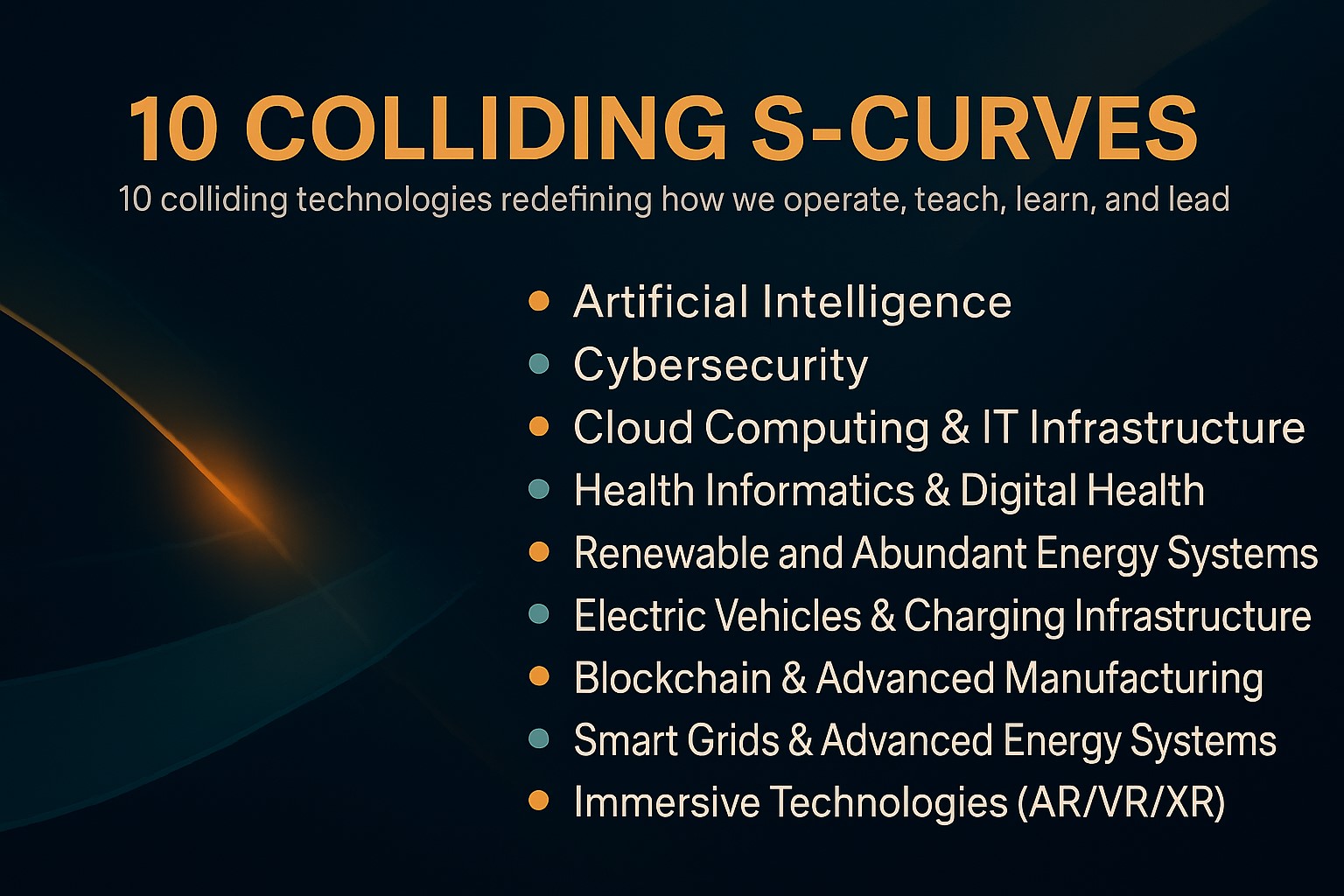
    None of these technologies stand alone, they amplify one another. AI drives analytics: analytics depend on cloud infrastructure; broadband enables immersive learning; and cybersecurity underpins them all. These collisions create turbulence but also immense possibility.

    During board retreats, I often illustrate this visually: layered S-curves rising and intersecting across time. Each curve represents a domain of change in teaching, infrastructure, workforce, or skills. The responsibility of leadership is not to ignore the curves but to recognize where they converge, that’s where strategy lives.
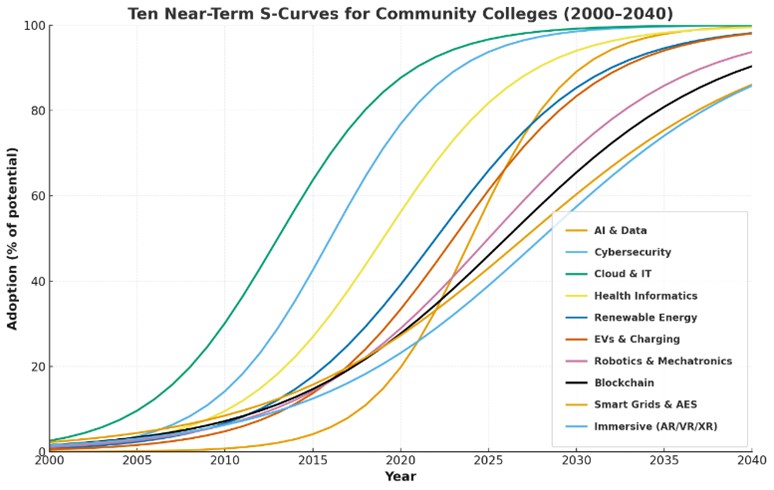
    1. Artificial Intelligence and Automation AI is redefining productivity and problem-solving across every sector, creating a world where continuous learning, adaptation, and ethical use of intelligent systems determine competitiveness.

    2. Cybersecurity and Digital Ethics As society becomes fully digital, safeguarding data and integrity has become a civic responsibility, anchoring public trust and protecting the infrastructure of modern life.

    3. Cloud and IT Infrastructure Global connectivity and distributed computing form the backbone of economic resilience, demanding leaders who can balance access, efficiency, and security at scale.

    4. Health Informatics and Digital Health Data-driven healthcare is transforming longevity and quality of life, requiring a workforce fluent in analytics, telemedicine, and ethical management of personal health data.

    5. Renewable and Abundant Energy Systems AI adoption is driving the need for vastly greater energy production. Clean-energy innovation and energy storage is reshaping geopolitics and economies, calling for technically skilled workers who can build and maintain resilient energy infrastructure.

    6. Electric Vehicles and Charging Infrastructure The shift to electrified mobility will redefine transportation networks, manufacturing, and urban planning creating millions of new technical and service roles.

    7. Blockchain Credentials and the Tokenization of the World Decentralized verification is building a new layer of digital trust, enabling individuals to own and exchange value, identity, and credentials securely across society.

    8. Robotics and Advanced Manufacturing
      Automation and collaboration between people and machines are reshaping industry; future roles will prize adaptability, oversight of automated systems, and digital craftsmanship.

    9. Data Analytics and Predictive Insights In every field, the ability to translate complex data into strategic foresight will guide smarter decisions, policies, and innovations across society.

    10. Immersive Technologies (Augmented and Virtual Reality) Immersive platforms are redefining how people learn, design, and connect, blending creativity and technology to shape experiences across education, commerce, and culture.

    Opportunity or Threat?

    Every S-curve carries both promise and peril. On the ascent, it offers innovation and growth; on the descent, obsolescence. Whether technology becomes opportunity or threat depends on how leaders engage it. Colleges that experiment thoughtfully gain early insight and workforce advantage. Those that wait for certainty often find themselves catching up at double the cost. Curiosity, not caution, is the competitive edge.

    The simple discipline I share with boards is the insight to review each technology through a SWOT (Strengths, Weaknesses, Opportunities, Threats) lens. What are our strengths in adoption? What weaknesses limit us? Which opportunities align with mission? What threats demand attention? The future rewards those who keep that conversation alive.

    The Board’s Role: Environmental Scanning and Sense-Making

    Governing boards are uniquely positioned to see these patterns first. Their distance from operations provides perspective, but only if it’s informed. That’s why environmental scanning is now a core competency of modern governance.

    A comprehensive scan looks across political, economic, social, technological, environmental, and legal trends (the PESTEL model). When coupled with institutional analytics, it becomes a strategic radar system detecting early signals that should shape budgets, partnerships, and academic focus.

    Boards should dedicate at least one annual session to technology foresight: Which emerging tools align with our mission? Which demand faculty development? Where can shared infrastructure reduce costs and increase access? Futuring is not prediction—it’s preparedness.

    Navigating the Intersections: A Leadership Framework

    To guide colleges through converging technologies without being overwhelmed:

    1. Identify the Forces. Map the emerging S-curves shaping your institution: AI, automation, robotics, blockchain and visualize how each influences mission and operations. Clarity builds shared understanding across leadership levels.

    2. Find the Intersections. Spot where these forces overlap—AI with analytics, broadband with workforce, secure systems, use of automation for efficiency, and design to reveal opportunities and tensions that demand attention.

    3. Assess Readiness and Define the Preferred Future. Evaluate where to lead, where to collaborate, and where to build capacity. Then describe what success looks like three to five years ahead if technology, mission, and workforce needs align.

    4. Align Resources to the Vision. Budgets, ethics, policies, and partnerships should follow the preferred future—not drive it. True innovation emerges when governance, strategy, and resources move in concert.

    Colleges that embed adaptability into their systems not just their programs will remain relevant regardless of how the next wave of disruption unfolds.

    Closing Reflection

    The challenge before community colleges isn’t mastering any single technology, it’s managing their intersections. Each innovation carries risk; together they define a moment of extraordinary possibility. Our task as leaders is to help boards, faculty, and communities see the full picture to connect the dots before they connect themselves. Futuring isn’t about forecasting gadgets; it’s about framing choices. When change arrives, it should find a college already in motion—aligned, adaptive, and anchored in purpose.

    —-

    At Aman and Associates, we help boards and executive teams navigate these converging S-curves through Futuring Retreats and Preferred Future Planning. If your college is ready to map its own technology landscape and identify the intersections that matter most, I’d welcome a conversation. Together, we can turn disruption into direction.

    Rick Aman, PhD Aman and Associates | rick@rickaman.com | rickaman.com/articles


  • Leading the Next S-Curve: From Futuring to Strategic Action

    Leading the Next S-Curve: From Futuring to Strategic Action

    Technology is a useful servant but a dangerous master — Christian Lous Lange

    In this final article of the Colliding S-Curves series, I turn from awareness to application — from seeing the patterns to leading through them. Higher education stands at a moment when technology, workforce, and society are reshaping each other faster than any strategic plan can track. The question for leadership is no longer what will change, but how we will prepare.

    Through my work with governing boards, CEOs, and professional organizations, I’ve seen how futuring can transform not only how we plan, but how we think. It reframes leadership as an act of anticipation rather than reaction to what is happening, a practice of envisioning and steering toward a preferred future rather than defending the status quo.

    From Awareness to Action

    Futuring is more than a thought exercise; it’s a discipline of looking ahead to guide decisions today. The institutions I work with often begin with a familiar story, a comprehensive strategic plan that once looked impressive, but now is adding 3% to last year. It feels outpaced by reality. The world moved, but the plan didn’t.

    That’s why I encourage boards and CEOs to view strategy as a living system rather than a static document. The process begins by identifying early signals of change, demographic shifts, emerging technologies, new learner expectations, and testing how those signals might impact mission, programs, and people. BTW, futuring doesn’t replace strategic planning; it precedes it. It sets the tone and direction for what’s likely ahead.

    In one leadership retreat I facilitated, trustees were asked a single question: “What does your institution look like three years from now when it is fully aligned with the next wave of workforce and learning demand?” The discussion that followed reshaped how they viewed their priorities. Budget assumptions changed. Program development accelerated. Conversations moved from managing the present to designing the future.

    The transition from awareness to action begins when leaders stop trying to predict the future and start preparing for multiple possibilities. Futuring gives them the tools and the language to do both.

     How AI Will Influence the Next Workforce Shift

    Across industries, a major realignment is underway. Artificial intelligence is moving up the value chain, automating work that once required advanced credentials or years of experience. What began as automation in logistics and manufacturing is now reshaping law, accounting, design, and management.

    White-collar employees, long protected from automation, are now facing task erosion. Large language models and AI agents are handling research, drafting, analysis, and administrative processes with increasing precision. The next workforce transformation will not only affect factory workers; it will redefine professional work itself.

    This isn’t solely a story of job loss; it’s a story of job redesign. As AI takes on routine and rules-based functions, the human advantage shifts toward judgment, creativity, empathy, and strategic reasoning. The future belongs to those who can partner with technology, not compete against it.

    At the same time, skilled trades and technical professions are entering a resurgence. Electricians, welders, healthcare technologists, and energy specialists perform complex, hands-on tasks that require adaptability and context, areas where AI has limited reach. These workers are essential to building and maintaining the very systems that enable digital transformation.

    A few years ago, I worked with a community college that recognized this transition early. Enrollment in general associate degrees was strong due to dual credit and college transfer, but demand in advanced manufacturing, cybersecurity and renewable energy was rising faster. The board made the strategic decision to reinvest in technical programs aligned with regional industry needs. Within two years, graduates were in high-wage, high-demand jobs, and the college had reclaimed its position as a workforce anchor. That’s what strategic foresight looks like in practice, seeing the shift before it becomes a headline.

    AI will not replace the human workforce, but it will reshape it. Institutions that prepare both knowledge workers and skilled professionals, those who think deeply and those who build boldly, will thrive on the next S-curve.

    Governing Boards, CEOs, and Professional Organizations: Leading with Foresight

    The collision of innovation and technological S-curves is not an abstract concept; it’s a leadership test. Strategic foresight must now sit alongside finance, policy, and compliance as a core responsibility.

    Boards that govern effectively are expanding their field of view. Beyond budgets and enrollment, they’re scanning for signals of relevance, what employers need, how students learn, and how technology is transforming work itself. CEOs are doing the same, often using AI-assisted labor analytics and scenario modeling to anticipate regional shifts.

    In one retreat I facilitated, a college board reviewed workforce data showing that automation would disrupt many of their traditional business and office programs. Instead of waiting for enrollment to fall, they took action, repositioning the business program around data analytics, logistics, and entrepreneurship. The board’s courage to pivot preserved relevance and opened new opportunities. That kind of foresight changes the leadership conversation. Instead of asking, “Which programs should we cut?”, the question becomes, “Where is our next relevance?”

    For CEOs, this means cultivating cultures of experimentation, testing small pilots, measuring outcomes, and scaling what works. For professional organizations, it means preparing members for new roles that blend human capability with digital fluency. And for boards, it means embedding anticipation into governance: reviewing trend data and scenario outcomes as part of every strategic discussion.

    The leaders I work with who excel in this space treat adaptability as a fiduciary duty. They understand that leadership isn’t about holding the line, it’s about helping the organization evolve before the curve steepens.

    Governance at the Edge of Change

    Governing in this environment requires dual focus: stability for today and transformation for tomorrow. Boards and CEOs must ensure fiscal discipline and compliance while also investing in innovation, talent, and technology.

    A simple futuring framework helps make this balance real:

    • Scan the horizon for signals of emerging change.

    • Imagine multiple plausible futures.

    • Select a preferred direction aligned with mission and opportunity.

    • Translate that vision into actionable, measurable initiatives.

    • Measure and adapt as new data emerges.

    When boards use this process regularly, planning becomes continuous rather than episodic.  Governance at the edge of change is not about predicting perfectly; it’s about preparing consistently. The institutions that practice disciplined anticipation will be those that shape the future, not just survive it.

    Summary: Vision as the Ultimate Advantage

    Strategy is about making choices, trade-offs; it’s about deliberately choosing to be different  — Michael Porter

    The Colliding S-Curves series has explored how technology, human capacity, and institutional vision intersect. The ultimate lesson is this: the future doesn’t reward certainty, it rewards clarity of purpose and readiness to act.

    For governing boards, CEOs, and professional organizations, vision must now function as the central organizing principle. It guides not just what an institution hopes to achieve, but how it prepares to evolve.

    AI will continue to redefine white-collar work while skilled trades rise in value. The challenge for higher education is to prepare both the innovators who design the systems and the builders who make them real. The work of higher ed leadership is to unite those converging curves with vision to anticipate change, alignment to stay true to mission, and resolution to act before the future arrives.

    —–

    Aman & Associates Insight At Aman & Associates, we help governing boards, CEOs, and professional organizations move from vision to measurable action through AI-assisted futuring and strategic leadership frameworks.

    Ask us about a half-day Futuring Mini-Retreat—a focused session for boards, leadership teams, or employer groups exploring how to align mission with the emerging technological S-curves reshaping work, learning, and leadership.

     rick@rickaman.com | www.rickaman.com/articles


  • Colliding S-Curves: How Community Colleges Navigate the Next Wave of Change

    Colliding S-Curves: How Community Colleges Navigate the Next Wave of Change

    Week 1 | Understanding Colliding S-Curves — The Shape of Change

    Why every college leader needs to recognize the pattern of disruption before it arrives.

    Introduction — Seeing the Pattern Before the Pivot

    Experience has taught me that disruption rarely announces itself with fanfare. It builds quietly beneath our feet, forming a new curve of growth just as the old one begins to flatten. One semester a program is thriving; the next, it’s stagnant while something entirely new begins to accelerate elsewhere. Leadership today demands that we see those patterns before the pivot.

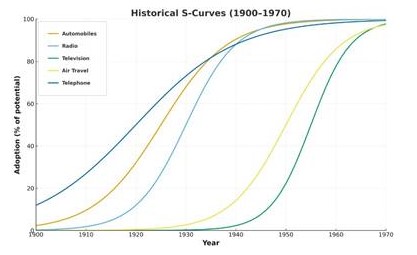
    The S-curve has long been used to describe this process. Every innovation, whether electricity, telephone, automobile, or personal computers follows a similar trajectory: slow adoption, rapid acceleration, and eventual maturity. The insight is simple yet profound: growth is never infinite. Each curve levels off, and another inevitably begins. Consider that when the automobile overtook the horse-drawn carriage, one curve rose as the other faded, progress that felt magical to some and intimidating to others. For most of higher-education history, we faced only one or two S-curves at a time. There was time to adjust. Change came sequentially. Today, however, we are witnessing colliding S-curves, multiple waves of innovation and social change rising simultaneously and intersecting unpredictably.  

    Arthur C. Clarke once said, “Any sufficiently advanced technology is indistinguishable from magic.”

    To many presidents, boards and executive teams, AI already feels like that kind of magic, both wondrous and unsettling. The challenge for community college leaders is not simply to watch the show, but to learn the science behind it to understand how to read the curves before they collide. I would like to spend the next few weeks exploring the magic of S-Curves, their value to colleges in predicting themes and trends, but mostly to help project organizations into a preferred future which uses these innovations as tools.

    The Original S-Curve: Innovation, Maturity, and Renewal

    The classic S-curve represents the life cycle of any idea or industry. It begins slowly, accelerates as adoption grows, and finally matures before decline. Each new curve builds on the one before it.

    A graph showing different colored lines

AI-generated content may be incorrect.Previous bodies of research always become the basis for fresh thinking at the fringe. That insight captures why innovation is rarely born in isolation. What’s mainstream today started years ago on the edge of someone’s imagination.

    American colleges have lived this pattern repeatedly. The post-WWII access revolution was one curve with veterans returning home, the GI Bill fueling growth, campuses springing up in every region. A generation later, workforce programs and applied-technology degrees caused the emergence of community colleges, marked another steep ascent as industry demanded skilled technicians. The rise of online learning formed the next curve, expanding access and redefining delivery. That movement, accelerated by the COVID-19 pandemic, pushed colleges to adopt digital, hybrid, and flexible models at scale transforming what began as an experiment in distance learning into a permanent dimension of higher education.

    Leaders who anticipate the next inflection point don’t abandon success; they extend it. Every success carries the seed of its own decline. The question isn’t whether a curve will flatten, it’s whether we’ll recognize the inflection point early enough to prepare for the next ascent.

    When Curves Collide: Exponential Growth and the Speed of Adoption

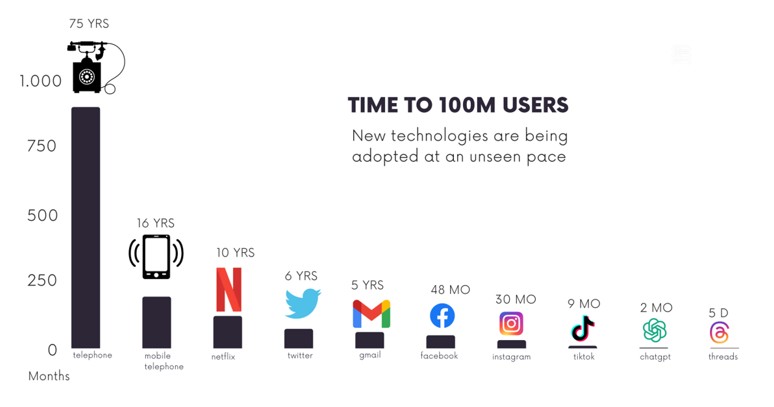
    In earlier decades, the time between curves gave institutions breathing room. The adoption of electricity, radio, and television spanned generations. Strategy could evolve slowly. Not anymore.  Consider how quickly new technologies reach a baseline of 100 million users:

    • Telephone: 75 years

    • Television: 50 years

    • Internet: 7 years

    • Instagram: 2 years

    • ChatGPT: 2 months

    In the twentieth century, society was shaped by only one or two dominant S-curves at a time. The industrial economy unfolded through electricity, automobiles, and radio, each building upon the last.

    Today, we face multiple transformative drivers converging at once:

    • Artificial Intelligence & Automation — redefining work, learning, and the skills required to thrive

    • Demographic Decline — shrinking youth cohorts and an aging workforce reshaping labor markets

    • Digital Infrastructure — expanding cloud computing, broadband access, and cybersecurity needs

    • Energy Transition — building entirely new workforce pipelines to power a sustainable economy

    Public Trust & Value Perception — questioning the cost, relevance, and return on higher education

    When curves collide, volatility spikes, but so does opportunity. Early adopters gain disproportionate advantage. As Wayne Gretzky advised, “Skate to where the puck will be.” For college leaders, that means positioning programs, partnerships, and budgets not for today’s demand curve, but for the next one forming just ahead.

    Forecasting isn’t fortune-telling; it’s pattern recognition. By studying trends, leaders can glimpse where momentum is built and allocate resources accordingly. The advantage of forecasting the future is simple: organizations that see trends early can prepare to take advantage of them.

    Futuring invites leaders to think beyond immediate pressures. It asks, what developments at the edge might soon reshape our core? Sometimes those signals appear in unrelated industries, a new technology in logistics that later transforms manufacturing, or an AI innovation in healthcare that soon affects education. Trends and themes help shape the broader context of a region or sector by revealing how developments in seemingly unconnected fields will affect us all.

    When I work with boards today, I remind them that the goal of futuring isn’t to predict which technology will win. It’s to cultivate awareness, to create the capacity to notice when the next curve begins to bend upward. Because once exponential growth starts, catching up is nearly impossible.

    Why Community Colleges Are the First Responders

    Community colleges have long been the nation’s shock absorbers in times of change. When industries collapse, we retrain the workforce. When technology advances, we translate complexity into curriculum. When economic shocks hit, our doors open wider. Community Colleges tend to be counter cyclical in times of unemployment.

    That agility positions us uniquely to navigate colliding S-curves, but only if we pair responsiveness with foresight. Rapid adaptation without direction can lead to mission drift; foresight turns reaction into strategy. Forecasting helps colleges anticipate trends. It enables boards and presidents to ask forward-leaning questions:

    • What are the emerging industries our region doesn’t yet recognize?

    • Which of our programs are approaching maturity and which are climbing?

    • How might AI or demographic change alter the very definition of student success?

    By asking these questions early, leaders create strategic margin the time and flexibility to act before necessity forces reaction. Our proximity to local communities gives us another advantage: we hear signals early. Employers mention new technologies before they hit headlines. Adult learners inquire about credentials that don’t yet exist. Civic leaders discuss workforce gaps that data won’t reveal for another year. Those whispers are the leading edge of the next curve. Still, awareness must be intentional. Futuring isn’t a luxury it’s a discipline.

    Summary and Application — Awareness Before Action

    The S-curve teaches that progress is cyclical: growth, maturity, renewal. What’s different today is both the speed and the convergence of change. Multiple curves are rising and intersecting at once, creating what I call the collision zone, a place of risk for those unprepared, but of reinvention for those who see it early.

    For community colleges, understanding these curves is more than theory, it’s a survival strategy. The institutions that thrive will be those that recognize the early signals of new demand, adapt their programs accordingly, and align mission with movement.

    These ideas capture the essence of futuring in higher education: to make sense of innovations before they overwhelm us and to position ourselves where the next opportunity will emerge. Awareness precedes readiness. Readiness produces resilience. And resilience will define the next generation of financially sustainable community colleges.

     —–

    At Aman & Associates, we help presidents, boards and executive teams develop foresight capacity to anticipate emerging S-curves, integrate futuring into strategy, and align decisions with mission and regional relevance. If your organization is ready to look beyond today’s horizon, I’d welcome the conversation.

    Rick Aman, PhD – Aman & Associates
    rickaman.com/articles

    © 2025 Aman & Associates. All rights reserved

  • When the Machines Learn, Humans Must Evolve

    When the Machines Learn, Humans Must Evolve

    The great aim of education is not knowledge, but action. — Herbert Spencer

    Last week’s article explored The AI S-Curve, how automation and intelligent systems are transforming the nature of work. The speed of technology adoption has never been greater, and the implications for human capability are profound.

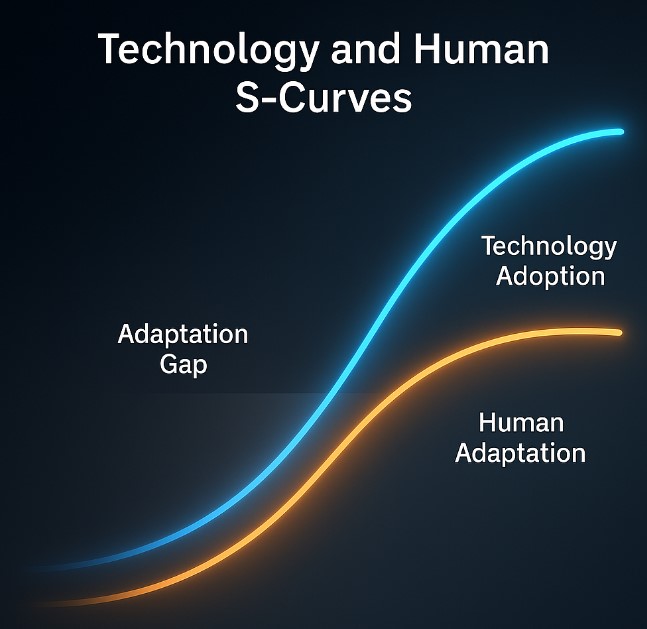
    Leaders now face two distinct curves: Technology Adoption and Human Adaptation. The technology curve rises sharply; the human curve lags behind. The space between them, the adaptation gap, is where organizations either stagnate or reinvent themselves.

    Technology accelerates change. Only humans can give that change meaning. Boards and CEOs must focus not on resisting automation but on preparing their people to thrive within it.

    The Workforce Transformation Imperative: Higher Education on the Next S-Curve

    Higher education stands at a pivotal point. The same forces transforming industry, automation, artificial intelligence, and digital disruption are now reshaping education itself. Colleges and universities can no longer operate at the top of an old S-curve while the next one accelerates beneath them.

    The 2025 Future of Work with AI Agents study from Stanford’s Digital Economy Lab and SALT Lab (Shao et al., 2025) confirms what many already sense: AI will automate an increasing share of tasks across nearly every field. Yet this is not a story of job loss, it’s a story of job redesign. Routine work is giving way to roles that demand judgment, empathy, creativity, and complex reasoning.

    This shift demands a parallel transformation in how higher education prepares learners. Institutions must evolve from credentialing past skills to curating future capabilities, integrating technical fluency, human insight, and adaptive learning models.

    The lesson of every S-curve is clear: growth follows experimentation, not preservation. The institutions that lead the next era will be those that recognize when their current model has plateaued and have the courage to leap to the next curve before being forced to.

    The role of higher education is no longer to merely respond to change, but to anticipate it, shaping learners and organizations to thrive amid continuous innovation.

    The New Currency: Skills; Not “Butts in Seats”

    For more than a century, higher education has measured learning in hours, credits, and degrees. While those measures still matter, degrees remain vital for advanced practice, leadership, and credibility; they are no longer sufficient.

    Industry now evaluates readiness through demonstrated competency: Can this person perform at the level the job requires? That question transcends transcripts.

    Today’s workforce values competency-based models that verify what learners can do, not just what they have completed. Micro-credentials, digital badges, and stackable certificates enable individuals to demonstrate market relevant skills. These credentials give employers evidence of capability and provide workers with portable proof of value.

    Higher education must build ecosystems where degrees and competencies coexist. Degrees anchor theory and depth; credentials capture agility and application. Together, they form the new currency of employability.

    Learning Velocity and Adaptability

    Adaptability has become a competitive advantage. The most resilient organizations are not those with the newest tools, but those that learn at about the pace of the environment changes.

    Learning velocity depends on more than professional development budgets, it requires a culture where curiosity, experimentation, and reflection are encouraged. The ability to unlearn and relearn may soon define career longevity as much as technical skill. If an organization’s learning rate falls below the rate of technological change, obsolescence begins. Investing in human capability is no longer a cost, it’s a strategic hedge against disruption.

    The Competency Model Mindset

    To build adaptive systems, leaders must shift from knowledge transmission to competency demonstration. A competency model defines the specific skills, behaviors, and mindsets required for success and creates clear pathways for development.

    Strong models do more than list skills, they Align workforce development with strategic goals, Clarify expectations and define excellence, Support stackable growth, linking learning to mastery and credentials, and Enable rapid reskilling as technology evolves.

    Boards and CEOs who champion competency frameworks send a powerful message: performance and potential are measured by contribution, not seat time.

    Human Infrastructure as a Strategic Asset

    Digital transformation captures headlines, but human transformation determines whether technology delivers value. Closing the adaptation gap requires deliberate investment in people systems.

    Key priorities include:

    1. Reskilling and Upskilling Pipelines – Continuous learning systems aligned to verified regional labor data.

    2. Micro-Credential Pathways – Embedded short-cycle credentials within degree programs so learners can stop, start, and advance fluidly.

    3. Faculty and Staff Readiness – Time and support to master emerging technologies and flexible delivery models.

    4. Culture of Lifelong Learning – Model adaptability from the top; create safe spaces for experimentation and iteration.

    Human infrastructure determines whether institutions can pivot when disruption hits. The organizations that thrive will plan their human curves as intentionally as their technology curves.

    Leadership and Board Implications: Building Human Capacity for the Next Curve

    As organizations invest in technology and innovation, the question is shifting from what to fund to how leadership sustains and integrates those investments. Leadership must serve as the bridge between acceleration and understanding.

    Boards and CEOs can no longer view workforce development as a routine expense, it is the frontline of relevance and strategic risk management for higher education. In a changing economy with emerging technologies, even the most advanced systems hold little value if graduates and employees lack the skills and adaptability to use them.

    Traditionally, universities viewed a degree as a journey of the mind; cultivating wisdom, character, and civic responsibility. Today, many students see it as a strategic investment, a path to employability, financial security, and relevance in a shifting economy.

    Higher education now stands between these expectations: preserving the ideals of intellectual formation while ensuring that graduates leave with the skills and flexibility the workforce demands.

    The measure of success is not just retention or completion but application, what learners and employees can do with what they know. When human capacity catches up to the technology curve, institutions are prepared for the next one.

    I often close board retreats with a Preferred Future Statement exercise, asking leaders to describe their organization three years ahead when people and technology are in sync. That shared vision becomes the anchor for decisions on budgets, programs, and partnerships. It helps boards see success not only as technological progress but as human advancement, the truest sign of readiness for the next curve.

    Closing the Adaptation Gap

    Consider again the two S-curves: one representing the rapid rise of technology, the other the slower but essential rise of human adaptation. The space between them, the adaptation gap, holds both anxiety and opportunity. The work of leadership is to close that gap through deliberate investment in competencies, learning systems, and culture. The faster the human curve rises, the greater the organization’s resilience and value.

    Technology may disrupt jobs, but leadership can redefine work. Every board and executive team should ask three questions:

    1. What skills are fading? Which competencies no longer create advantage?

    2. What must be learned next? Which emerging skills will sustain relevance and revenue?

    3. How will we prove it? What evidence will demonstrate real capability and readiness?

    These questions form the blueprint for the Human S-Curve.

    Summary

    Week 5 of the Colliding S-Curves series explores The Human S-Curve, the arc of skills, adaptability, and competency that must rise to meet accelerating AI and automation. Boards, professional organizations and CEOs can close the adaptation gap by investing in reskilling systems, micro-credentials, and cultures of lifelong learning that turn disruption into advantage.

    Source: Shao, Y., Zope, H., Jiang, Y., Pei, J., Nguyen, D., Brynjolfsson, E., & Yang, D. (2025). Future of Work with AI Agents: Auditing Automation and Augmentation Potential across the U.S. Workforce. Stanford Digital Economy Lab & SALT Lab. https://arxiv.org/pdf/2506.06576.pdf

    —–

    Aman & Associates Insight

    At Aman & Associates, we help boards, executive teams, and professional organizations align their human and technology curves through AI-assisted futuring, mission-focused strategy grounded in Ikigai principles, and strategic leadership development. Our work centers on building adaptive institutions prepared for the AI and technological s-curve disruption already underway.

    Every organization faces colliding curves. The goal isn’t to slow the technology line; it’s to accelerate the human one.

    © 2025 Aman & Associates rick@rickaman.com | www.rickaman.com/articles

  • The AI S-Curve: Redefining Work and Learning

    The AI S-Curve: Redefining Work and Learning

    Every great transformation from electricity to the internet created new industries and displaced old ones. Artificial Intelligence is different because it touches them all.

    If each era of progress has had its own defining curve of growth and adoption, AI is the general-purpose curve. It accelerates every other S-curve, economic, technological, and societal simultaneously. Rather than viewing it as another innovation to manage, leaders should see it as the accelerant that steepens the slope of change across everything we do.

    For boards and CEOs, this creates both opportunity and responsibility. The question is no longer whether AI will transform your institution; it’s how you will guide that transformation with wisdom, ethics, and purpose.

    Understanding the AI S-Curve

    Artificial Intelligence is not a single technology; it is a capability layer that amplifies every function it touches. Like electricity in the industrial age, AI powers other systems rather than standing alone. It enhances automation, accelerates creativity, and extends human decision-making.

    We are already seeing compounding effects: productivity gains from automation, design tools that co-create content, and research models that process information faster than any human team could. The pace of adoption is unprecedented. The telephone took 75 years to reach 100 million users, the internet seven, and ChatGPT just two months.

    We are living in the steep middle of the S-curve, where adoption is outpacing our comprehension. Leaders who focus on how AI accelerates, rather than what AI replaces, will shape the next stage of institutional relevance.

    Implications for Work and Learning

    A recent Future of Work Stanford study underscores this acceleration: more than 80 percent of U.S. occupations have at least moderate exposure to AI augmentation. In short, the vast majority of work will be reshaped, not removed. Every technology curve produces a human curve. AI is no exception, but its speed and scale make the response urgent.

    Jobs are being redefined around collaboration with intelligent systems. AI takes over repetitive tasks and frees people to focus on creativity, empathy, and judgment. Accountants supervise analytics tools; healthcare providers use generative models to summarize complex data; engineers design with AI partners. The real skill gap ahead is not between degrees of acceptance, it is between those who know how to use AI and those who do not.

    Higher education must evolve in parallel. The emphasis is shifting from content mastery to cognitive adaptability, learning how to think with AI. Students need to frame better questions, validate outputs, understand the ethics of AI use, and apply discernment to machine-generated insight. Faculty must model adaptability, evolving from delivering knowledge to orchestrating intelligence. Boards and CEOs should reexamine what a degree signifies in the age of AI. Likewise, business and industry must define what level of AI competence they expect from today’s graduates.

    Just as the printing press democratized access to information, AI democratizes access to expertise, but at far greater speed. Learning institutions must become agile laboratories, embedding AI as a tool for higher-order thinking rather than a threat to it.

    For community colleges and universities, this is a once-in-a-generation opportunity to redefine relevance. Regional economies need AI-readiness hubs, trusted organizations that help individuals and industries thrive alongside intelligent systems. A perfect niche for local higher ed institutions. That means developing AI-literacy programs across disciplines, creating micro-credentials in applied AI, and investing in faculty readiness that pairs ethics with experimentation. Institutions that move early will meet workforce demand and strengthen their social contract as engines of opportunity in an AI-driven economy.

    Evidence from the Future of Work Stanford Study

    The Future of Work with AI Agents (June 2025) report from the Stanford Digital Economy Lab and SALT Lab offers one of the clearest pictures yet of how AI is reshaping the U.S. workforce. Researchers examined more than 900 occupations, mapping which are most susceptible to automation, and which are ripe for augmentation.

    Their findings reveal a nuanced landscape: about 84 percent of jobs contain tasks that can be augmented by AI, while only a small fraction face full automation. The highest-impact sectors include management, healthcare, education, finance, and administrative services.

    To illustrate this diversity of impact, Stanford organized the workforce into four quadrants based on AI capability (automation potential) and worker desire (willingness to adopt AI tools):

    1. High Automation / High Augmentation – Green Light Zone: Roles such as financial analysts, software developers, and data scientists, where AI boosts productivity while relying on human oversight. Ideal for responsible deployment.

    2. High Automation / Low Augmentation – Red Light Zone: Routine, rule-based jobs; data entry, payroll, and administrative processing, face displacement risk from high AI capability but low worker desire.

    3. Low Automation / High Augmentation – R&D Opportunity Zone: Professions emphasizing human judgment and empathy; educators, healthcare providers, and managers, show strong worker interest but limited AI tools, calling for targeted innovation.

    4. Low Automation / Low Augmentation – Low Priority Zone: Roles requiring manual dexterity or local context such as construction, hospitality, and food service where AI’s near-term impact is modest.

    Current investment, especially among startups, is over-concentrated in the Red Light and Low Priority zones, chasing efficiency rather than human-centered value. The real opportunity lies in the Green Light and R&D zones, where AI can augment human capability and strengthen social benefits.

    The insight is pivotal: AI is not a job destroyer; it is a work re-designer. It shifts value from repetition to interpretation. As AI handles routine analysis and retrieval, humans are freed to focus on creativity, empathy, and leadership.

    For higher education, the implications are profound. Curriculum must integrate AI as a literacy, not a specialty. Career pathways should align with augmentation-oriented roles; AI-enabled nursing, precision manufacturing, and data-informed teaching. Colleges must also partner with employers to reskill professionals who will collaborate with AI rather than compete against it.

    Viewed through a governance lens, these are strategic imperatives. Boards must ensure their institutions are equipped to lead by asking hard questions about policy, data ethics, digital infrastructure, faculty readiness, and responsible adoption.

    (Source: Shao, Y., Zope, H., Jiang, Y., Pei, J., Nguyen, D., Brynjolfsson, E., & Yang, D. (2025). Future of Work with AI Agents: Auditing Automation and Augmentation Potential across the U.S. Workforce. Stanford Digital Economy Lab & SALT Lab. https://arxiv.org/pdf/2506.06576.pdf)

    The Executive and Governance Lens: Policy, Ethics, and Capacity

    Last week I attended the WCET Conference in Denver. WCET (WICHE Cooperative for Educational Technologies) is a national organization advancing the effective use of technology in higher education by connecting institutions, leaders, and innovators to improve teaching, learning, and student success.

    I presented on organizational futuring, and like many sessions, conversations centered on AI, policy, and agility. Executive teams, departments, and workforce boards now stand at the intersection of innovation and integrity, guiding adoption responsibly while balancing agility with accountability.

    Policy must align AI use with institutional mission and values, addressing privacy, intellectual property, and transparency. The goal isn’t to slow innovation but to create ethical guardrails that allow it to flourish.

    Ethics call boards to confront algorithmic bias, data misuse, and the tension between efficiency and equity. Trustees must see AI ethics not as compliance, but as leadership. The most trusted institutions will be those that pair technological progress with moral clarity.

    Capacity requires investment in infrastructure, training, and governance. Faculty development, AI steering committees, and digital readiness are no longer optional, they’re strategic necessities.

    Ultimately, how an institution approaches AI reveals what it truly values. Adoption isn’t just a technology decision, it’s a decision about identity.

    Summary

    AI isn’t just another wave of innovation, it’s the tide lifting every other S-curve of change. The Future of Work Stanford study shows that more than 80 percent of U.S. jobs will be augmented, not automated, redefining how we work, learn, and lead.

    For colleges, universities, and governing boards, the challenge is to guide this transformation responsibly aligning ethics, policy, and capacity to ensure relevance in an AI-driven economy. Institutions that act now will become trusted hubs of AI literacy and workforce readiness.

     —–

    At Aman & Associates, we guide boards and executive teams through AI-assisted futuring and strategic visioning retreats. Each session helps leaders identify emerging forces, craft a Preferred Future Statement, and align initiatives with mission, ethics, and capacity. Our facilitation blends foresight tools, AI insights, and practical strategy to prepare organizations for relevance in an AI-driven world.

    Rick Aman, PhD Aman & Associates   Futuring | Strategy | Board Development rick@rickaman.com | rickaman.com/articles
    © 2025 Aman & Associates. All rights reserved

  • Three Forces Shaping the Future: Technology, Society, and Institution

    Three Forces Shaping the Future: Technology, Society, and Institution

    There is every indication that the period ahead will be an innovative one, one of rapid change in technology, society, economy, and institutions. — Peter Drucker

    In the first two articles of this series, I explored what is changing due to colliding S-Curves of innovation, the visible shifts shaping the future of community colleges and the organizations they serve. This week, I want to focus on how those changes interact across systems. Understanding the patterns beneath disruption is the next step in moving from awareness to strategic action. Disruption is rarely a single event; it’s a collision of forces moving at different speeds. Technology may trigger change, but institutions and societies determine whether it becomes progress.

    To make sense of this complexity, I use a framework called – The Three Forces Shaping the Future—Technology, Society, and Institution. Each move at its own pace, but together they form the ecosystem in which every organization must lead. Seeing these forces together helps boards and executive teams avoid reacting to isolated issues and instead understand the larger system at work. These forces also represent the landscape where the major S-curves of innovation, the accelerating waves of change, collide with the mission of higher education.

    Technology

    The first force, Technology, represents the tools and engines of disruption: artificial intelligence, automation, increasing demand for energy, digital health, and cybersecurity. These technologies follow familiar S-curves of innovation: they start slowly, accelerate exponentially, and then mature. The challenge for presidents and boards is recognizing when a curve is entering that rapid growth phase and ensuring institutional strategy keeps pace. Multiple S-curves are rising at once, AI redefining knowledge work, automation transforming industries, and clean energy reshaping infrastructure.

    These advances move fast, often faster than staff and systems can adapt. For governance boards, this force demands both curiosity and accountability. It requires asking: Are our technology investments forward-looking or reactive? Do we have the infrastructure and workforce readiness to adapt? Where are we responsibly experimenting, and where are we lagging? Technology is no longer a support function; it’s the catalyst behind nearly every operational and educational shift we face.

    Institutions that thrive will be those that invest not only in hardware or systems but also in digital fluency across leadership. The ability to interpret data, integrate AI ethically, and leverage automation wisely has become a board-level competency. Yet while this force accelerates innovation, it can also widen the gap between those prepared to adapt and those who maintain the past. Technology represents the front line of change, but beneath its speed are slower forces that determine whether it leads to opportunity or mediocrity.

    Society

    The second force, Society, represents the human context in which change unfolds. It includes demographic shifts, access, economic realignment, public trust, and evolving learner expectations. Unlike technology, societal change moves gradually, often over decades of cultural transformation and generational turnover. Yet it is this force that defines why innovation matters.

    For boards and CEOs, understanding the societal force means looking beyond dashboards to the people behind the numbers. Demographics is destiny and workforce trends tell us about who we will serve next. How are economic changes reshaping pathways to employment? Are our programs designed for the current students coming to us, or for those we once served?

    Societal change often rises slowly but carries enduring influence. The aging of America’s population, declining birth rates, and the shift from degrees to credentials are reshaping higher education’s purpose. A generation motivated by flexibility and seeking return on educational investment is redefining value. Boards must view these shifts not as threats but as indicators of where to align mission with emerging demand.

    Institution

    The third force, Institution, is the slowest to evolve but perhaps the most pivotal. It represents how colleges and organizations adapt internally through governance, funding, policy, and culture. Institutional forces reflect cycles of maturity and renewal, how we grow, plateau, and reinvent. Progress depends not only on what we do but on how we decide.

    I have asked boards to reflect on three questions: How fast can we move from insight to action? Do our structures encourage adaptability or reinforce stability? Are we built for iteration or preservation? When public institutions lag, innovation stalls. Even strong strategies can fail when filtered through outdated decision-making processes.

    The institutions that adapt best are those that continually examine their systems, rethinking committee structures, streamlining decision cycles, and aligning funding with strategic priorities rather than legacy programs. Institutional agility isn’t about chasing trends; it’s about creating the conditions for innovation to succeed.

    When leadership and boards view all three forces together, patterns emerge. Technology drives possibility. Society defines purpose. Institutions determine pace. The future won’t be shaped by any single force but by our ability to understand how they interact. Disruption is rarely a surprise to those who look across systems. The signals are usually visible, emerging in workforce data, cultural attitudes, and organizational behavior, but too often they’re analyzed in isolation. The challenge for leadership is to connect the dots and see across systems.

    Summary

    For trustees and CEOs, the call to action is clear: before acting, chart your system. Identify where your institution resides within each of the three forces. Determine where you lead and what lags. That simple act of mapping provides clarity for prioritizing resources, aligning strategy, and governing with foresight. Boards that understand these dynamics can move from reacting to anticipating, from maintenance to momentum.

    Understanding these interactions allows boards to see not just what is changing, but how change behaves. That’s the essence of futuring, not prediction, but preparation. The future belongs to institutions that learn faster than their environment changes. By considering these three forces shaping our future and understanding how the major S-curves of innovation intersect with our mission we can lead with confidence, seeing the system rather than the silos. The future won’t be shaped by any single force but by our ability to understand how they interact.

     —–

    At Aman & Associates, we help boards and CEOs look beyond the plan and see the future. Through facilitated board retreats, strategic futuring, and executive mentoring, we create clarity, unity, and momentum. Our approach blends foresight, governance expertise, and practical leadership experience to help organizations move from maintenance to transformation.

    Let’s shape your preferred future—together.

    Rick Aman, PhD Aman and Associates | rick@rickaman.com | rickaman.com/articles