
Category: Governing Boards

  • Contrasting Governance Structures Within Non-Profit, Government and Corporate Boards

    Contrasting Governance Structures Within Non-Profit, Government and Corporate Boards

    An organization’s ability to learn, and translate that learning into action rapidly, is the ultimate competitive advantage.  – Jack Welch

    Throughout my career in higher education, I worked alongside a variety of governing board types. Each with different missions, governance structures, and challenges. Whether in the nonprofit sector, government agencies, or corporate boardrooms, strong governance is essential for long-term success. Yet, each type of board operates with distinct responsibilities, balancing oversight with strategic leadership.

    Effective board governance requires a deep understanding of an organization’s purpose, the role of its leadership, and the challenges it faces. While nonprofit, government, and corporate boards differ in their goals, they share a fundamental duty: to guide, protect, and strengthen the organizations they serve.

    Nonprofit Boards: Mission-Driven Leadership

    Nonprofits exist to serve a cause, not to generate profit. Their boards are not accountable to shareholders; they are responsible to donors, grantors, and, most importantly, the communities they serve. That is a heavy responsibility, and it requires a special kind of leadership.

    Unlike corporate boards, where financial returns drive decision-making, nonprofit boards must ensure that every dollar is used effectively to advance the mission. They are responsible for strategic direction, financial stewardship, and supporting the organization’s leadership. In many cases, board members also engage directly in fundraising, advocacy, and community engagement to help secure resources and expand impact.

    Governing a nonprofit is complex. Financial sustainability is always a concern. Balancing short-term needs with long-term viability is a constant struggle, and in a world where one ethical misstep can erode public trust, transparency is everything. A single financial oversight or governance lapse can damage credibility and hinder fundraising efforts.

    Unlike in the corporate world, where revenue is generated through products or services, nonprofits often depend on the generosity of individuals, foundations, and grants. This means boards must be proactive in strengthening financial resilience by diversifying funding sources, building endowments, and ensuring responsible fiscal management. Furthermore, a strong nonprofit board fosters a culture of collaboration, where board members see themselves not just as overseers, but as active ambassadors for the organization’s mission.

    Government and Public Sector Boards: Navigating Policy and Accountability

    Public sector boards operate in a completely different landscape. These boards, whether overseeing higher education institutions, regulatory agencies, or municipal entities, exist to serve the public interest. Their authority often comes from legislative mandates, and their decisions can have wide-ranging impacts on communities, industries, and economies.

    Unlike nonprofit and corporate boards, government boards do not answer to a CEO or a set of stakeholders. They are accountable to the public. That means intense scrutiny, complex regulatory environments, and the challenge of political influence.

    One of the greatest challenges for board members is maintaining independence while operating within a political system. In many cases, board members are appointed by elected officials, such as a governor, which can create pressure to align with political agendas rather than focusing solely on the institution’s long-term needs. However, some boards, such as those governing community colleges and K-12 school districts, are elected by the public, providing a different form of accountability. Additionally, certain boards, such as faculty senates or private institutional boards, may have members who are elected by existing board members or internal stakeholders rather than the general public.

    Regulatory complexity adds another challenge. Laws and policies are constantly shifting, and boards must ensure that the institutions they govern remain compliant while still fulfilling their mission. At the same time, transparency is non-negotiable. Public trust depends on clear, honest communication and responsible financial management.

    Effective governance in the public sector also requires an understanding of bureaucratic processes, where decisions can be slowed by layers of policy and oversight. Strong government boards embrace data-driven decision-making and community engagement to ensure that policy initiatives reflect the actual needs of the people they serve. Additionally, the most effective public sector boards work to depoliticize their decision-making processes, focusing on long-term stability rather than short-term political gains.

    Corporate Boards: Balancing Profitability and Responsibility

    Corporate governance is about strategy, risk, and financial performance. While nonprofits and government boards focus on mission and public service, corporate boards exist to drive shareholder value. The best corporate boards understand that profitability and responsibility are not mutually exclusive. They go hand in hand.

    A corporate board’s primary role is to oversee executive leadership, particularly the CEO. They set strategic direction, ensure financial stability, and position the company for sustainable growth. Their decisions affect not just quarterly earnings but long-term viability.

    Ethical leadership is a major challenge. Scandals, governance failures, or unchecked executive power can destroy trust and erode financial performance. The best boards do not just react to problems, they anticipate them, addressing risks before they become crises.

    Corporate boards also deal with mergers and acquisitions, investor relations, and competitive positioning. Their job is not just oversight but active strategic guidance to keep the company ahead of the curve. Strong corporate governance requires a careful balance of financial discipline, ethical leadership, and long-term strategic thinking.

    One of the hallmarks of an exceptional corporate board is its ability to foster innovation while maintaining stability. This means supporting leadership in taking calculated risks, embracing new technologies, and ensuring the company remains agile in an evolving market. Additionally, corporate boards must recognize their broader role in society, balancing profit motives with social responsibility, environmental concerns, and ethical business practices to build lasting success.

    Stewardship vs. Strategy: Defining the Core Role of Each Board Type

    Over the years, I’ve worked with nonprofit and government boards. One of the biggest lessons I’ve learned is that while governance is universal, its focus varies significantly. At its heart, every board as a whole is responsible for stewardship, the duty to safeguard the mission, resources, and values of the organization. But what that stewardship looks like depends on the sector. Nonprofit boards act as stewards of mission, ensuring that every decision supports the organization’s purpose and community impact. Government boards are stewards of public trust, responsible for making sure institutions remain transparent, accountable, and policy-driven. Corporate boards serve as stewards of shareholder value, balancing financial performance with strategic growth.

    While stewardship is foundational, what sets boards apart is their approach to strategy. In the nonprofit world, strategy revolves around fulfilling the mission, sustaining financial health, and expanding impact. Government boards must think long-term while navigating political realities, regulatory shifts, and public expectations. Corporate boards, on the other hand, operate in a competitive environment, where strategy is about market position, profitability, and risk management. In my experience, the real contrast is how each board defines success. Nonprofits measure success by impact, government boards by accountability, and corporate boards by financial performance. Understanding these differences is key for any board member whether you’re leading, advising, or just stepping into governance for the first time.

    Why Representation and Perspective Matter on Boards

    One of the most significant factors influencing board effectiveness is the range of perspectives at the table. When a board is made up of individuals with different backgrounds, experiences, and professional expertise, better decisions follow.

    In the nonprofit world, ensuring that board members reflect the communities served leads to more inclusive programs and policies, increasing impact.

    In the public sector, incorporating multiple viewpoints into policy decisions reduces blind spots and strengthens public trust. A board that understands the diverse needs of the community it serves is more likely to make equitable and informed decisions.

    In corporate governance, having a wide range of expertise is not just about ethics. It is about results. Studies show that companies with leadership teams who bring different viewpoints to the table outperform those with more uniform perspectives. Varied experiences drive innovation, improve risk management, and make organizations more adaptable to change.

    Broad representation on boards is not just about fairness; it is about equipping leadership teams with the knowledge, strategic insight, and cultural awareness needed to lead effectively in an increasingly complex world.

    Comparing and Contrasting Board Governance
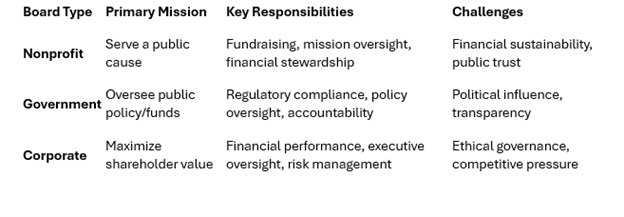
    Despite their differences, all boards share a common responsibility: to lead with integrity, think strategically, and ensure the long-term success of the organizations they govern.

    Summary

    Board governance, whether in the nonprofit, government, or corporate sector, is about leadership, accountability, and strategy. Nonprofit boards must balance mission fulfillment with financial sustainability, government boards navigate public policy and accountability, and corporate boards oversee profitability while maintaining ethical responsibility.

    Strong boards are defined by their ability to think long-term, anticipate challenges, and create a culture of transparency. The most effective boards embrace varied perspectives, ethical leadership, and forward-thinking strategy.

    If you are serving on a board or considering joining one, engage fully. Your leadership matters, and your decisions will shape the future of the organizations and communities you serve.

    A diverse mix of voices leads to better discussions, decisions, and outcomes for everyone. – Sundar Pichai

    —

    If your organization is ready to explore its preferred future using advanced futuring tools or seeks to enhance collaboration between its board of directors and CEO, Aman and Associates is here to support you. We specialize in facilitation for strategic futuring, AI-driven trend analysis, scenario planning, and executive coaching. Let us partner with you to align your vision with actionable strategies, ensuring your organization thrives in a rapidly changing world. Together, we can chart a course for sustainable success.

    Rick Aman, PhD

    208.850.6707

    rick@rickaman.com

    www.rickaman.com/articles

    16437

  • The Art of Board Governance: Building a Foundation for Organizational Success

    The Art of Board Governance: Building a Foundation for Organizational Success

    If you want to go fast, go alone. If you want to go far, go together. – African Proverb

    Introduction

    Strong governance is the cornerstone of institutional success. Having served as a community college president, I have witnessed firsthand how an effective board can either propel an institution forward or hinder its progress. I have benefited from insightful guidance from diverse trustees and have worked with a board that provided stability during difficult, sometimes unpopular decisions. Governing boards are not just oversight bodies; they shape strategy, ensure accountability, guide the CEO, and align with the institution’s mission. Their decisions carry lasting consequences for students, faculty, and the community at large. This article explores the essential functions of governing boards—whether elected or appointed, public or for-profit. While the structure and selection of board members may vary, their core responsibilities remain remarkably consistent.

    The Role of the Governing Board

    The governing board is responsible for safeguarding an organization’s mission, vision, and financial health. Various types of boards exist, each serving distinct functions across nonprofit organizations, corporations, educational institutions, and government agencies. Boards may represent regional constituents, corporate shareholders, legislative oversight bodies, or nonprofit stakeholders, and each group carries its own set of priorities and governance structures.

    A high-functioning board does more than approve budgets and policies; it ensures that the organization stays aligned with its strategic objectives. In corporate settings, boards provide strategic direction, uphold fiduciary responsibilities, and protect shareholder interests. Nonprofit boards focus on fundraising, program oversight, and advancing the organization’s mission. Educational boards, such as those governing community colleges or universities, play a critical role in ensuring student success, institutional development, and accreditation compliance.

    Effective governance requires a deliberate balance of strategic planning, oversight, and executive support. Regardless of the type of board, members must avoid micromanaging daily operations and instead focus on high-level governance. This means trusting executive leadership to handle operations while ensuring accountability through clear policies, long-term planning, and performance evaluations. Strong boards operate with integrity, foresight, and a commitment to the organization they serve, ensuring sustained success and adaptability.

    A board’s fiduciary duty extends beyond financial oversight to encompass ethical leadership and a commitment to long-term sustainability. Board members must act in the best interests of the organization, making informed decisions that foster institutional effectiveness and future-readiness. The most effective boards are proactive rather than reactive, anticipating challenges and positioning their institutions for long-term growth. Without this forward-thinking approach, organizations risk stagnation, missing key opportunities, and struggling to adapt to an evolving landscape.

    Core Functions of Board Governance

    Strategic Planning and Vision

    One of the primary responsibilities of a governing board is to define the organization’s strategic direction. This requires ongoing dialogue about the institution’s future and a willingness to adapt to remain relevant.

    For example, during my tenure as a community college president, our board played a pivotal role in deciding to construct a much needed energy, innovation and technology building on campus. Their involvement went beyond simply approving the project; they engaged with students, local employers, elected officials, and community stakeholders to ensure the facility addressed real workforce and academic needs. They also played a key role in securing funding sources, advocating for the project at state and local levels, and articulating the long-term value of the facility to the broader community. Ultimately, their ability to see the bigger picture and align the initiative with future workforce demands ensured the college remained adaptable in the face of economic and demographic shifts.

    Effective boards do more than approve strategic plans; they contribute meaningfully to their development, ensuring leadership decisions align with long-term goals. This engagement involves setting measurable milestones, assessing progress regularly, and adjusting strategies as needed. Over time, our institution refined its approach by integrating futuring techniques which are forward-thinking methodologies into their planning process, moving beyond traditional strategic planning models to anticipate and proactively shape the future of education in our region.

    Accountability and Oversight

    Boards are responsible for ensuring financial sustainability, risk management, and regulatory compliance. To do this effectively, they must ask the right questions: Are we allocating resources effectively? Are we anticipating and managing risks? Are we compliant with federal and state regulations? Are we fiscally sustainable?

    Additionally, boards must evaluate executive leadership performance. A high-performing board doesn’t just hire a CEO and step away—it actively provides guidance, sets clear expectations, and ensures accountability. Regular performance reviews help ensure leadership remains aligned with institutional goals and community expectations. Beyond financial oversight, boards should take a long-term view, balancing short-term financial decisions with a commitment to future viability.

    Mission Fulfillment and Stakeholder Trust

    A governing board’s primary charge is to ensure that every decision, policy, and initiative advances the institution’s mission. Without a clear and unwavering commitment to mission fulfillment, organizations risk drifting into short-term decisions that may ultimately erode their foundational purpose.

    Every successful organization I have encountered can confidently answer the essential question: Why do we exist? This clarity of purpose guides effective governance, ensuring that leadership remains mission-driven rather than simply reactive to external pressures or fleeting opportunities.

    To uphold stakeholder trust, boards must embed mission fulfillment into their strategic decision-making process. This means continuously evaluating whether institutional strategies, financial priorities, and policy frameworks truly contribute to the organization’s long-term impact. Governance should measure success not just through financial health or enrollment numbers but through real-world impact how well the institution serves its students, community, and stakeholders.

    During my presidency, our board prioritized community, student, and employer engagement through open trustee meetings, civic engagement, and advisory committees. These forums provided invaluable insights that informed our decision-making and ensured our strategic priorities remained responsive to the evolving needs of our communities. By actively listening and adapting, the board strengthened trust and built lasting institutional resilience.

    Best Practices for High-Impact Governance

    Board Composition & Diversity

    A high-functioning board reflects a mix of expertise, backgrounds, and perspectives. Having board members with diverse professional experiences such as finance, education, business, and public service enhances decision-making. Additionally, diversity in gender, race, and age ensures a broader range of viewpoints, leading to more informed governance.

    Regular evaluation of board effectiveness and succession planning is essential. Institutions may actively recruit individuals who bring the skills and perspectives needed for the challenges ahead. Board continuity is complex when board members are elected, but in appointed boards, the concept of leadership continuity is valuable. An effective succession plan ensures continuity of leadership and prevents disruptions in governance. Additionally, periodic board self-assessments allow institutions to identify gaps in expertise and areas for improvement.

    Clear Governance Policies & Structure

    Well-defined roles, responsibilities, and term limits enhance accountability and prevent governance drift. Without clear policies, boards risk becoming ineffective or exceeding their authority. Organizing the board into specialized committees such as finance, audit, strategy, or technology enables focused discussions and strengthens oversight. Additionally, maintaining strong relationships with legal counsel and human resources professionals is essential for ensuring compliance, supporting ethical governance, and mitigating the risk of unintended legal or personnel consequences.

    One mistake I have seen boards make is engaging in operational management rather than governance. A strong board empowers the CEO to lead while maintaining clear oversight. This distinction must be reinforced through structured governance practices and ongoing board training. Well-defined governance policies that are regularly reviewed create consistency in decision-making and prevent conflicts of interest. Furthermore, ensuring adherence to ethical standards builds public trust and reinforces institutional credibility.

    Stakeholder Communication & Transparency

    Effective governance requires open communication and transparency with key stakeholders, in the case of educational institutions these can include faculty, staff, students, employers and the broader community. A well-informed board fosters trust and credibility by ensuring that institutional decisions align with stakeholder needs and expectations.

    Regular updates, public board meetings, and clear reporting on institutional priorities, finances, and strategic goals enhance accountability. Additionally, soliciting stakeholder input through advisory councils, town halls, or surveys can strengthen decision-making and reinforce the institution’s commitment to openness.

    Boards that actively engage with stakeholders not only maintain public confidence but also ensure that their governance aligns with the institution’s mission and long-term sustainability.

    Continuous Learning & Engagement

    Board service is not static. The best boards commit to ongoing education on governance best practices, industry trends, and institutional challenges. Regular retreats, professional development opportunities, and strategic discussions keep boards proactive rather than reactive.

    From my experience, the most effective boards held annual retreats to assess their performance and refine their strategies. These sessions allowed board members to realign their efforts and recommit to the institution’s mission. Board development is crucial for members to stay informed about evolving governance practices and emerging challenges. Boards that prioritize continuous learning are better prepared to navigate change and lead with confidence.

    Conclusion: Building a Resilient and Forward-Thinking Board

    Good governance is the art of putting wise thought into prudent action in a way that advances the well-being of those we serve. — Diane Kalen-Sukra

    Institutions thrive when their governing boards are engaged, well-informed, and mission-oriented. High-impact boards foster institutional success through strategic leadership, collaboration, and a commitment to continuous improvement. Effective governance is not a static responsibility, but an ongoing dedication to ethical oversight, adaptability, and long-term vision.

    A well-functioning board acts as a driving force for resilience and innovation. By embracing these best practices, boards do more than make decisions, they shape the future. When leaders govern with clarity, accountability, and stakeholder engagement, they ensure their organizations remain sustainable, relevant, and equipped to navigate toward a preferred future.

    ————

    If your organization is ready to explore its preferred future using advanced futuring tools or seeks to enhance collaboration between its board of directors and CEO, Aman and Associates is here to support you. We specialize in facilitation for strategic futuring, AI-driven trend analysis, scenario planning, and executive coaching. Let us partner with you to align your vision with actionable strategies, ensuring your organization thrives in a rapidly changing world. Together, we can chart a course for sustainable success.

    Rick Aman, PhD
    208.850.6707
    rick@rickaman.com
    www.rickaman.com/articles

    15850

  • Navigating Role Clarity: Governing Boards vs. Executive Leadership

    Navigating Role Clarity: Governing Boards vs. Executive Leadership

    “Good boards create clarity by setting the destination; great CEOs make the journey possible.” – Unknown

    When organizations progress toward their desired future, it is often due to the harmonious interplay between a visionary governing board and a capable CEO. Governing boards serve as the strategic compass, steering the organization toward its long-term goals, ensuring financial stability, establishing and revising policy, supporting and evaluating the CEO and safeguarding the mission. They are entrusted with big-picture responsibilities in the realm of accountability to their stakeholders. By focusing on governance, each board ensures the organization remains future-focused and aligned with its purpose, even as the landscape evolves.

    In contrast, the CEO drives the organization’s daily tactical operations, ensuring that short-term actions align with long-term strategic objectives provided by the governing board. While the board sets the destination, the CEO determines the best path to get there. The CEO and executive team are responsible for turning strategic vision into actionable plans, leading teams, managing resources, and making operational decisions that keep the organization running efficiently. Unlike the board’s governance-oriented role, the CEO is deeply involved in execution, addressing immediate challenges while adapting strategies to meet organizational goals.

    The interplay between these two roles is crucial. A governing board without a strong CEO may struggle to see its vision come to life, while a CEO without a clear and engaged board risks operating without a coherent direction. Understanding and respecting these distinct yet complementary roles is the foundation for effective collaboration and organizational success. Together, the board and CEO provide the leadership and execution needed to sustain and grow their organization into an uncertain future.

    Roles Defined: Governance vs. Management

    Governing boards and CEOs serve as the organizational backbone, but their responsibilities differ significantly. The governing board operates at a high level, focusing on strategy, oversight, and accountability representing their constituent group. Boards are stewards of the organization’s long-term vision, ensuring financial health and mission alignment. They shape policies, oversee resource allocation, and provide a strategic framework that guides the organization into the future and supervise one employee.

    CEOs, on the other hand, are responsible for the day-to-day execution of the board’s vision. CEOs manage operations, supervise and lead the full staff, and act as the bridge between the board and the organization’s stakeholders. The CEO translates the board’s strategic goals into actionable plans, aligning teams and resources to achieve success. They provide regular updates and status reports to the governing board normally through the board chair.  

    At its core, the distinction lies in governance versus management. The board provides the vision, outlining the organization’s broader goals, while the CEO translates that vision into actionable steps, ensuring day-to-day efforts align with the long-term objectives, financial sustainability, and mission fulfillment. For example, the board might decide to expand services in underserved areas, and the CEO would execute this by recruiting talent, opening facilities, or securing partnerships. When these roles are clearly defined, the board and CEO can function as a cohesive team, each complementing the other’s strengths while maintaining focus on their distinct responsibilities.

    Common Role Clarity Challenges
    Despite their complementary roles, blurred boundaries between boards and CEOs can lead to inefficiencies and conflict. Below are three common challenges that arise from unclear role distinctions:

    1. Micromanagement by the Board
    Micromanagement occurs when boards delve too deeply into operational details, bypassing the CEO’s authority to engage directly with staff or make day-to-day decisions. This often stems from a lack of trust or a misunderstanding of the board’s responsibilities. Micromanagement can stifle innovation and undermine the CEO’s authority, creating confusion within the organization. For example, when board members attempt to direct specific program initiatives, talk with staff directly about program specifics, or critique operational decisions as individuals, it can disrupt the organization’s chain of command. These actions, even if well-intentioned, can leave the CEO feeling disempowered and staff uncertain about whom to follow. Clarifying operational boundaries and reinforcing trust in the CEO’s leadership is essential to prevent these issues.

    2. Board Disengagement
    On the other end of the spectrum, disengaged boards rubber-stamp decisions, fail to provide strategic input, or participate minimally in governance activities. There is a professional expectation that board members will be prepared for meetings and come ready to support both the board chair and CEO.
    Signs of disengagement include missing meetings, failing to review materials, or relying entirely on the CEO for organizational updates. This lack of involvement can lead to missed opportunities, weak accountability, and a diminished capacity to navigate challenges. Boards must prioritize active engagement, regular communication, and ongoing education about their roles to ensure they provide value and maintain oversight.

    3. CEO Overreach or Underperformance
    CEOs may also contribute to role confusion. Overreach occurs when CEOs bypass the board in general or the board chair on major decisions, such as signing contracts, changing policies, or setting strategic priorities without approval. This diminishes the board’s governance role and can lead to significant risks, including legal or financial repercussions.

    Conversely, underperformance arises when CEOs fail to execute the board’s vision effectively or neglect transparent communication. When the CEO does not deliver measurable results or keep the board informed, the entire organization suffers. Clear performance metrics, regular updates, and a collaborative relationship between the CEO and board chair can help address these issues and foster mutual accountability.

    The Key to Success: Role Clarity and Communication

    An approach to overcome these challenges lies in establishing role clarity and maintaining open communication between boards and CEOs. Below are strategies for fostering this clarity:

    1. Setting Expectations from the Start

    Clearly defined roles and responsibilities should be established during the onboarding of both board members and CEOs. Governance charters and board handbooks can outline these expectations, ensuring all parties understand their duties and boundaries. For instance, boards should focus on long-term vision, mission alignment, and financial oversight, while CEOs are responsible for operational management, staff leadership, and strategy execution. Setting these expectations early helps prevent misunderstandings and creates a solid foundation for collaboration.

    2. Clear Communication Channels

    Effective communication is the cornerstone of a strong board-CEO relationship. Establishing regular communication channels, such as scheduled reports, standing meetings, and informal check-ins, ensures that both parties stay aligned. Transparency is key. CEOs should provide the board with clear, concise updates on organizational performance, challenges, and progress toward strategic goals. Similarly, boards should communicate their expectations and provide constructive feedback to the CEO. In most board chair and CEO relationships the prime responsibility of the CEO is to ensure the chair is never surprised, especially when issues become public.

    3. The Importance of Boundaries

    Boundaries prevent role overlap and foster collaboration. Boards should refrain from intervening in day-to-day operations, while CEOs should avoid making strategic decisions without board input. Governance policies, like delegation frameworks, can delineate decision-making authority. For illustration, financial decisions over a certain threshold might require board approval, while smaller operational expenses remain under the CEO’s jurisdiction.

    Practical Strategies for Maintaining Balance

    Boards and CEO know that the hard work of collaboration lie at the center of overcoming these challenges. Success in mission fulfillment comes from establishing role clarity and maintaining open communication between boards and CEOs. Below are a couple strategies for fostering this clarity:

    1. Training and Education

    Ongoing training for board members on governance best practices and for CEOs on leadership development is essential for fostering mutual understanding and alignment. Workshops, webinars, and retreats offer valuable opportunities to clarify roles, align expectations, and strengthen relationships. Many institutions, non-profits, and government entities benefit from national organizations that support both governing boards and CEOs, offering resources such as hiring assistance during leadership transitions, professional development opportunities, and national conferences. These organizational conferences provide expert advice, guidance, and networking opportunities, equipping boards and CEOs to work together effectively while staying informed on emerging trends and best practices in governance and leadership.

    2. Performance Evaluations

    Structured evaluation processes for both the board and CEO ensure accountability and continuous improvement. Performance metrics should be clearly defined and tied to the organization’s strategic goals.

    For example, a CEO’s performance might be measured by enrollment growth, financial sustainability, or program outcomes, while a board’s effectiveness could be assessed by attendance, participation, and the quality of strategic input.

    3. Delegation Frameworks

    Delegation frameworks clarify decision-making authority, ensuring each party knows where their responsibilities begin and end. These frameworks can specify areas such as financial approvals, policy decisions, and operational autonomy.

    4. Clarity of Communications

    In many boards, both public and private, an agreement as to communication protocols is vital. At the highest level, an agreement of who publicly speaks for the organization to news media or for official reasons. It would be common that either the board chair or CEO have the primary responsibility to speak on behalf of the organization. This is where there is trust and alignment are critical between the board chair and CEO. Within most boards, individual members may have personal opinions, but only the board chair will speak on behalf of the board. Conversely, staff members will have personal opinions, but only the CEO will formally speak on behalf of the organization. Agreement between the CEO and board chair adding clarity as to when staff or board members should delegate tasks or communicate on operational topics.

    5. Collaborative Planning

    Annual board planning and organizational strategic planning are traditional and well understood. Joint planning Involving both the board and CEO in strategic planning ensures alignment and buy-in from both parties. Tools like dashboards and key performance indicators (KPIs) allow boards to track progress without overstepping into operations.

    6. Fostering Mutual Respect

    Ultimately, trust and respect are the foundation of an effective board-CEO relationship. Both parties should actively listen, provide constructive feedback, and work collaboratively to achieve the organization’s mission. Healthy organizations tend to have good working relationships between board chairs and CEOs. Trust is the key factor as well as transparency are essential.

    The Long-Term Benefits of Role Clarity

    When roles are clearly defined and communication is strong, organizations thrive. Clear boundaries enhance decision-making, foster stronger leadership, and ensure that both boards and CEOs remain focused on their respective responsibilities. Role clarity also builds resilience, enabling organizations to navigate challenges confidently. Additionally, effective governance inspires trust and collaboration throughout the organization, creating a positive and productive culture.

    Conclusion

    Navigating role clarity between boards and CEOs is essential for organizational success. When the roles of governance and execution are clearly defined, organizations are better equipped to maintain strategic focus, drive operational efficiency, and respond effectively to challenges. Boards serve as the strategic compass, guiding long-term vision and ensuring accountability, while CEOs translate that vision into actionable plans and oversee day-to-day operations.

    Establishing and maintaining role clarity requires deliberate effort, including well-documented policies, regular discussions about expectations, and consistent performance evaluations. Open communication between the board chair and CEO is vital to fostering trust, addressing potential conflicts, and ensuring alignment on priorities.

    By fostering mutual respect and understanding, boards and CEOs can establish a partnership that seamlessly integrates governance and execution. This collaboration creates a unified governance and leadership team that drives organizational success, supports adaptability, and ensures a persistent focus on achieving its mission.

    “Governance provides the framework for purpose, and leadership provides the engine to drive it forward.” – Rosabeth Moss Kanter

      ———-

    If your organization is ready to explore its preferred future using advanced futuring tools or seeks to enhance collaboration between its board of directors and CEO, Aman and Associates is here to support you. We specialize in facilitation for strategic futuring, AI-driven trend analysis, scenario planning, and executive coaching. Let us partner with you to align your vision with actionable strategies, ensuring your organization thrives in a rapidly changing world. Together, we can chart a course for sustainable success.

    Rick Aman, PhD
    208.850.6707
    rick@rickaman.com
    www.rickaman.com/articles

  • The Critical Role of Governing Boards in Shaping an Organization’s Future

    The Critical Role of Governing Boards in Shaping an Organization’s Future

    The Foundation of Governing Boards

    This article launches a new series dedicated to exploring the critical role of governing boards and their profound influence on organizational success. Building on my previous work on futuring and strategic planning, this series shifts focus to the unique relationship between boards and CEOs, a dynamic that shapes strategy, accountability, and long-term sustainability. Governing boards are more than policymakers; they are stewards of vision, guardians of mission, and partners to executive leadership. By guiding strategy, fostering ethical governance, and empowering CEOs to execute the organizational mission, boards play an indispensable role in ensuring resilience, adaptability, and relevance across nonprofits, corporations, government and public agencies, and educational institutions.

    Governing boards are pivotal to the success of organizations, serving as the cornerstone of strategic leadership. These boards are entrusted with oversight, policy development, financial stability, governance, oversite of the CEO and the long-term vision necessary to sustain and grow their organizations. Whether in nonprofits, corporations, or educational institutions, governing boards act as stewards of their organization’s mission, aligning goals and resources to achieve sustainability and relevance.

    The composition of these boards often includes individuals with diverse expertise, ranging from financial management and legal compliance to industry-specific knowledge. Members may be elected, appointed by elected officials, selected by the board itself, selected by constituents, or accepted as dedicated volunteers. This diversity in expertise and background ensures a balanced perspective, enhancing the board’s ability to make well-rounded decisions that align with organizational goals.

    From nonprofits to corporations and educational institutions, effective boards champion accountability, transparency, and collaboration, directly influencing an organization’s resilience and adaptability. This article delves into the vital contributions of governing boards, showcasing their critical role in shaping the future and ensuring sustainable success.

    At their core, governing boards are leadership bodies responsible for guiding their organizations through strategic decision-making. Their purpose is to ensure that the organization fulfills its mission while adapting to evolving challenges while representing constituent groups. For instance, a nonprofit board may focus on advancing its cause and maximizing donor contributions, while a corporate board prioritizes shareholder value and market competitiveness. Despite these differences, all governing boards share the responsibility of ensuring that their organizations operate ethically, transparently, and in alignment with stakeholder expectations. By shaping policy, allocating resources, and fostering ethical decision-making, governing boards bridge the gap between stakeholders such as donors, shareholders, employees, citizens or students and organizational leadership.

    A fundamental aspect of governance is understanding the distinction between governing and managing. Governing boards focus on high-level strategy, vision, and policymaking, while the CEO and executive team handle the day-to-day operations. The board provides guidance, but it is the management team that translates this guidance into actionable steps. Maintaining this distinction is critical for organizational success. When boards overstep into management, they risk undermining the CEO’s authority and effectiveness. On the other hand, disengaged boards may fail to provide the strategic direction needed to keep the organization on course. For example, a board that micromanages operational decisions may stifle innovation, whereas a board that lacks engagement may miss critical opportunities for growth. Striking the right balance ensures that the board remains future-focused while empowering executives to lead effectively. Clear role definitions and regular communication between the board and management are essential to maintaining this balance.

    “Leadership is not about being in charge. It is about taking care of those in your charge.” – Simon Sinek

    The Core Responsibilities of Governing Boards

    The responsibilities of governing boards are vast and multifaceted, encompassing oversight of accountability, leadership, policy development, and financial stewardship. These responsibilities serve as the pillars of effective governance and are essential to aligning the organization’s operations with its mission and long-term goals.

    One of the most critical responsibilities is accountability to stakeholders. Governing boards must establish transparency in decision-making to build trust and maintain credibility. Stakeholders who may include shareholders, donors, employees, community members, citizens of a region or clients each rely on the board to ensure the organization operates ethically and efficiently. This accountability is achieved through several mechanisms, including regular financial reporting, detailed impact assessments, and strict compliance with legal and regulatory standards. For example, a nonprofit board might host an annual meeting to present its financial performance and program outcomes to donors and beneficiaries. In contrast, a corporate board may release quarterly reports to shareholders detailing revenue growth and operational efficiencies. Beyond reporting, boards also engage stakeholders through surveys, town halls, and other feedback mechanisms to ensure the organization remains responsive to their concerns and needs.

    Another critical role of governing boards is hiring, supporting and evaluating the CEO. Boards tend to supervise one employee, the CEO. The CEO serves as the bridge between the board and the organization, implementing the board’s vision while leading daily operations. Selecting the right CEO requires careful consideration of leadership attributes, industry expertise, and alignment with the organization’s culture. Boards often employ professional search firms or form special committees to conduct exhaustive recruitment processes. Once the CEO is in place, the board’s role evolves into one of support and oversight. This includes providing mentorship, resources, and regular performance evaluations based on clear and measurable objectives. For example, a higher education board might evaluate its president on metrics such as enrollment growth, student success rates, and fundraising outcomes. Conversely, a corporate board might evaluate its CEO on metrics such as revenue growth, profitability, market share expansion, and successful execution of strategic initiatives. Additionally, the board may assess the CEO’s leadership in fostering innovation, talent retention, and maintaining shareholder value. For instance, in a tech company, the CEO’s performance could be measured by the launch of new products, user adoption rates, and alignment with emerging technology trends.

    Developing, revising and implementing policies is another vital responsibility of governing boards. Policies serve as the framework for decision-making and operations, establishing ethical, legal, and operational standards. Governance policies clarify the roles and responsibilities of board members, ensuring that decision-making processes are transparent and well-structured. Operational policies, such as employee codes of conduct or cybersecurity protocols, help protect the organization’s assets and reputation. Financial policies, meanwhile, ensure the responsible management of resources through guidelines on budgeting, spending, and investment practices. The implementation of these policies often involves close collaboration between the board and the CEO, who is responsible for communicating them to staff and integrating them into organizational practices.

    Financial oversight is one of the most visible and critical responsibilities of governing boards. This involves approving budgets, monitoring expenditures, reviewing audits, and ensuring the organization’s financial health and long-term sustainability. Boards assess revenue projections, evaluate funding needs, and regularly review financial reports to track performance and maintain fiscal accountability.

    To ensure accuracy and compliance with regulatory standards, boards also arrange for independent audits to validate financial records. Beyond routine oversight, boards play a pivotal role in managing financial risks. This may include establishing reserve funds to buffer against economic downturns or developing contingency plans to address potential funding shortfalls. For non-profit boards, responsibilities often extend to supporting fundraising efforts and fostering collaborations to secure essential resources.

    Effective financial stewardship ensures the organization can sustain its operations and achieve its mission. For example, a hospital board might balance investing in cutting-edge medical equipment with the need to provide affordable patient care. In all cases, financial oversight requires diligence, expertise, and a steadfast commitment to transparency.

    “Transparency is the currency of trust.” –  Fredrick W. Smith

    Strategic Vision: Guiding the Organization’s Future

    Of all their responsibilities, shaping the organization’s strategic vision may be the most defining role of governing boards. A strategic vision serves as a roadmap for the future, guiding decisions and ensuring alignment with the organization’s mission. It reflects the board’s ability to anticipate challenges, seize opportunities, and chart a course toward long-term success. This responsibility requires a combination of forward-thinking leadership, deep industry knowledge, and an ability to synthesize complex information.

    Developing a strategic vision is a collaborative process that involves input from both the board and the executive team. Boards begin by conducting a thorough analysis of the organization’s internal strengths and weaknesses, as well as external opportunities and threats. Tools such as SWOT (Strengths, Weaknesses, Opportunities, Threats) analyses, environmental scans, and stakeholder surveys can provide valuable insights. Based on this analysis, the board defines clear priorities and identifies key challenges and opportunities. For instance, a community college board might focus on expanding access to underserved populations, adapting to technological advancements in education, and aligning programs with local workforce needs. The resulting strategic plan outlines specific goals, timelines, and performance indicators, creating a clear path for the organization to follow.

    Once the vision is established to align with the organization’s mission, the board plays a critical role in ensuring that strategic priorities and performance metrics are in harmony with that mission. This process begins with hiring the right CEO, who works collaboratively with the board to align organizational strategy with its mission and vision. Regular reviews of key performance indicators such as financial performance, program outcomes, and customer or stakeholder satisfaction ensure ongoing progress and accountability.

    A particular example is Arizona State University (ASU), under the leadership of its board and President Michael Crow, redefined its strategic vision to align with its mission of broadening access to education and fostering innovation. ASU adopted the “New American University” model, emphasizing enrollment growth, student success, and the impact of innovative programs. By closely monitoring metrics such as the expansion of online education, the development of interdisciplinary programs, and the creation of industry partnerships, ASU ensured its strategic priorities supported its mission while adapting to changing demands in higher education.

    The board’s commitment to aligning mission, vision, and strategy, paired with ongoing performance collaboration with the CEO enabled ASU to achieve relevance, growth, and sustainability in an evolving landscape. This demonstrates how mission alignment with strategy and clear priorities drives organizational success.

    A well-crafted strategic vision empowers organizations to thrive amid uncertainty, providing clarity and direction in pursuit of their mission. It also unites stakeholders around a shared purpose, fostering collaboration and commitment. Ultimately, the board’s ability to guide the organization toward its preferred future is a testament to its leadership, foresight, and dedication.

    “Strategy is not the consequence of planning, but the opposite: its starting point.” – Henry Mintzberg

    Conclusion

    Governing boards are the foundation for effective leadership, providing oversight, guidance, and vision to drive organizational success. Their responsibilities span from ensuring accountability to stakeholders and hiring effective CEOs to developing robust policies, overseeing finances, and crafting and monitoring strategic visions. By maintaining a clear distinction between governance and management, boards empower their organizations to navigate complex challenges and seize opportunities for growth.

    Investing in effective governance is essential for any organization seeking to thrive in today’s dynamic and competitive environment. A strong governing board is not merely a guide; it is the foundation upon which sustainable growth and long-term impact are built. Through their strategic leadership, governing boards shape not only the future of their organizations, but also the communities and industries they serve.

    ———-

    If your organization is ready to explore its preferred future using advanced futuring tools or seeks to enhance collaboration between its board of directors and CEO, Aman and Associates is here to support you. We specialize in facilitation for strategic futuring, AI-driven trend analysis, scenario planning, and executive coaching. Let us partner with you to align your vision with actionable strategies, ensuring your organization thrives in a rapidly changing world. Together, we can chart a course for sustainable success.

    Contact:
    Rick Aman, PhD
    208.850.6707
    rick@rickaman.com
    www.rickaman.com/articles