Category: Ikigai

  • Ikigai – Finding Your Preferred Future

    Ikigai – Finding Your Preferred Future

    “The future depends on what you do today.” — Mahatma Gandhi

    Strategic plans often fail for reasons that have little to do with effort, intelligence, or commitment. Most organizations work hard. They gather data, hire consultants, hold retreats, and produce thoughtful plans. Yet many of those plans lose momentum within a year or two. Failure is rarely execution. It is far more often a loss of clarity. When an organization lacks a shared sense of identity and corresponding mission, even carefully articulated strategies become a list of aspirations rather than a living direction.

    This is where Ikigai for Organizations becomes an especially powerful tool. Throughout this series, I have described Ikigai as a way to clarify organizational identity and, at the governance level, protect mission. In this final article, I want to move Ikigai one step further. Ikigai is not only a lens for oversight or decision-making. When used well, it becomes the foundation for defining an organization’s preferred future.

    Why Preferred Futures Break Down Without Identity

    Many mission statements (preferred future) statements fail because they attempt to describe outcomes before clarifying identity. Leaders jump quickly to questions of scale, growth, innovation, and reputation without first anchoring who the organization is becoming. The result is a future that sounds attractive but lacks gravitational pull. It is easy to support in theory and difficult to sustain in practice.

    Without a shared center, futures become additive. New priorities are layered on top of old ones. Initiatives multiply, metrics proliferate, energy disperses. Over time, the organization becomes busy, well-intentioned, and unfocused. The future exists on paper, but the day-to-day work of the institution pulls in multiple directions.

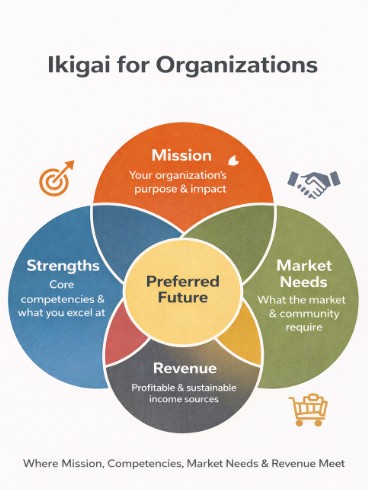
    Ikigai addresses this problem at its root. By clarifying what the organization is deeply committed to, what it does exceptionally well, what the community truly needs, and what can be sustained financially, Organizational Ikigai creates a coherent center. That center gives the future weight. It slows decision-making in productive ways making it more deliberate. It introduces discipline before ambition. Most importantly, it answers a foundational question that many planning processes skip: who are we becoming?

    You cannot design a preferred future without first clarifying identity. Futuring not grounded in identity tend to drift. Futuring grounded in Ikigai has a better chance to endure.

    Ikigai as the Anchor of the Preferred Future

    Organizational Ikigai should not sit alongside strategic planning as a parallel exercise. It belongs in the beginning and at the center. When placed there, it naturally shapes everything that follows. The preferred future statement becomes an expression of identity rather than a marketing narrative. Key initiatives emerge as commitments rather than hope. Measures begin to reflect direction rather than activity. Alignment across teams and budgets becomes easier because decisions reference a shared center instead of competing priorities.

    In practice, this shift changes the tone of leadership conversations. Instead of asking whether an initiative is innovative or timely, leaders ask whether it strengthens who the organization is becoming. Instead of debating tradeoffs in isolation, teams evaluate options through a consistent identity lens. Strategy becomes less about enforcement and more about coherence.

    One of the most important outcomes of placing Ikigai at the center is that alignment stops being a goal in itself. When identity is clear, people understand why certain priorities matter and others do not. Budgeting conversations become less adversarial. Tradeoffs become defensible. Leaders no longer need to rely on authority to drive alignment; the logic of identity does the work.

    From Identity to Direction: Stating the Preferred Future

    A preferred future is not a forecast. It is not a prediction of market conditions or enrollment trends. It is a declaration of intent grounded in identity. Ikigai ensures that this declaration is authentic, relevant, and sustainable.

    Authentic futures reflect who the organization truly is, not who it wishes it were. Relevant futures respond to real community needs rather than abstract trends. Sustainable futures acknowledge financial realities and institutional capacity. When these three conditions are present, the future becomes credible. Importantly, leadership, staff, and constituents can see themselves in it. They understand their role in bringing it to life.

    One of the most useful prompts I offer leadership teams is simple: if we grew into our Ikigai (preferred future), what would be unmistakably true three years from now? This question shifts the conversation from tactics to trajectory. It invites leaders to imagine the organization as a coherent whole rather than a collection of initiatives moving into an unknown future.

    From this clarity, key initiatives begin to narrow. Ikigai does not encourage doing more. It encourages doing less with greater intention. Initiatives become expressions of identity rather than reactions to trends. Fewer initiatives create clearer ownership and stronger outcomes. Energy is conserved rather than dissipated. Over my career I have seen strategic plans with fifty-plus individual items.

    Ikigai does not answer the question of what should we do next. It answers a more demanding question: what must we do to become who we say we are? According to the authors of The Great Upheaval, Levine and Van Pelt, that distinction changes everything.

    Measuring Progress Toward Identity

    Traditional metrics are necessary. They help leadership understand and operationalize performance, efficiency, and compliance. But they are insufficient when the goal is long-term direction. Ikigai-aligned organizations measure progress toward identity, not just activity and head count.

    This shift does not imply abandoning dashboards or data. It requires reframing what success looks like. Boards and CEOs begin to look for confidence in trajectory rather than perfection in execution. Measures emphasize depth over breadth, coherence beyond growth, and alignment over volume. For example, instead of tracking how many initiatives are underway, leaders ask whether the work is becoming more focused. Instead of celebrating growth alone, they examine whether growth reinforces identity. Instead of measuring activity across every domain, they pay attention to where the organization is becoming unmistakably strong and relevant.

    What gets measured signals what the organization truly values. When measures reflect Ikigai, they reinforce identity rather than distract from it.

    Closing Reflection: Choosing the Future from the Center

    “Efforts and courage are not enough without purpose and direction.” — John F. Kennedy

    Organizational Ikigai becomes the bridge between identity and a preferred future. It is not a slogan and not a planning tool in the narrow sense. It is a steady reference point that allows organizations to adapt without losing focus. In times of disruption, this matters more than optimization. Organizations that know who they are can change without panic. Those that do not will optimize themselves into irrelevance.

    Organizations do not drift into strong futures. They choose them, and the strongest choices are made from a clear center.

    Ikigai as the Bridge

    My articles over the past four weeks included:

    • Week 1: Why Ikigai matters now

    • Week 2: Organizational Ikigai

    • Week 3: Governance and identity

    • Week 4: Ikigai as the bridge from identity to a preferred future

    —–

    Aman & Associates works with governing boards and CEOs to clarify organizational Ikigai before strategy, plans, and initiatives are set. Building on the Organizational Ikigai frameworks explored in this series, we facilitate focused board and leadership sessions that strengthen decision quality, reduce mission drift, and support long-term sustainability. As a new year begins, a short board or leadership retreat can be a timely way to reconnect organizational identity with a preferred future. Aman & Associates offers a half-day Zoom session designed specifically for organizational Ikigai alignment. If this would be useful for your board or leadership team. Feel free to message me.

    Rick Aman, PhD Aman & Associates   

    rick@rickaman.com | rickaman.com/articles
     

  • Ikigai for Organization: The Four Questions

    Ikigai for Organization: The Four Questions

    Strategy without purpose is motion. Purpose without discipline is sentiment. — Roger Martin, adapted from Playing to Win

    Ikigai has traditionally been used as a personal centering practice. It helps individuals clarify meaning, direction, and purpose in their lives. At its core, Ikigai answers a simple but profound question: Why do I do what I do? What is often overlooked is that colleges and nonprofit organizations need centering just as much as individuals do. Institutions drift when activity outpaces purpose. When applied at the organizational level, Ikigai becomes a disciplined way for boards and leadership teams to re-center on mission and clearly define their why before setting goals, approving initiatives, or reallocating resources.

    In higher education today, the pressure to act is relentless. Demographics are shifting. Workforce demands are evolving. Technology is accelerating. Funding is tightening. In response, colleges often layer initiative upon initiative, believing momentum itself will produce relevance. But motion without meaning rarely delivers impact. The institutions that remain strong are not simply those that move quickly, but those that remain centered.

    Ikigai offers a framework for that centering. Adapted for organizations, it invites boards and executives to examine four intersecting questions. None stand alone. Together, they form a powerful governance lens for clarity, alignment, and sustainability.

    What Do We Love to Do?

    Mission energy versus mission drift

    This first question is not about sentimentality or tradition. It is about energy. In organizations, love shows up where commitment is sustained over time. It is visible in faculty engagement, staff pride, and student success. It is present where people believe the work matters.

    Mission drift often begins quietly. A new grant opportunity appears. A promising partnership emerges. A program is added to solve a short-term problem. Each decision may be reasonable on its own. Over time, however, the institution begins to feel stretched, fragmented, and fatigued. What once felt purposeful starts to feel heavy.

    Boards play a critical role here. Trustees are uniquely positioned to step back from daily operations and notice where mission energy is strong and where it has dissipated. Programs aligned with the heart of the mission tend to generate momentum naturally. Programs that have drifted often require constant explanation, emergency funding, or heroic effort to sustain.

    A useful board-level question is simple: Where do we see genuine energy, and where are we compensating for its absence? Protecting mission energy is not a soft governance issue. It is central to long-term effectiveness.

    What Are We Truly Good At?

    Distinctiveness, not aspiration

    This question is frequently misunderstood. Many institutions answer it by listing what they hope to be good at rather than what evidence shows they already do well. Being good at something requires proof. Completion rates. Job placement. Transfer success. Employer confidence. Community reputation. Distinctiveness emerges where performance is consistent and visible, not where ambition is loud.

    I often see boards and presidents tempted to approve initiatives designed to make their college resemble a peer institution across town or across the state. The risk is subtle but significant. When colleges imitate rather than differentiate, they dilute their identity and stretch resources thin. Aspiration replaces evidence, and focus erodes. Boards add real value when they insist on clarity. The question is not Could we do this? but Do we already demonstrate excellence here? Distinctiveness is an institutional asset. It deserves intentional protection.

    What Does Our Region Need From Us?

    Workforce, access, and regional  trust

    Colleges exist in relationship with place. Regional need is not static, and it extends well beyond workforce metrics alone. Yes, employers matter. Skills alignment matters. But so do access, affordability, and public trust. I often ask boards to imagine their community five years from now. What pressures will families face? Which industries will struggle to find talent? Where will opportunity gaps widen if no one intervenes?

    Listening is not optional governance work. It is essential. Boards that remain insulated from regional voices risk approving strategies that make sense internally but miss the moment externally. Employer roundtables, civic partnerships, K–12 relationships, and community conversations are all sources of insight trustees should value.

    A powerful test is this: If our college disappeared tomorrow, what would our region lose that could not be easily replaced? The answers often reveal the institution’s true role more clearly than any labor market dashboard.

    The counter narrative is also worth considering. Just because a large employer or community segment wants something, such as sports, that may not be core to where the college mission rests or in alignment with mission focus. Saying “not now” can be prudent in times of financial pressure.  

    What Sustains Us Financially?

    Financial sustainability without mission erosion

    Financial sustainability is not the same as chasing revenue. Sustainable funding models reinforce mission rather than distort it.

    In challenging environments, pressure builds to pursue any revenue that keeps the doors open. The danger is that short-term financial fixes can quietly pull institutions away from their core purpose. Programs launched solely for margin often struggle once initial enthusiasm fades.

    Boards must consistently ask whether a revenue source strengthens who the institution is becoming or simply delays a harder conversation. Sustainability is about durability over time. It requires alignment between mission, capacity, and funding. One helpful governance question is: If this revenue disappeared in three years, would we still be glad we built the program? If the answer is no, the institution may be trading identity for cash.

    The Intersection Is Where Strategy Lives

    None of these questions stand alone. Institutional Ikigai exists only at the intersection of all four.

    When a college does work it loves, does well, meets regional need, and is financially sustainable, momentum builds naturally. When one or more elements are missing, friction follows. Staff feel stretched. Students experience inconsistency. Boards sense confusion but struggle to name it.

    This intersection test gives boards a shared language. It allows trustees to move beyond subjective debates and ask disciplined, mission-centered questions. It also helps CEOs explain why certain initiatives should move forward while others should pause or end.

    I have seen this framework change trustee and president conversations. Instead of approving long lists of initiatives, boards begin asking which proposals truly belong at the center of the institution’s identity. Strategy becomes clearer because purpose is no longer assumed.

    Ikigai as a Governance Discipline

    Ikigai is not a replacement for strategic planning. It precedes it. It clarifies the why before leaders argue about the how.

    For boards, this framework is especially useful in retreats, strategic visioning, and CEO evaluation. It provides a consistent lens for decision-making across time, not just during planning cycles. When trustees and presidents share a common understanding of institutional Ikigai, alignment improves and execution accelerates.

    In uncertain times, colleges rarely suffer from a lack of activity. They suffer from a lack of centering. Ikigai offers a way back to purpose. Before asking what to build next, boards would be wise to pause and ask who they are and who they are becoming.

    —

    At Aman &  Associates, we work with presidents, executive teams, and governing boards to help institutions re center on purpose before strategy, structure, or initiatives are set. Using an Ikigai based approach, we facilitate focused leadership sessions that clarify mission, strengthen decision making, and support long term sustainability. As one year closes and another begins, a board or leadership retreat can be a timely moment for organizational centering. Aman and Associates offers a short half day Zoom session focused on Ikigai alignment for institutions. If this framework would be helpful for your organization, DM me on LinkedIn for more details.

    Rick Aman, PhD Aman & Associates   

    Futuring | Strategy | Board Development rick@rickaman.com | rickaman.com/articles
     

  • Ikigai for Organizations: Why Purpose Must Precede Goals

    Ikigai for Organizations: Why Purpose Must Precede Goals

    Institutions that thrive will be those that clearly understand who they are and why they exist. — Arthur Levine (The Great Upheaval)

    As the calendar turns toward a new year, college and nonprofit leaders and their boards feel a familiar pressure. Trustees approve goals. Presidents finalize plans. Executive teams line up initiatives. There is a quiet urgency to be ready for what comes next. Yet activity is not the same as purpose, and goals are not mission.

    For generations, individuals have used Ikigai to align purpose, values, and daily work. The idea entered the modern conversation through Ikigai: The Japanese Secret to a Long and Happy Life by Héctor García and Francesc Miralles, whose work drew global attention to Okinawa and other Blue Zones where longevity is closely linked to clarity of purpose.

    That same concept has something important to say to institutions, especially at a time when mission drift and reactive strategy are common. Centering is the discipline of returning to why the organization exists before deciding what it will do next. Ikigai, often translated as “reason for being,” offers boards and CEOs a practical lens for this work. It reinforces the board’s role as steward of mission and values, and the CEO’s responsibility to translate that purpose into coherent strategy and culture. When leadership is centered, decisions become clearer, tradeoffs more intentional, and strategy more durable.

    What stands out in this research is not longevity alone, but clarity of purpose. Individuals with a clear sense of Ikigai wake up knowing why their lives matter. They make decisions from a grounded sense of meaning rather than reacting to every external pressure. Their lives are not free from complexity, but they remain aligned. Ikigai was never intended to be a productivity hack or a self-help trend. It is a discipline of alignment.
    Over time, I began to recognize something familiar in this idea. Institutions behave much like individuals. When they are centered, decisions feel coherent. When they are not, strategy becomes reactive, fragmented, and exhausting. This is especially true for community colleges navigating significant disruption.

    Why Centering Matters Before Goal Setting

    Most strategic plans do not fail because they are poorly written. They are ineffective because they start in the wrong place. They begin with goals instead of purpose. In my years as a community college president and now working with boards and CEOs, I have seen institutions work incredibly hard while slowly losing coherence. New initiatives launch. Metrics multiply. Committees stay busy. Yet beneath the activity is a persistent feeling that the organization is reacting rather than choosing a preferred future.

    This is not a leadership failure. It is an alignment problem.

    Community colleges are operating in an environment of constant pressure. Demographic shifts, workforce realignment, emergence of artificial intelligence,  technology acceleration, political scrutiny, and financial constraint are no longer episodic challenges; they are the context. In response, institutions often expand programs, pursue new funding sources, connect with legislators and chase opportunities as they arise. Each decision may make sense on its own. Collectively, they can pull the institution away from its core.

    Without a clear center, strategy becomes a list of responses instead of a set of choices. Ikigai offers a way to pause before planning. It does not replace strategic planning, budgeting, or accreditation processes. It precedes them. It asks leaders to clarify identity before direction.

    From Ikigai for Individuals to Ikigai for Institutions

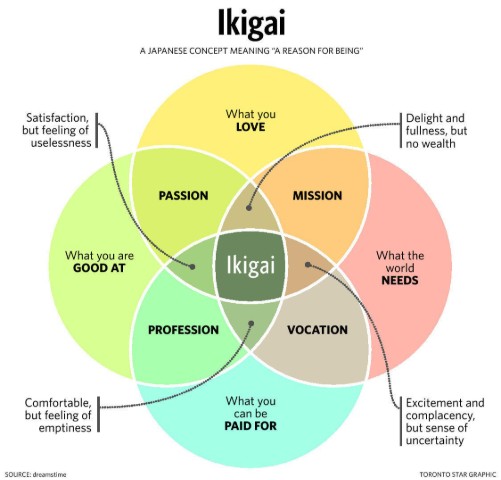
    At the individual level, Ikigai is often described through four intersecting questions:

    What do I love? What am I good at? What does the world need from me? What sustains me economically? 

    When these questions align, individuals experience clarity. When they do not, people feel stretched, unfocused, or disconnected from their work. The same dynamic exists inside institutions. Colleges and non-profits can drift into doing work they no longer love, offering programs they are not particularly strong at, misreading what their region truly needs, or relying on revenue models that quietly erode mission. None of this happens overnight. It happens gradually, often in response to well-intended decisions made without an anchoring framework.
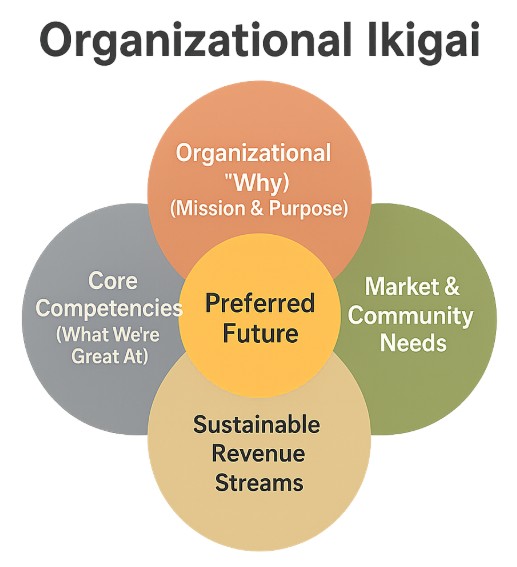
    Ikigai translates naturally into an institutional context, especially for community colleges. When adapted thoughtfully, it provides a language for purpose that boards and presidents can hold together.

    Why Strategy So Often Misses the Mark

    I often ask presidents and trustees a deceptively simple question: “Why does your college exist today, not ten years ago?” An alternative question is: “What does your degree mean to the student, employers and the community?”

    The answers are thoughtful, but they are rarely crisp. Mission statements are recited. Values are referenced. Yet when we explore how those ideas shape actual decisions, gaps begin to appear. Goals are approved before identity is clarified. Initiatives are launched before alignment is tested. Strategy becomes additive rather than intentional.

    This is where Ikigai becomes useful, not as a model to diagram, but as a discipline to practice. Ikigai does not ask, “What should we do next year?” — It asks, “Who are we, and why does that matter now?” When that question is left unanswered, even strong leadership teams struggle to maintain focus.

    Boards and Presidents as Stewards of Purpose

    Ikigai resonates at the institutional level because it aligns naturally with the shared responsibility of boards and presidents. Presidents and CEOs lead the organization day to day. Boards govern with a longer horizon. Both are stewards of purpose. Boards, in particular, are positioned to hold the center. Their distance from operations is a strength. They are not meant to manage, but to ensure alignment between mission, strategy, and community need. Ikigai provides a language for that work.

    Instead of beginning conversations with goals, boards can ask whether the institution remains centered on why it exists. Presidents benefit from this clarity as well. When purpose is clear, leadership decisions become more principled. Trade-offs feel less personal. Saying no becomes easier.

    Four Questions Worth Considering at Year End

    At the institutional level, Ikigai translates into four questions that boards and executive teams should be willing to sit with before approving goals or launching new initiatives.

    What do we love? This is not sentimentality. It is about where the institution’s energy truly lives. Which students, programs, and outcomes draw genuine commitment? Where does the college show up at its best? What is the unique value your institution brings.

    What are we genuinely good at? Not what we aspire to be good at, and not what peers are doing. This question requires honesty about distinctive strengths. Institutions that try to be everything to everyone often dilute what they do best.

    What does our region need from us now? This grounds purpose in place. Workforce needs, access gaps, demographic change, and civic trust all matter. Ikigai keeps the institution outward-facing.

    What sustains us financially? Purpose without sustainability is fragile. This question is not about commercialization of mission, but about ensuring the institution can continue to serve over time without erosion or burnout. These questions are not meant to be answered quickly. When they are, it is usually a signal that deeper work remains.

    A Year-End Invitation

    Mid-December is a natural moment for reflection. Boards are approving budgets, presidents are setting direction, and leadership teams are preparing to move from planning to action. Before finalizing goals for the year ahead, this is an opportunity to step back and clarify the institution’s north star, its reason for being, not as inherited language or an aspirational slogan, but as a clear expression of purpose grounded in today’s realities, regional needs, and institutional strengths.

    Used this way, Ikigai becomes a centering discipline for organizations. It does not prescribe strategy; it creates alignment. That alignment allows boards to steward mission with confidence and enables CEOs to translate purpose into coherent strategy and culture. In the weeks ahead, I will explore how Ikigai’s four guiding questions can be applied practically in community colleges, how boards can use Ikigai as a governance lens, and how this framework directly informs a clearly articulated preferred future. Strategy follows purpose. It always has.

    —-

    This is the work I do through Aman & Associates. I partner with boards and executive teams to apply these four Ikigai principles to their unique organization, helping leaders center on mission, sharpen strategic clarity, and align future decisions around purpose. For institutions ready to do this work together, I offer a focused half-day Zoom retreat designed to translate Ikigai from concept into practical strategic insight and movement toward a preferred future. DM me with any questions.

    Rick Aman, PhD Aman & Associates   Futuring | Strategy | Board Development rick@rickaman.com | rickaman.com/articles

  • Ikigai – Governing Board’s New Work: Mission and Identity

    Ikigai – Governing Board’s New Work: Mission and Identity

    Without a clear sense of identity, organizations drift toward whatever is easiest or most rewarded — Margaret J. Wheatley, Leadership and the New Science

    In working with governing boards, most mission drift does not happen because leaders lose sight of purpose. It happens because good intentions accumulate faster than clarity. New programs are added, partnerships are approved, initiatives stack up, and before long the organization is busy, well-meaning, and unfocused. The board is doing its job, but the institution’s identity has quietly blurred. This is where Ikigai becomes especially powerful at the governance level. Not as a feel-good exercise or a strategic retreat activity, but as a disciplined lens for decision-making. When used well, Ikigai helps boards protect institutional identity, prevent mission sprawl, and elevate the quality of boardroom conversations from operational review to generative leadership.

    Ikigai as a Board-Level Discipline

    Boards are uniquely positioned to steward identity. Unlike management, they are not responsible for day-to-day execution. That distance is a strength. It allows boards to ask questions that cut across programs, budgets, and structures and get to the deeper issue of who the organization is and is not meant to be.

    Ikigai provides a simple but demanding framework for this work. When applied at the board level, it asks trustees to continually test decisions against four framework realities: What the institution is deeply committed to, What it does exceptionally well, What the community truly needs, and What can be sustained financially over time.

    When these elements are aligned, identity is clear. When they drift apart, confusion follows. Used this way, Ikigai is not about inspiration. It is about discipline. It gives presidents and boards a shared language for saying yes, for saying no, and just as importantly, for saying not now.

    Preventing Mission Sprawl

    Mission sprawl is one of the most common challenges I see in higher education and nonprofit governance. It rarely shows up as a single bad decision. More often, it is the result of many reasonable decisions made without a consistent identity filter. A grant opportunity appears attractive. A partnership seems aligned with a neighboring institution. A new program promises growth. Each decision, evaluated on its own merits, makes sense. Taken together, they stretch leadership capacity, dilute focus, and strain resources.

    Ikigai helps boards slow this pattern down. It gives trustees permission to ask a different kind of question before approving something new: Does this strengthen who we are, or does it simply add activity? Does this sit at the center of our purpose, or at the edge of our capacity? Boards that adopt this posture begin to shift from expansion thinking to identity thinking. They stop measuring success by how much the organization is doing and start measuring it by how coherent the work has become.

    Clarifying What to Stop Doing

    One of the most difficult governance responsibilities is deciding what to stop. Boards in conjunction with presidents are often far more comfortable approving new initiatives than sunsetting existing ones. Yet clarity of identity requires subtraction as much as addition. Ikigai makes this conversation possible without turning it into a critique of effort or history. Programs and initiatives can be honored for the role they once played, while still being acknowledged as no longer central to the institution’s purpose. The question is not whether something was valuable. The question is whether it still belongs at the center of the mission today. When boards use the four frameworks of Ikigai as a reference point, stopping becomes a strategic act rather than a reactive one. It creates space. It reduces noise. And it signals to the organization that focus is a form of leadership, not a failure of imagination.

    Improving Generative Board Conversations

    Many boards spend much of their time in fiduciary and operational review. This is necessary work, but it is not sufficient. The most effective boards also engage in generative conversations, discussions that explore meaning, direction, and long-term implications.

    Ikigai naturally elevates board dialogue. It shifts conversations from reports to reflection. Instead of asking only whether a program is performing, boards begin to ask whether it belongs. Instead of focusing solely on metrics, trustees explore alignment. Instead of reacting to proposals, they frame them within a shared understanding of identity. I have seen boards become more confident, more engaged, and more strategic when they adopt this approach. Trustees stop feeling like passive reviewers and start acting as stewards of purpose. The quality of questions improves. The tone of meetings changes. And decisions gain coherence over time.

    Testing New Programs Through an Identity Lens

    When boards evaluate new programs through Ikigai, the conversation changes immediately. Rather than asking whether a program is innovative or marketable, trustees ask whether it fits. Does this program reflect what we do best, or does it pull us into unfamiliar territory without clear advantage? Does it meet a genuine community need, or simply follow a trend? Does it strengthen long-term sustainability, or create hidden dependencies? These questions do not slow innovation. They sharpen it. Programs that survive this level of scrutiny tend to be clearer, stronger, and better supported once launched.

    Evaluating Partnerships with Greater Clarity

    Partnerships can accelerate mission, but they can also blur identity if not carefully considered. Boards often approve partnerships based on opportunity rather than alignment. Ikigai offers a way to evaluate partnerships without defaulting to enthusiasm or fear. Trustees can ask whether a partnership amplifies the institution’s strengths or compensates for weaknesses in ways that create long-term risk. They can examine whether the partnership deepens community impact or distracts from core commitments. When boards use Ikigai in this way, partnerships become intentional extensions of identity rather than tactical arrangements.

    Framing Strategic Priorities

    Strategic planning often struggles because organizations confuse priorities with lists. Ikigai helps boards narrow focus by grounding priorities in purpose. Rather than asking what the institution should do next, boards begin by clarifying who the institution is becoming. Strategic priorities then emerge naturally as expressions of that identity. This approach reduces initiative overload and creates alignment across leadership, budgeting, and execution.

    Identity Matters More Than Optimization

    In times of disruption, organizations are often tempted to optimize. Improve efficiency. Streamline processes. Do more with less. These efforts matter, but they are secondary. What matters most in uncertainty is identity. Organizations that know who they are can adapt without losing coherence. Those that do not will optimize themselves into irrelevance. Ikigai helps boards anchor leadership in identity rather than activity. It provides a steady reference point when the environment is volatile. And it reminds trustees that their highest responsibility is not oversight alone, but stewardship of purpose.

    A Closing Reflection

    If you have more than three priorities, you don’t have any. — Jim Collins, Good to Great

    As you prepare for your next board meeting, consider this simple shift. Before approving something new, before debating metrics, before reviewing performance, pause and ask: Does this decision strengthen who we are? That single question, asked consistently, has the power to transform governance. Ikigai can be considered risk management for identity, a concept boards increasingly care about.

    —–

    Aman & Associates partners with governing boards and CEOs to protect organizational mission and identity before strategy and initiatives are set. Using an Ikigai-based framework, we facilitate focused board and leadership sessions that sharpen decision-making, reduce mission sprawl, and support long-term sustainability. As this year closes and another begins, a brief board or leadership retreat can be a timely moment to reaffirm institutional identity. Aman & Associates offers a short, half-day Zoom session designed specifically for organizational Ikigai alignment. If this approach would be helpful for your board or leadership team, DM me on LinkedIn to explore next steps.

    Rick Aman, PhD Aman & Associates   

    Futuring | Strategy | Board Development rick@rickaman.com | rickaman.com/articles