Category: In the Beginning Was the Future

  • Seminar – Shaping Tomorrow, Today

    Seminar – Shaping Tomorrow, Today

    An Invitation to Create Your Organization’s Preferred Future Seminar

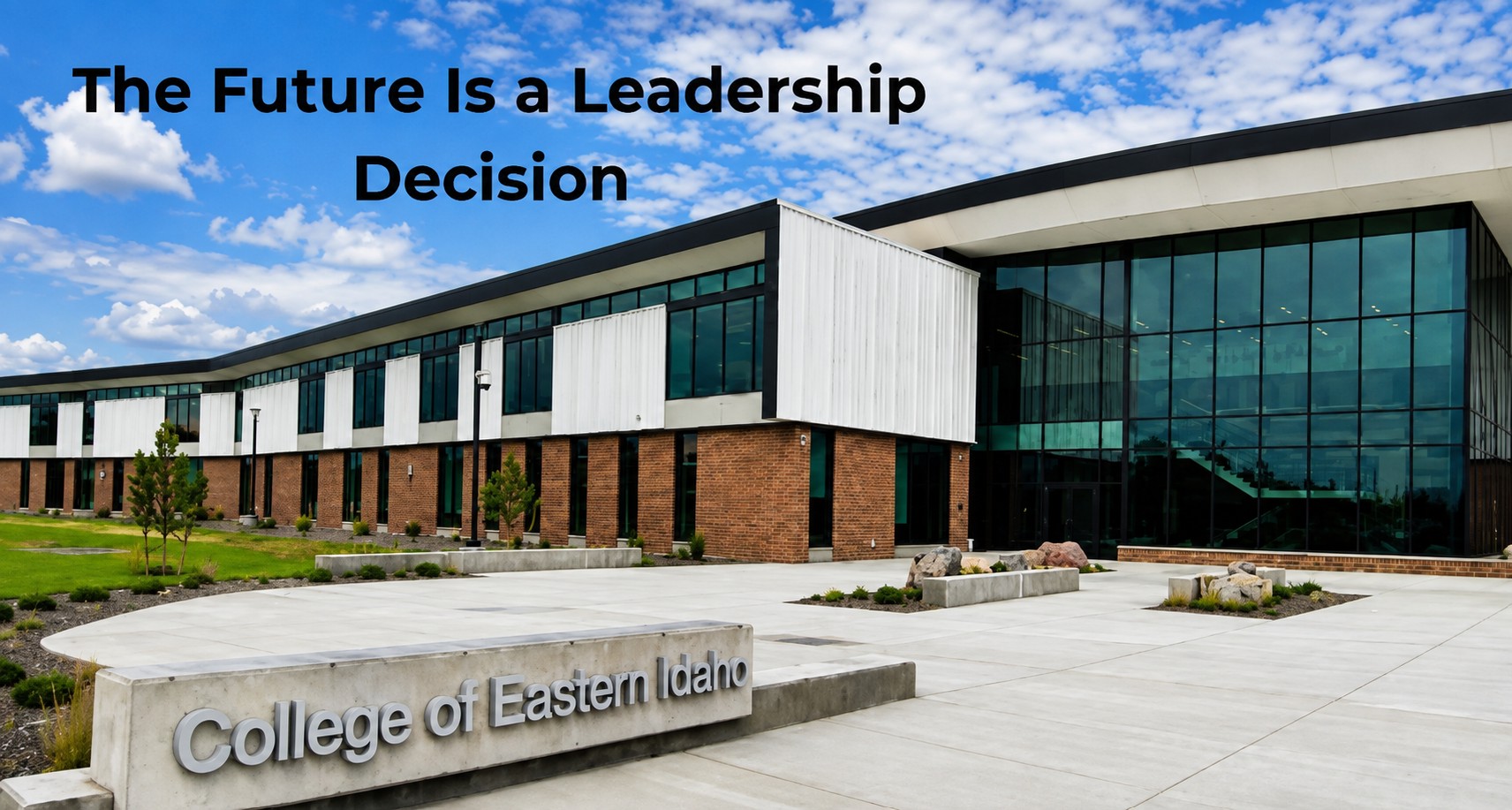
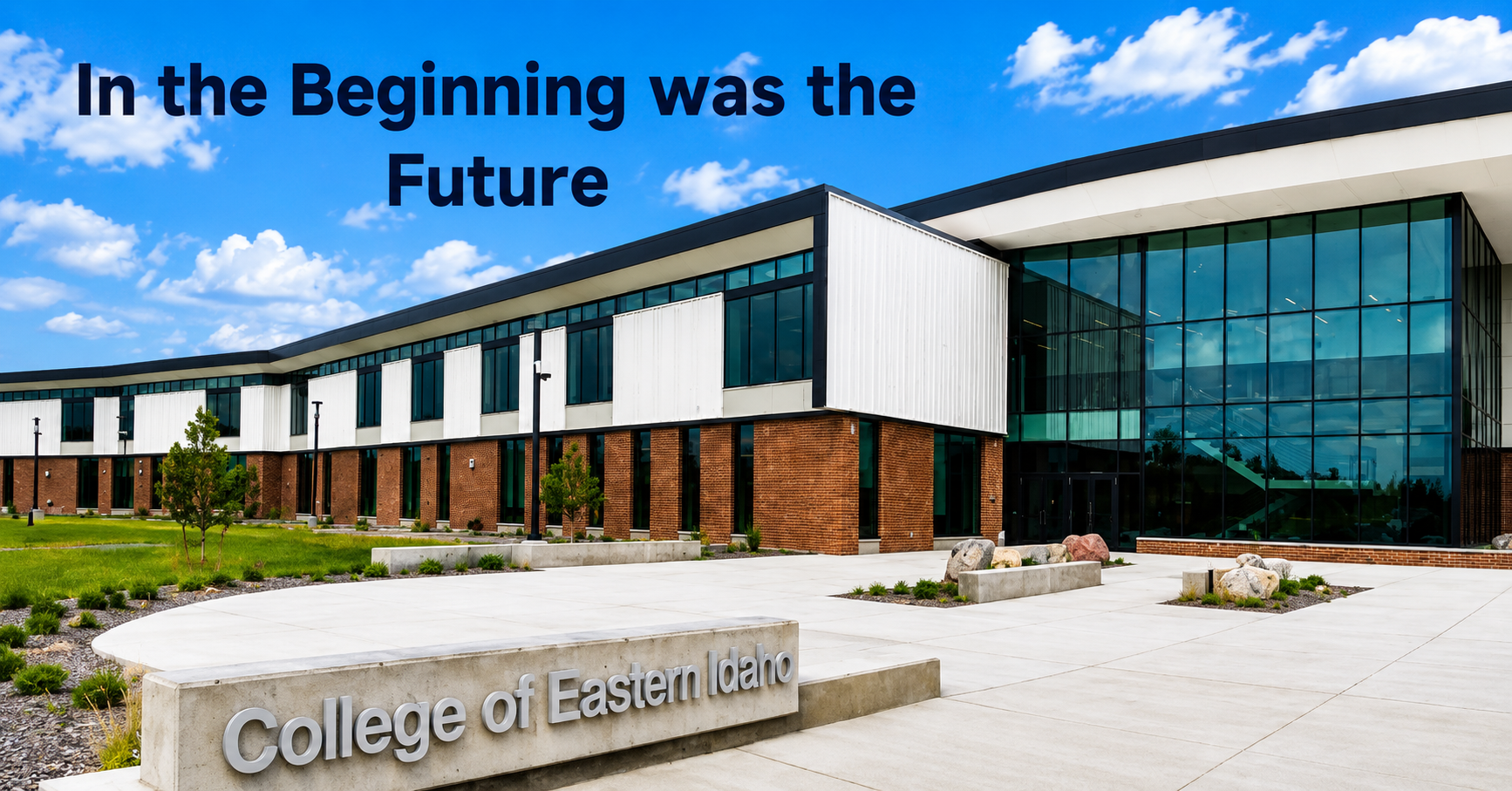
    Over the past three weeks, I have been writing about Futuring—an idea that has shaped much of my thinking about leadership, strategy, and organizational change. I began with the experience of walking into the new Future Tech Building at the College of Eastern Idaho and realizing that I was standing inside something that, years earlier, had existed only as an idea. From there, I explored how leaders can move from imagining a Preferred Future to creating one, and why choosing a future worth pursuing is ultimately a leadership responsibility.

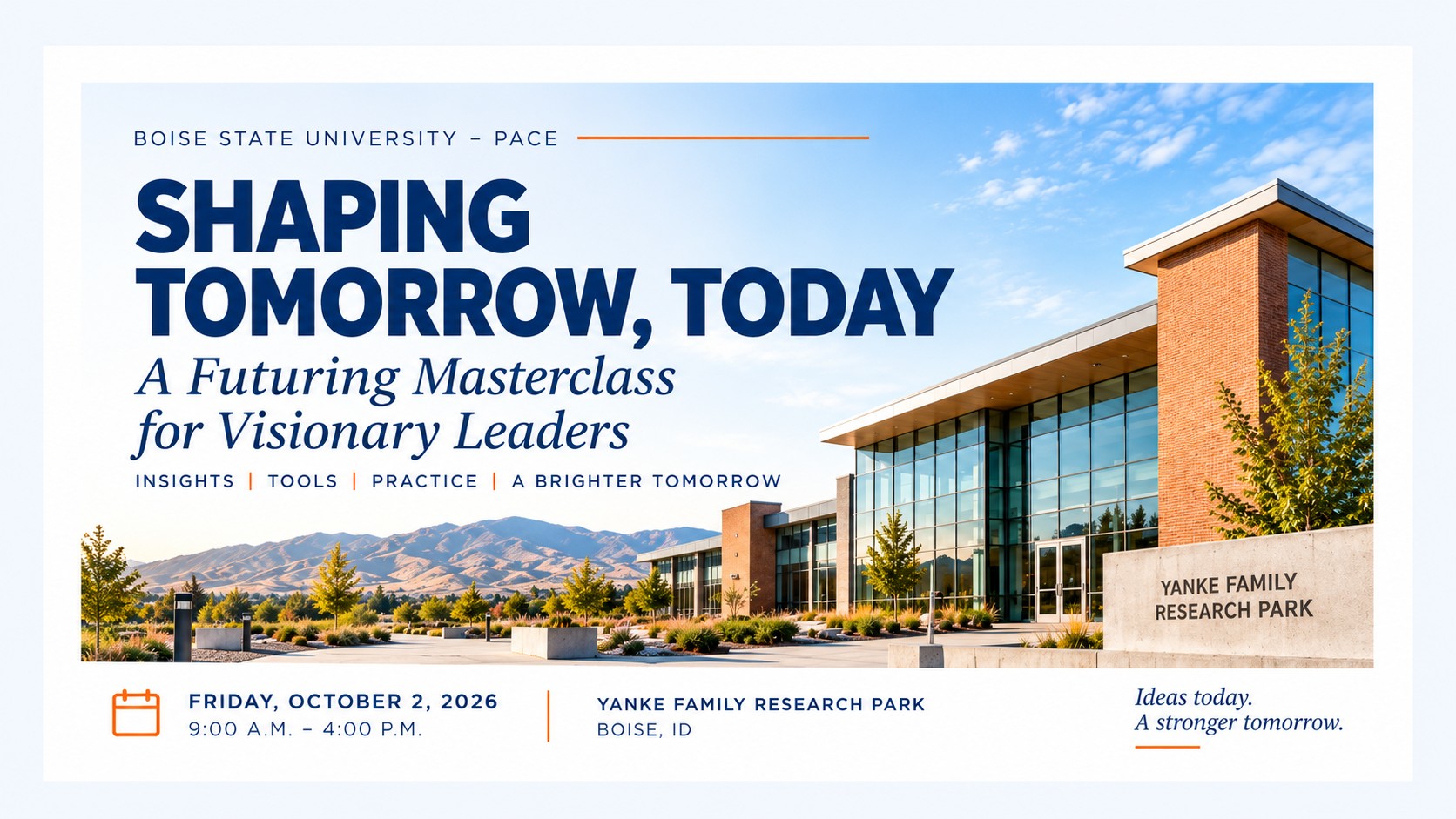
    Those articles generated several conversations about a natural next question: How do you actually put Futuring into practice? On Friday, October 2, I will spend a full day exploring that question through Boise State University’s PACE program in a seminar titled Shaping Tomorrow, Today: A Futuring Masterclass for Visionary Leaders. If the ideas I have been writing about have interested you, I would enjoy having you join me.

    Begin with the Future, Not the Plan

    Futuring begins with a somewhat different way of thinking about strategic planning. Traditional planning often begins with the organization we have today. We examine our mission and values, assess strengths and weaknesses, identify problems, establish goals, and begin moving forward. All of that can be useful, but there is a danger in allowing today’s organization to establish the boundaries of what we can imagine for tomorrow.

    Futuring begins farther out. It asks leaders to look three to five years into the future and consider a different question: What organization do we want to become? Once that destination becomes clear, we can work backward to determine what we should begin doing today. Futuring does not replace strategic planning; it changes where the planning begins.

    An important part of that process is recognizing that there is never just one future. The Possible Future asks what could happen as technology, demographics, economics, competition, public expectations, and other forces change. The Probable Future asks where our current direction is likely to take us if we continue largely as we are.

    But the central question of Futuring comes with the Preferred Future: Of all the futures that might emerge, what future do we intentionally want to help create? That moves leaders from forecasting what might happen toward considering what they want to make possible. We cannot control the future, but neither are we simply passengers waiting for it to arrive.

    Centering Purpose: Ikigai for Organizations

    Before we can meaningfully answer that question, we need to understand why the organization matters in the first place. One of the frameworks we will use during the October seminar is Ikigai for Organizations, my adaptation of the Japanese concept often associated with purpose and meaning.

    For organizations, I center the conversation around four questions: What do we love? What are we good at? What does our community need? What will sustain the organization? The intersection of those questions can help leaders rediscover the purpose at the center of their organization.

    I think of this as Centering Purpose. Futuring should not simply produce a bigger or busier organization; it should create one increasingly aligned with why it exists and the difference it is uniquely positioned to make. From there, three simple words become particularly useful: Why, What, and How. Purpose establishes why the organization exists, the Preferred Future describes what it intends to become, and strategy determines how we begin moving toward that destination.

    The sequence matters. Leaders naturally want to move quickly to the how—initiatives, budgets, timelines, assignments, and measures. But an organization can be extraordinarily busy without necessarily making meaningful progress. I frequently return to a simple principle in my work with leadership teams: clarity precedes progress. Without clarity about why the organization matters and what future we are trying to create, more activity may simply move us somewhere faster.

    AI Gives Leaders a New Futuring Tool

    There is another dimension of Futuring that makes this an especially interesting time for leaders: artificial intelligence. Organizations now have access to tools that can dramatically expand their ability to understand the forces changing around them. AI can inform the Futuring process, but organizational purpose—why we exist, what we value, and what future is worth pursuing—remains a human responsibility.

    During our day together, we will use AI not to replace leadership judgment, but to strengthen it. AI can help examine demographic and economic trends, develop and challenge a SWOT analysis, conduct a PESTEL environmental scan, identify emerging technologies and disruptions, compare peer organizations, explore scenarios, and test assumptions. Research that once required days can increasingly be explored in minutes, allowing leadership teams to ask more questions and consider more possibilities.

    As we work with AI, we will also discuss the AIM framework for prompting: Act As, Information, and Mission—a useful way to give AI the role, context, and task it needs. Better prompt construction can lead to better questions, deeper analysis, and more useful insights.

    But there is an important boundary. AI can expand what leaders see, but it cannot decide what leaders should value. It can identify trends, challenge assumptions, and help us imagine different futures. Deciding which future is worth pursuing remains a human responsibility grounded in purpose, values, judgment, wisdom, and leadership.

    Futuring Is Ultimately About Leadership

    The more I work with Futuring, the less I think of it simply as another planning methodology. It is fundamentally about leadership.

    Leaders live under the gravitational pull of the present. There is always a budget issue, staffing problem, operational challenge, new regulation, customer concern, board agenda, or unexpected event requiring attention. Responsible leaders cannot ignore those realities. But if every leadership conversation begins and ends with today’s problems, the present eventually becomes the architect of the future.

    Leadership requires managing the organization we have today while also accepting responsibility for the organization that will exist three to five years from now. A Preferred Future gives leaders another vantage point from which to make those decisions. Instead of asking only what problem needs to be solved today, we can also ask: Does this decision move us toward our Preferred Future?

    That question becomes particularly powerful when circumstances change, because they inevitably will. Futuring does not provide a detailed map of the next five years, nor should it. Technology will change, new opportunities will emerge, and strategies will need to adapt. A Preferred Future provides a destination that gives those changing strategies direction—and over time, that can become a leadership discipline.

    Join Me on Friday, October 2, 2026

    If you serve on a governing board, lead a business or nonprofit, work in government or education, or have responsibility for helping an organization navigate what comes next, I invite you to bring that organization with you conceptually. Bring the challenges you are facing, the assumptions you have about where the organization is headed, and the questions that may not yet have good answers. Most importantly, bring a willingness to look beyond the organization as it exists today and imagine what it could become. This will not be a day of abstract discussion about the future, but an opportunity to begin doing the work of shaping one.

    Shaping Tomorrow, Today: A Futuring Masterclass for Visionary Leaders will be held Friday, October 2, from 9:00 a.m. to 4:00 p.m. at Boise State University’s Yanke Family Research Park in Boise. The registration fee is $275. I would enjoy having some of my LinkedIn friends and colleagues join me for the day as we move from talking about the future to doing the work of intentionally shaping it.

    Learn more and register through Boise State University PACE

    Every future begins as an idea. Its real power comes when people see that future together and begin moving toward it. Perhaps that is the question worth leaving with leaders and governing boards: Are you planning from where your organization is today, or are you creating a clear enough picture of the future that people can begin moving toward it together?

    Rick Aman, PhD | Aman & Associates – Strategic Futuring & Board Training
    rick@rickaman.com | rickaman.com

    The future will arrive. The leadership opportunity is to decide how intentionally we will help shape it.
  • The Future is a Leadership Decision

    The Future is a Leadership Decision

    Why Leaders Must Choose What They Are Trying to Create

    Over the past two weeks, I have written about futuring from two perspectives. The first began with walking into the new Future Tech Building at the College of Eastern Idaho and realizing that I was standing inside something that, years earlier, had existed only as an idea. The second addressed the question that naturally followed: How do you actually create a preferred future? I described a process for understanding the present, considering possible and probable futures, defining a Preferred Future, and then working backward to determine what we should begin doing today.

    There is one more part of futuring that deserves attention, and perhaps it is the most important: the future is a leadership decision. Leaders certainly do not get to decide what the future will be. Markets change, technology advances, political and economic conditions shift, demographics change, and unexpected events intervene. Anyone who has led an organization knows how quickly circumstances nobody anticipated can disrupt a carefully developed plan. But that does not mean leaders are powerless in shaping what comes next. I have come to believe that one of the most important responsibilities of leadership is deciding what future is worth trying to create.

    Every Organization Is Headed Toward a Future

    During my years as a college president, I spent considerable time thinking about the future. Some of that was unavoidable. Higher education is constantly affected by forces outside its control: demographics, technology, workforce needs, and changing expectations from students and employers. The organization you lead today will not be the same one that exists five years from now. The important question is how much of that change will simply happen to the organization and how much will be influenced by choices its leaders make.

    That became especially clear during the development of the College of Eastern Idaho. When the community voted in 2017 to create a community college, we were taking responsibility for an institution that did not yet exist. There was no established CEI culture or predetermined picture of what the college had to become. We had the unusual opportunity and responsibility to ask what Eastern Idaho would need from its community college in the years ahead. That experience reinforced something I now see working with governing boards and executive teams: every organization is headed toward a future whether its leaders deliberately think about that future or not. Today’s decisions are already creating it. The people we hire, the technology we employ, the partnerships we form, and the buildings we construct have consequences beyond the current year. Even decisions we postpone shape what becomes possible later. The future, in that sense, is already under construction.

    Leaders therefore face a choice. We can allow today’s pressures and circumstances to largely determine where the organization eventually arrives, or we can develop a clear picture of where we would prefer to go and begin making decisions that increase the likelihood of getting there. The future will arrive. The leadership decision is whether we intentionally influence what that future becomes.

    Leadership Is Not About Predicting the Future

    One challenge with talking about the future is that conversation can quickly become an exercise in prediction. Leaders should pay attention to the forces shaping their environment. But the primary responsibility of leadership is not to correctly predict what happens next. I certainly could not have predicted everything that would happen during my years at CEI. We experienced leadership and legislative changes, technological developments, new partnerships, unexpected opportunities, and a global pandemic. Any detailed long-range plan developed at the beginning would have been obsolete long before we reached the end. Yet something important can remain relatively stable even as circumstances change: direction.

    This is why I find the distinction between the possible, probable, and Preferred Future useful. The possible future asks what could happen if technologies, circumstances, or assumptions change. The probable future asks where current trends are taking us. They both matter, but neither represents the fundamental leadership decision. That comes with the preferred future. After considering what is likely and what is possible, leaders must ask a different question: Given what could happen, what future do we want to purposefully create?

    That question moves the conversation from forecasting to agency. We cannot eliminate uncertainty or guarantee that the future we prefer will occur, but we can decide what we value, what kind of organization we want to become, what outcomes matter, and what direction is worth pursuing. Leadership does not require certainty about the future. It requires enough clarity about the destination to begin moving toward it.

    Choosing a Preferred Future Is a Leadership Decision

    This is where futuring becomes more than a planning exercise. A Preferred Future is not simply an attractive paragraph developed during a board retreat and inserted into a strategic plan. If it is meaningful, it represents choices, and choices are where leadership becomes consequential.

    Defining a Preferred Future requires leaders to move beyond describing what they hope will happen and decide what they actually intend to pursue. It creates a destination against which priorities, resources, and opportunities can be considered. Without that clarity, organizations can become extraordinarily busy launching initiatives, responding to immediate needs, and pursuing new opportunities without being certain that all of that activity is moving them in the same direction. I have often said that clarity precedes progress, and futuring has reinforced that conviction for me.

    Once leaders become clear about the future they are trying to create, the nature of the conversation changes. What do we want to become known for? Resources are finite, as are leadership attention and organizational capacity. Choosing a Preferred Future means choosing among competing possibilities. Some investments will become more important, while others may need to wait. Some opportunities will move the organization toward its future, while attractive alternatives may not. Longstanding programs or traditions may even need to be reconsidered. This is why creating a Preferred Future requires more than vision. Vision becomes meaningful only when it begins influencing choices.

    Lead from the Future, Not Just the Present

    Today, as I work with governing boards and executive teams, I see how difficult this can be. Leaders live under the gravitational pull of the present. There is always a budget issue, operational problem, new regulation, or unexpected challenge requiring attention. Responsible leaders cannot ignore those realities. But if every leadership conversation begins and ends with today’s problems, the present eventually becomes the architect of the future. A Preferred Future gives leaders another place from which to make decisions. Instead of looking only from today toward tomorrow, we can occasionally stand conceptually in the future we are trying to create and look backward. From that vantage point, today’s choices can look different. A partnership that seems optional may become essential. A technology investment that appears expensive may become foundational. A longstanding program may no longer contribute to where the organization is going. An opportunity that does not fit today’s organization may fit perfectly with the organization we are trying to become.

    During the development of CEI, strategies changed many times. They had to. People, circumstances, opportunities, and the environment changed. But the larger picture of what the college could become and what it could mean for Eastern Idaho provided continuity. Strategy could adapt without abandoning the destination. That may be one of the most important lessons of futuring: direction should provide continuity while strategy provides adaptability. A Preferred Future does not provide a detailed map of the next five years. It provides something more useful: a North Star against which today’s decisions can be considered. Governing strategy can all be evaluated by asking one recurring question: Does this move us toward our Preferred Future? Over time, that question can become a leadership discipline.

    Three weeks ago, I began this series with the experience of standing inside a future we had once only imagined. Last week, I described how leaders can begin creating a Preferred Future by looking beyond the present, defining a destination, working backward, and then acting forward. The final point may be the simplest: someone has to choose to lead toward it.

    The responsibility of leadership is not to predict the future perfectly. It is to see possibilities, remain grounded in purpose, choose a future worth pursuing, and make today’s decisions in light of tomorrow’s destination. So perhaps the question to take into your next board or executive team meeting is this: Are your most important decisions primarily helping you manage the organization you have today, or create the organization you intend to become tomorrow?

    ——

    The future is not something leaders can predict with certainty, but it is something they can intentionally influence. For governing boards, that begins by asking: What organization are we trying to become? Through Aman & Associates, I can facilitate a focused two-hour Zoom session with your board or executive team to help define that Preferred Future and the strategic direction needed to pursue it. The future will arrive; leadership determines how intentionally we meet it.

    Rick Aman, PhD | Aman & Associates

    rick@rickaman.com | rickaman.com

  • Creating the Preferred Future

    Creating the Preferred Future

    How Boards and Executive Teams Turn Futuring into a Leadership Discipline

    “The future is not something we enter. The future is something we create.” Leonard I. Sweet

    Last week I wrote about what it feels like to stand inside a future that once existed only as an idea. The Future Tech Building at the College of Eastern Idaho provided a very tangible example. Years earlier, there was no building. There were ideas, conversations, possibilities, and eventually a shared vision of something that could exist. Last week, we walked through its doors at the ribbon cutting. Several people responded to that story and particularly to the idea of futuring. Their comments led naturally to another question: How do you actually do it?

    I have spent much of my career thinking about that question, first as a college president working with governing boards and executive teams and now as a consultant helping organizations think about their own futures. Over time, I have become convinced that futuring requires a somewhat different way of thinking about strategy. It does not replace strategic planning, but it changes where the planning begins. Traditional planning usually begins with the organization we have today and asks how we can improve it. Futuring begins farther out. It asks what organization we want to become and then works backward to determine what we should begin doing today.

    The Hardest Part Is Getting Out of the Present

    One of the things I have noticed when working with boards and planning teams is how difficult it can be to escape the gravitational pull of the present. Put 10 leaders in a room and ask them to talk about the future, and before long the conversation often returns to the budget, staffing, facilities, competition, technology, or whatever issue dominated the last board meeting. That is understandable. Leaders are responsible for the organization that exists today, and those issues are real. But there is also a danger in allowing today’s realities to establish the boundaries of what we can imagine for tomorrow. We can become so immersed in managing what is that we have difficulty seeing what could be.

    That is why I usually begin futuring by helping leaders understand the present without asking them to plan from it. Tools such as SWOT and PESTEL can be useful. So can examining demographic trends, emerging technologies, disruptions, and what I sometimes describe as colliding technological S-curves; one way of doing things beginning to decline just as something new is accelerating. The purpose of this work is not to predict the future. It is to understand the forces that may shape it.

    Once we have looked carefully at the environment, the conversation can move beyond today’s organization to what I describe as the three futures. The probable future asks: What is likely to happen if we do nothing different? If today’s trends and momentum continue, where are they likely to take us? The possible future asks: What could be? What new opportunities, technologies, disruptions, or changing assumptions might create futures different from the one we currently expect? But neither is the central question of futuring. That comes when we consider the Preferred Future and ask: What do we want the future to be? Of all the futures that could emerge, what future do we want to help create?

    I have watched the nature of a conversation change when a board begins seriously considering that question. Leaders stop merely forecasting what might happen to them and begin discussing what they want to make happen. We cannot control the future, but neither are we simply passengers waiting for it to arrive. Futuring gives leaders a degree of agency by asking them to identify a future worth pursuing.

    Begin at the Destination and Work Backward

    Once a board begins looking beyond the present, the next challenge is to make that Preferred Future clear enough that people can actually see it. I generally ask organizations to look three to five years ahead. Ten years can become speculation, while next year tends to pull us immediately back into operational planning. Three to five years creates useful distance. It is far enough away that meaningful change is possible but close enough that today’s board and leadership team can begin influencing it. This is where questions become particularly powerful.

    If we were standing in our organization three years from now and the future had developed the way we hoped, what would be different? What would our students, customers, patrons, members, or community be experiencing that they do not experience today? What would we have become known for? What would people be saying about us? The goal is not to predict exactly what the organization will look like. We cannot. The goal is to make the destination sufficiently clear that people can begin seeing the same future.

    This is also where I have found three simple words particularly helpful: Why, What, and How. Purpose establishes why the organization exists and why the future matters. The Preferred Future describes what the organization intends to become. Strategy then determines how we begin moving from where we are today toward that destination. The order is important because leaders naturally want to move quickly to the how. We are comfortable with action. We want initiatives, goals, timelines, budgets, assignments, and measures. All of those things eventually matter, but I have learned that an organization can be extraordinarily busy without necessarily making meaningful progress. That is one reason I frequently return to a simple principle: clarity precedes progress. If the destination is unclear, more activity may simply get us somewhere faster without knowing whether it is where we wanted to go.

    Once the Preferred Future becomes sufficiently clear, however, the conversation changes again. We can begin standing conceptually in that future and looking backward toward today. If this is where we intend to be three years from now, what must be true for that future to exist? What capabilities must we develop? What might we need to stop doing? What must we begin doing? What relationships, partnerships, investments, or staffing will become important? From those questions, a relatively small number of strategic initiatives usually begin to emerge. Those initiatives create the bridge between today’s organization and tomorrow’s Preferred Future.

    We still will not know every step along the way, nor should we expect to. Circumstances will change, technology will change, leadership may change, and opportunities will emerge that no planning process could have anticipated. What matters is having enough clarity about the destination that we can recognize the right next step when we see it. In that sense, futuring asks leaders to do something that initially seems backward: begin at the destination, work backward toward the present, and then act forward toward the future.

    When the Preferred Future Becomes a Leadership Discipline

    Perhaps the greatest danger in any planning process occurs after the retreat. Everyone leaves encouraged by the conversation. Someone produces a polished document. It is presented at a board meeting, perhaps placed on the website or stored in a shared drive, and gradually the organization returns to business as usual. A Preferred Future becomes valuable only when it begins influencing decisions.

    The CEI experience I wrote about last week reinforced this for me. The journey from the creation of the college to the opening of Future Tech was never governed by a detailed plan extending nearly a decade into the future. Such a plan would have become obsolete long before the building opened. Presidents changed. Trustees changed. Governors and legislators changed. Technology evolved. New partnerships developed, and opportunities emerged that we could not have anticipated when the college was created. Strategies changed as well, and they should have. Strategy must be able to adapt to circumstances. What provided continuity was a larger picture of what CEI could become and what it could mean for Eastern Idaho. That picture allowed successive boards and leaders to keep asking a relatively simple question: Does this move us toward our Preferred Future? Over time, that question can become a leadership discipline. The Preferred Future becomes more than a destination. It becomes a filter through which important decisions can be considered.

    That is why I increasingly think of futuring as a cycle rather than an event. We understand the present, explore possible futures, define the Preferred Future, work backward, act forward, and then reassess. The environment changes, assumptions change, and new information becomes available, so we periodically look outward again and ask whether our understanding of the future has changed. The Preferred Future provides direction without pretending that leaders can predict the road. I think this distinction is particularly important for governing boards. Management understandably spends much of its time operating in the present. Boards have a different responsibility. Good governance certainly requires stewardship of the organization that exists today, but stewardship also carries responsibility for the organization that will exist tomorrow. Boards therefore need occasions when they deliberately lift their eyes beyond today’s agenda and today’s problems and ask where the organization is going. Futuring does not give them certainty about what will happen. It gives them clarity about the future they are trying to create. That clarity may be increasingly valuable in an environment where technology, demographics, economics, and social expectations can change faster than even a well-developed strategic plan can accommodate. We cannot know precisely what the next three to five years will bring, but we can decide what we value, what kind of organization we want to become, and what future is worth pursuing. Then we can begin making today’s decisions in light of tomorrow’s destination.

    Last week I wrote about the unusual privilege of eventually standing inside a future we had once only imagined. But long before anyone can stand inside a Preferred Future, someone has to see it, leaders have to describe it clearly enough for others to see it too, and an organization has to begin making choices that move toward it. Perhaps, then, the question for your next board or executive team meeting is not simply, “What should we do next?” A better question might be: “Are we spending most of our time managing the organization we have, or are we also creating the organization we intend to become?”

    —–

    Aman & Associates helps boards and executive teams move beyond managing the present to creating their Preferred Future. A focused two-hour Zoom session can introduce your leadership team to strategic futuring and help you begin seeing your organization’s future differently. Sometimes a few hours and the right questions are enough to change the direction of the conversation.

    Rick Aman, PhD | Aman & Associates rick@rickaman.com | rickaman.com