Author: Rick Aman

  • Who Speaks for the Organization? Ensuring Clarity and Transparency in Public Communication.

    Who Speaks for the Organization? Ensuring Clarity and Transparency in Public Communication.

    “It takes 20 years to build a reputation and five minutes to ruin it.” – Warren Buffett

    One of the most critical yet often-overlooked responsibilities of a governing board is deciding who speaks publicly for the organization. In times of crisis or volatile events, when information moves swiftly, and public scrutiny is intense, unclear or conflicting messages can erode trust and damage credibility. With constant social media coverage and a highly attentive audience, clear communication protocols are not optional; they are essential. A well-defined strategy ensures the right voice is heard at the right time, protecting the organization’s reputation, strengthening stakeholder confidence, and preventing costly missteps.

    Why Clear Protocols Matter

    When communication roles are not clearly defined, mixed messages and misunderstandings are bound to arise. In a world where information spreads instantly, inconsistent or contradictory statements from different representatives can quickly undermine stakeholder confidence. Trust is the foundation of any successful organization, and ambiguous messaging or conflicting voices can rapidly erode that trust.

    Conversely, when spokesperson roles are clearly defined, organizations can maintain greater control over their public image and the narrative surrounding key issues. Clearly outlined protocols ensure that each representative speaks from the same page, reinforcing transparency, accountability, and credibility. This allows the organization to navigate public scrutiny with confidence and manage reputational risks effectively. By having structured communication roles in place, organizations can build stronger relationships with their communities, mitigate the risks of confusion, and ensure that their strategic direction is communicated clearly.

    Defining the Voice of the Organization

    For any organization to communicate effectively, it must establish best practices that ensure clarity, consistency, and a unified message. A well-coordinated approach prevents mixed signals and reinforces trust with stakeholders. The first step is to develop clear communication policies that designate who is authorized to speak on specific matters. These policies should define each spokesperson’s responsibilities, any limitations they may have, and the approval processes required before making public statements. Because crises can emerge suddenly, these protocols must be determined in advance rather than being developed ad hoc in the moment. A prepared organization can respond swiftly and with a cohesive voice, ensuring that messaging remains clear, credible, and aligned with its values.

    Typically, three primary spokespersons represent an organization:

    • Board Chair: The board chair serves as the official spokesperson for decisions and policies approved by the governing board. This role includes explaining the board’s strategic direction, addressing governance-related controversies, and providing clarity on board processes.

    • Executive Director (or CEO/President): The CEO or executive director speaks on behalf of the organization’s daily operations, implementation of policies, and overall performance. This individual is often the public face of the organization’s internal workings.

    • Public Relations Officer: The public relations officer manages interactions with journalists, coordinates press releases and ensures that messages align with the organization’s objectives. This role is crucial for managing the public narrative and handling media inquiries. In times of crisis, the public relations officer can also represent the organization when the CEO is engaged in managing the situation, ensuring that communication remains clear, consistent, and aligned with the organization’s values and goals 

    On occasion, other senior leaders or specialized board members may speak on specific issues related to their areas of expertise (e.g., financial matters or legal concerns). However, these instances should be pre-approved and clearly communicated to avoid overstepping authority or creating mixed messages.

    Best Practices for Effective Organizational Communication

    Clear and consistent communication is essential for any organization. Establishing structured messaging protocols ensures that messages are delivered with authority and coherence. This prevents misinformation and ensures that those with the appropriate expertise represent the organization.

    Equally important is preparing designated spokespeople. Simply assigning individuals to speak is not enough, they must be trained to handle media interactions, navigate challenging questions, and maintain alignment with the organization’s messaging. Providing media and crisis communication training equips them to respond confidently and effectively, particularly in high-pressure situations.

    To maintain a unified message, organizations should hold regular briefings for spokespeople and senior leaders, especially during sensitive situations. Consistency in messaging prevents confusion among stakeholders and strengthens the organization’s credibility. Additionally, having a well-defined crisis communication plan is critical. Since crises can escalate quickly, predetermined protocols ensure rapid, coordinated, and effective responses, helping the organization maintain control over its narrative

    Statements, especially those with significant impact, should undergo a formal, perhaps legal review process.  Requiring approval from leadership, such as the board chair or executive team ensures accuracy, alignment with strategic goals and consistency across all communications. 

    Common Pitfalls and How to Avoid Them

    Even with well-established communication protocols in place, organizations can still fall into common traps that hinder effective communication. One of the most frequent pitfalls is speaking off-script. While it’s important for spokespeople to be flexible and natural, even well-intentioned, spontaneous comments can lead to confusion or contradictions. To avoid this, organizations should emphasize the importance of sticking to the agreed-upon messaging. Spokespeople should understand the key points they are expected to communicate and avoid straying from these unless approved by the proper authorities.

    Another significant issue is delayed responses. Amid constant and unanticipated change, waiting too long to address a crisis or public inquiry can result in speculation, misinformation, or unnecessary escalation of the situation. To mitigate this risk, it’s crucial to have a rapid-response team in place that is prepared to act quickly. This team should be equipped with pre-prepared messaging and an established protocol for how to handle different scenarios, ensuring that responses are both timely and consistent.

    Unauthorized statements also pose a risk to organizational communication. While board members or staff may occasionally feel compelled to comment on matters outside their designated role, this can lead to confusion or create mixed messages. To prevent this, it’s essential to reinforce the communication protocols regularly, making it clear that only those authorized to speak on certain issues should do so. Unauthorized statements can create internal conflict, jeopardize the organization’s credibility, and even open the door to legal issues.

    Overstepping boundaries is another common problem. Each spokesperson should be clear about the scope of their responsibility and authority. For instance, the board chair should avoid speaking on operational matters, while the CEO or executive director should refrain from commenting on governance-related issues unless absolutely necessary. When spokespersons overstep their bounds, it can undermine the clarity and consistency of the message, creating confusion both internally and externally. It’s important for everyone involved in public communication to respect their roles and only speak to issues within their area of expertise.

    Finally, many organizations fail to adequately prepare spokespeople for media interactions, which can result in a lack of control during interviews or press conferences. Preparation is key, as spokespeople should be well-versed in both the organization’s message and the potential questions they may face. Without this preparation, spokespeople may become rattled or provide incorrect or incomplete answers, which can damage the organization’s reputation. Ensuring that spokespeople have proper training and preparation is essential to maintaining control over media narratives and ensuring that the organization’s voice remains clear and consistent.

    The Power of Clarity

    Organizations with clear communication protocols are better equipped to manage their reputations, foster stronger relationships with stakeholders, and navigate controversies with confidence. A well-coordinated communication strategy ensures that the organization’s voice is consistent, credible, and aligned with its values. For governing bodies and organizational leadership teams, taking the time to define who speaks, when, and about what, is not just a good practice, it’s essential to strong, transparent, and accountable leadership.

    Five Key Takeaways for Effective Organization Communication:

    1. Stay On Message: Always ensure that public communication aligns with the organization’s approved message. Avoid personal opinions or speculations.

    2. Clarify Your Role: Be clear about whether you are speaking as the board chair, executive director, or public relations officer, and restrict comments to areas within your authority.

    3. Prepare and Rehearse: Anticipate potential questions or sensitive issues, prepare responses, and rehearse to ensure comfort and confidence during interviews or public statements.

    4. Be Transparent and Truthful: Always provide accurate, truthful information. If you don’t have all the answers, make sure to follow up and provide information when available.

    5. Respond Timely and Confidently: Address public inquiries or crises quickly and confidently to maintain control of the narrative and reassure stakeholders.

    Final Thoughts

    Communication is one of the most powerful tools an organization must build trust, maintain credibility, and manage its reputation. By clearly defining communication roles and following best practices for messaging, organizations can ensure their public voice is both unified and authoritative. Effective communication isn’t just about speaking, it’s about speaking with purpose, alignment, and confidence.

    “When dealing with the public, transparency is your greatest asset.” – Richard Edelman


    ———

    Aman and Associates: Empowering Boards and Leaders for a Resilient Future

    Effective board communication, especially during a crisis, requires preparation, clarity, and a strategic approach. Beyond crisis response, boards, CEOs, and institutional leaders must also focus on long-term vision, governance, leadership development, stakeholder engagement, and regulatory readiness. Aman and Associates offers a range of services to help organizations navigate these challenges with confidence.

    Our services include:

    • Futuring & Strategic Planning – Helping boards and executives anticipate future challenges, explore emerging trends, and develop long-term strategic plans toward a Preferred Future.

    • Board Development & Governance Best Practices – Training and consulting on board roles, responsibilities, and decision-making to enhance organizational leadership.

    • CEO & Leadership Coaching – Providing personalized coaching on board relations, strategic leadership, and navigating complex organizational challenges.

    • Stakeholder Engagement & Alignment – Strengthening relationships with faculty, staff, students, donors, and community partners to support institutional success.

    • Mock Accreditation Facilitation for Post-Secondary Institutions – Conducting simulated accreditation reviews to prepare institutions for official evaluations and ensure compliance.

    If your board or leadership team is seeking guidance in any of these areas, I’d be happy to discuss how Aman and Associates can support your organization’s success. Feel free to reach out to me at rick@rickaman.com  or connect with me on LinkedIn.

    Rick Aman, PhD www.rickaman.com

     22724

  • Shared Vision – Distinct Roles: Strengthening the Board-CEO Partnership

    Shared Vision – Distinct Roles: Strengthening the Board-CEO Partnership

    “Role clarity is not a luxury—it’s a requirement for effective collaboration at the top.” – Harvard Business Review

    Why Role Clarity Between the Board and CEO Matters

    Having spent portions of my career as a CEO and now serving as a governing board member, I’ve seen firsthand how critical it is for boards and CEOs to operate within their defined roles. A well-functioning institution thrives when the board provides strategic oversite while the CEO leads operational execution. But when these roles become blurred, the results can be frustrating if not dysfunctional for the board, executive leadership and for the institution as a whole.

    Boards that overstep into management often create decision-making bottlenecks, slowing progress and limiting the agility needed to respond to challenges. Conversely, when CEOs try to dictate governance matters or shape board policies, they risk eroding board trust and weakening oversight. The most successful institutions I’ve worked with have one thing in common: a strong, well-defined partnership between the board and CEO, where each entity understands its responsibilities and respects the other’s role.

    Institutions suffer when these lines are crossed. I’ve seen cases where a board, eager to make an impact, became overly involved in operational decisions dictating hiring choices, approving minor expenditures, and even micromanaging faculty matters. This led to delayed decisions, frustrated executives, and an exhausted CEO who felt powerless to lead. On the other hand, when a board stays in its lane focusing on strategic vision, financial oversight, and accountability the CEO is free to execute effectively, and the institution flourishes. 

    If we are to lead our institutions toward a preferred future, we must get governance right. Boards must govern. CEOs must lead. Each role is distinct yet complementary, and when executed well, they create a powerful leadership dynamic that drives institutional success.

    The Governing Board’s Strategic Role

    The governing board’s role is not to manage the organization; it is to ensure the institution is on the right path and positioned for long-term success. That means making high-level strategic decisions, not overseeing day-to-day operations. Having served in both capacities, I can say with confidence that boards function best when they focus on mission alignment, financial health, policy governance, and CEO accountability rather than operational details. 

    One of the most critical responsibilities of a board is to define and protect the institution’s mission and vision as well as representing constituent groups. Boards are responsible for ensuring that all major decisions, budget allocations, program approvals, and policy changes align with the institutional long-term goals. If an organization suddenly shifts focus without a clear strategic reason, it is the board’s job to ask tough questions and ensure institutional integrity is maintained.

    Another key function of the board is financial oversight. This does not mean reviewing every invoice or approving every contract. Instead, it involves ensuring financial sustainability, approving the budget, reviewing audits, and monitoring fiscal health. Board members must focus on the big picture. Are we financially stable? Do we have revenue diversification strategies? Are we investing in programs that align with customer needs? A strong board sets financial policies, while the CEO and CFO handle execution.

    Perhaps the most delicate responsibility of a board is hiring, supporting, and evaluating the CEO or Executive Director. The board’s most significant decision is selecting the right CEO; one who aligns with the institution’s vision and can lead effectively. But that’s just the beginning. Once a CEO is in place, the board must empower them to lead while also holding them accountable. If a CEO is micromanaged, they won’t be able to function effectively. But if the board fails to set clear expectations and conduct regular performance reviews, it risks a lack of accountability. In short, the board’s role is to govern, not manage. It should be forward-thinking, mission-focused, and strategy-driven, allowing the CEO to handle the operational side of the institution.

    The CEO’s Operational Leadership

    As a former college president, I know the challenges that come with leading an institution. A good president doesn’t need a board to run the college; they need a governing board to set the strategic framework that allows them to lead effectively. The CEO is responsible for implementing the board’s vision, leading daily operations, and ensuring the institution remains responsive to external demands.

    One of the CEO’s primary responsibilities is executing the board’s strategic priorities. In the case of a higher education institution, should the board decide that workforce alignment is a key focus area, the CEO determines how to achieve that whether through new industry partnerships, program development, or faculty training. The CEO makes daily operational decisions to bring the board’s vision to life.

    Operational leadership also means managing, staff, and institutional culture. While the board approves policies affecting personnel, the CEO is responsible for hiring, training, and leading the institution’s workforce. A strong CEO builds a high-performing team, fosters innovation, and ensures student success, which requires autonomy in decision-making.

    Another major responsibility is financial and resource management. While the board sets the budget and provides fiscal oversight, it is the CEO’s job to allocate resources efficiently, secure funding, and manage financial sustainability. This includes fundraising, grant acquisition, and infrastructure strategies, all of which require a proactive, executive-level approach.

    CEOs must also be agile leaders who respond to crises and industry shifts. In today’s uncertain landscape, leaders must navigate funding challenges, technological disruptions, and shifting customer or constituent needs. The best CEOs anticipate change, adapt, and innovate, but they can only do this if the board gives them the authority to lead.

    A CEO should never dictate board policies, just as a governing board should never dictate daily operations. When both entities stay in their lanes, institutions thrive.

    Best Practices for a Strong Board-CEO Relationship

    I’ve seen that strong institutions are built on strong board-CEO relationships. Trust, communication, and well-defined roles make all the difference. Here are four key strategies for achieving that balance:

    1. Establish Clear Communication Channels – Boards and CEOs must have regular, structured communication to ensure alignment. Monthly reports, strategic updates, and clear expectations prevent misunderstandings and keep both parties informed. A CEO should never be blindsided by board decisions, just as a board should never be left in the dark about institutional challenges. The most effective communication channel is between the board chair and the CEO. That one-to-one discussion can happen far easier than waiting for a full-board meeting where open meeting laws are in place.

    2. Avoid Micromanagement While Maintaining Accountability – The best boards ask the right questions but don’t dictate the answers. A board should hold the CEO accountable for results, but it should not interfere in how those results are achieved. Likewise, a CEO should welcome board oversight but maintain the autonomy to lead.

    3. Prioritize Continuous Governance Training – Many governance challenges arise from lack of clarity about roles. Boards should invest in training, self-assessments, and governance best practices to ensure they operate at a high level. Strong governance isn’t static, it requires ongoing learning and adaptation.

    4. Align Around a Shared Strategic Vision – Even with good communication, clear boundaries, and training, the board and CEO can still drift apart if they aren’t aligned around where the institution is headed. Regular collaboration on strategic priorities, mission alignment, and long-term goals ensures that both governance and leadership are rowing in the same direction. A shared vision brings purpose to every meeting and decision. Planning based on a preferred future can make this alignment possible.

    Summary: Why Role Clarity is Essential for Institutional Success

    Board members and CEOs each have distinct, but complementary roles in organizational governance. When boards govern strategically and focus on mission, policy, financial and CEO oversight, and CEOs lead operationally and execute the institution’s vision, the result is a high-functioning institution with strong leadership.

    The most effective organizations are those where boards set the course, and CEOs steer the ship; not where both are fighting over the wheel. By embracing strategic governance, operational leadership, and a culture of mutual trust, boards and CEOs can work together to create a thriving institution positioned for a successful future.

    —–

    If your board or executive team is ready to define a clear path forward and strengthen collaboration, let’s talk. At Aman and Associates, we work alongside CEOs, boards, and leadership teams to turn vision into action through strategic visioning, futuring, AI-driven trend analysis, scenario planning, and executive coaching. We help organizations anticipate change, align leadership, and build effective strategies. Reach out to explore how we can support your next step forward.


    Rick Aman, PhD

    208.850.6707

    rick@rickaman.com

    www.rickaman.com/articles


     21287

  • Governing Board Self-Evaluation: The Strategic Power of Self-Evaluation

    Governing Board Self-Evaluation: The Strategic Power of Self-Evaluation

    “A board that fails to evaluate itself is like a ship sailing without a compass. Self-assessment is the key to staying aligned with the organization’s mission and vision.” — Peter Drucker

    Introduction: The Power of Reflection in Board Governance

    Great boards don’t simply oversee, they reflect. In my years working in community college leadership as well as serving on a variety of boards, I have seen firsthand how self-evaluation transforms governance from routine oversight to a dynamic and strategic force. A strong board understands that its effectiveness is not static; it must be assessed, refined, and improved continuously. Yet, despite the clear benefits, many boards resist self-evaluation, often citing time constraints, fear of critique, or a misplaced belief that “we’re doing fine.” However, just as CEOs undergo performance evaluations, boards must hold themselves to the same standard. Self-evaluation sharpens focus, strengthens engagement, and ensures that governance aligns with the organization’s mission and strategic direction. It is a powerful tool that fosters trust with stakeholders, mitigates risks, and enhances leadership effectiveness.

    When a board neglects self-assessment, it risks stagnation and misalignment with organizational goals. Over time, this can lead to ineffective decision-making, disengaged members, and eroding stakeholder confidence. Boards that actively engage in self-evaluation, however, position themselves as forward-thinking and adaptive, able to navigate complex challenges with clarity and purpose. This article explores four key strategies that successful boards use to assess their performance, improve governance, and drive continuous improvement.

    Measuring Board Performance: Key Metrics for Strategic Impact

    An effective governing board doesn’t just oversee operations; it actively drives strategic impact. To assess its effectiveness, a board must move beyond subjective self-reflection and implement measurable performance metrics. Without clear benchmarks, it’s difficult to determine whether governance is truly effective or just procedural. By tracking key indicators, boards can ensure they are making meaningful contributions to their organization’s success.

    A key metric for board effectiveness is strategic impact how well the board is advancing the organization’s mission and long-term goals. High-performing boards can point to tangible achievements, such as successfully implementing a strategic plan, managing leadership transitions, or supporting major institutional initiatives. This is the place where having a preferred future, strategic vision or clear mission fulfilment can act as a compass. Another critical measure is board engagement, which includes attendance, active participation, and the depth of discussions. An engaged board maintains strong attendance, fosters meaningful dialogue, and ensures decisions are well-informed. One best practice I’ve observed is a board chair concluding each meeting by inviting every member to share key insights, reinforcing both reflection and participation while enhancing overall meeting effectiveness.

    Another key metric is decision effectiveness not just the number of decisions made but their long-term impact. While board decisions cannot always be assessed immediately, their effectiveness becomes clear over time. Boards should evaluate whether past decisions led to the desired outcomes or resulted in unintended consequences. Are key initiatives progressing as expected? Have policy changes strengthened institutional performance? Regular post-decision reviews provide valuable insights into governance quality.

    Finally, boards must measure stakeholder trust and perception. Effective governance extends beyond the boardroom—it influences staff, leadership, and community stakeholders. Gathering feedback from CEOs, executive teams, and external partners through surveys or feedback sessions provides an objective measure of the board’s credibility and effectiveness.

    Leveraging External Assessments for Deeper Insights

    While metrics offer a measurable snapshot of board performance, feedback tools provide valuable qualitative perspectives. Boards function within a larger ecosystem that includes executive leadership, staff, donors, and the broader community. Gaining insight into how these stakeholders perceive the board’s effectiveness is essential for ongoing improvement and strategic decision-making.

    One of the most effective feedback tools is the 360-degree evaluation. This method gathers anonymous input from fellow board members, the CEO, and key stakeholders, assessing areas such as strategic vision, collaboration, and leadership effectiveness. A well-designed 360-degree evaluation allows board members to receive candid, constructive feedback that they might not otherwise hear. Another valuable tool is stakeholder feedback surveys, which solicit input from those who interact with the board, such as institutional staff, donors, or external partners. These surveys can assess perceptions of board effectiveness, engagement, and transparency.

    A third external assessment tool is a board peer review facilitated by an external governance expert. This process involves bringing in an independent consultant or governance professional to evaluate board effectiveness, facilitate structured discussions, and provide an objective perspective on board dynamics, decision-making, and strategic oversight. External peer reviews can highlight blind spots, uncover governance inefficiencies, and offer best-practice recommendations tailored to the organization’s specific challenges.

    For feedback to be useful, it must be structured and action-oriented. Responses should be anonymized to encourage honest input, and trends should be reviewed biannually to track progress. Boards that embrace structured feedback tools gain invaluable perspectives that drive meaningful change.

    Fostering Self-Reflection and Board Awareness

    Beyond external feedback, effective boards must prioritize self-reflection. Individual board members play a critical role in governance, and their commitment, engagement, and understanding of responsibilities directly impact overall board performance. Without personal accountability, even the most well-structured board can struggle to function effectively.

    A structured approach to self-reflection encourages board members to assess their contributions and preparedness. Simple yet powerful questions such as, “Did I actively contribute to discussions?” or “Have I dedicated time to understanding key issues?” help members evaluate their engagement. This process fosters accountability and highlights areas for growth, ensuring that each member takes ownership of their role in board success.

    Another valuable tool is board observation, where a peer board chair or governance coach systematically evaluates meeting dynamics, participation levels, and leadership distribution. A well-functioning board meeting should maintain a balance of voices, focus on strategic priorities, and run efficiently. If certain members dominate discussions or if meetings frequently veer off course, structured observation can pinpoint areas for improvement, leading to better decision-making and collaboration. Regular self-assessments and structured meeting reviews provide actionable insights that drive governance refinement. Boards that cultivate a culture of self-awareness and intentional growth set the stage for long-term effectiveness and strategic leadership.

    Turning Insights into Continuous Improvement

    Self-evaluation is not merely an exercise in reflection, it must be translated into action. The most effective boards use evaluation insights to implement tangible improvements that strengthen governance and drive better decision-making.

    Turning insights into action requires linking assessment findings to development plans. If a board identifies gaps in strategic foresight, it might arrange training sessions on emerging trends. If stakeholder feedback indicates a lack of transparency, the board can adjust its communication strategies to enhance visibility. Individual board members can also set personal growth goals, such as mentoring a new member, improving meeting preparedness, or deepening their expertise in a critical governance area.

    Peer coaching is another powerful way to support board development. Observation-based feedback can be used to foster mentorship, helping less experienced members build confidence and leadership skills. Additionally, stakeholder engagement strategies should evolve based on feedback, ensuring that board decisions remain aligned with organizational needs.

    Ultimately, self-evaluation should be embedded into board culture, not treated as a one-time activity. Boards that commit to ongoing assessment and refinement cultivate a governance model that is agile, forward-thinking, and deeply connected to organizational success.

    Key Factors for High-Impact Board Evaluations: Beyond the Basics

    Effective board evaluation goes beyond routine self-assessment, it requires a deeper examination of governance dynamics, strategic alignment, and leadership effectiveness. To maximize impact, boards should consider key factors such as CEO collaboration, crisis preparedness, inclusivity, governance efficiency, and benchmarking against industry best practices.

    · Board-CEO Relationship Alignment – It may be helpful for a board to include a reflection of how their evaluations align with their CEO or executive director. Boards should not only assess themselves but also gather feedback from CEOs on how governance decisions are impacting institutional performance.

    · Crisis Preparedness and Decision – Making Resilience – A board’s effectiveness is often tested in times of crisis. Adding a reflection on how well the board has handled past challenges or crises (e.g., financial downturns, pandemic response, leadership transitions, or external political pressures) could provide a critical metric for self-evaluation.

    · Board Composition and Diversity – Effective governance also depends on having a diverse board with a mix of expertise, backgrounds, and perspectives. Boards should assess whether their composition supports informed decision-making and whether they have succession plans to maintain a strong leadership pipeline.

    · Governance Efficiency Beyond Meeting Structure – Most boards can benefit by addressing and streamlining agendas and time management. It may be useful to discuss whether boards are focusing enough time on strategic priorities rather than operational matters. Many boards struggle with balancing oversight vs. management.

    · Benchmarking Against Peer Institutions – Boards should assess how their governance practices compare to peer institutions or best practices in the field. Introducing external benchmarking as part of the evaluation process can help boards see where they excel and where improvement is needed.

    Conclusion: Embedding Self-Evaluation into Board Excellence

    “Governance is not about power—it’s about service, stewardship, and strategic impact. The most effective boards constantly reflect on how they can lead better.” — Jeffrey Sonnenfeld

    Strong governance evolves through intentional reflection and continuous improvement. Boards that commit to self-evaluation become more strategic, responsive, and aligned with their organization’s long-term success. Governance is not just about oversight, it’s about driving impact, fostering trust, and adapting to change. By integrating structured performance metrics, external feedback, self-reflection, and action-driven improvements, boards can transform evaluation from a periodic task into a core governance practice. Assessing decision effectiveness, stakeholder trust, engagement levels, and strategic impact ensures they remain forward-thinking and accountable.

    A high-impact board doesn’t just measure success, it acts on insights. Leveraging peer reviews, CEO collaboration, and benchmarking against best practices helps identify blind spots and refine governance processes. Whether refining decision-making, enhancing transparency, or strengthening leadership, self-evaluation should drive meaningful improvements. Boards that embrace self-improvement cultivate resilience, agility, and strategic foresight, ensuring they not only meet expectations but exceed them. Now is the time to embed self-evaluation into governance culture, setting the stage for stronger leadership and lasting organizational impact.

     ——-

    Aman and Associates — Effective leadership begins with clarity, alignment, and strategic foresight. Aman and Associates specializes in strategic visioning, futuring, AI-driven trend analysis, and executive coaching to help governing boards and CEOs navigate mission complexity with confidence. We equip organizations with the tools to enhance board evaluations, strengthen leadership collaboration, and anticipate future challenges supporting an organization’s long-term success in an evolving landscape.

    Rick Aman, PhD — 208.850.6707

    rick@rickaman.com

    www.rickaman.com/articles

    #Futuring

    19244


  • Assessing a CEO: Key Tactics That Deliver Results

    Assessing a CEO: Key Tactics That Deliver Results

    “The single biggest problem in communication is the illusion that it has taken place.” – George Bernard Shaw

    Evaluating a CEO is one of the most critical responsibilities of a governing board. Without a structured process, assessments can become inconsistent, overly subjective, or even avoided altogether. This lack of evaluation allows misalignment to grow and prevents meaningful progress. Drawing from my experience as a former college president and an active board member on several regional and national boards, I have seen how a well-executed evaluation strengthens leadership and ensures institutional success. It is the board’s duty to provide clear expectations, ensure accountability, and support growth. A strong evaluation framework fosters leadership excellence, mitigates risk, enhances institutional resilience, and reinforces the partnership between the board and the CEO.

    A CEO translates the board’s vision into action, driving progress through key performance indicators. The board must ensure that leadership decisions align with strategic goals and that the CEO has the necessary support and accountability to succeed. A well-structured evaluation process not only measures performance, but also promotes continuous improvement, strengthening both the CEO and the organization.

    Why CEO Evaluation Matters—and Its Challenges

    Assessing a CEO goes beyond financial performance; it encompasses leadership, innovation, and cultural impact. A well-executed evaluation ensures alignment with the mission while identifying gaps that need attention. Having served on multiple boards, I observed that key assessment areas include strategic direction, operational efficiency, cultural leadership, stakeholder relations, crisis management, technology innovation, financial stewardship, regulatory compliance, reputation management, and customer impact. Despite its importance, CEO evaluation is often inconsistent due to subjectivity and a lack of clear benchmarks. In fact, a survey by Agenda and Hay Group revealed that only 49% of boards formally evaluate their CEOs once a year, highlighting a widespread lack of regular and informed feedback. An effective assessment process provides a structured approach to measuring leadership effectiveness while fostering professional growth.

    Core Metrics and Mechanisms for CEO Assessment

    A strong CEO evaluation must blend measurable data with qualitative insights to capture a comprehensive picture of leadership effectiveness. Financial performance assesses revenue growth, cost control, and fiscal responsibility. However, numbers alone do not define success. Boards must also examine strategic milestones how well the CEO aligns actions with institutional goals and meets key performance indicators. Workplace culture plays a crucial role as well; employee satisfaction surveys and engagement scores reveal the health of the organization under the CEO’s leadership.

    To gain a broader perspective, 360-degree feedback from direct reports, peers, and external stakeholders provides valuable insights into leadership style and effectiveness. Stakeholder surveys, including donor confidence, peer input and scores from faculty and staff, help measure the CEO’s broader impact on the organization. Board observations of leadership behavior in strategic discussions and decision-making provide critical context that numbers alone cannot convey. Integrating these diverse evaluation mechanisms ensures that boards make informed decisions that balance accountability with long-term leadership development.

    Best Practices for Constructive CEO Evaluation

    “Honest feedback is a gift. Clear expectations are a roadmap. When combined, they create a powerful force for leadership success.” – Unknown

    A well-executed CEO evaluation is about fostering leadership excellence, strengthening institutional resilience, and ensuring long-term success. A structured and transparent assessment process allows boards to provide meaningful feedback, address leadership gaps, and reinforce accountability. Without clear expectations and regular evaluations, CEOs may struggle to align their efforts with strategic priorities, leading to stagnation or mission drift. Evaluations should be designed to support growth, encourage open dialogue, and drive continuous improvement. I have found the following best practices to be essential in achieving an effective evaluation process:

    • Setting Clear Expectations: CEOs perform best when they understand how success is defined. Boards should establish well-defined performance indicators that align with institutional priorities, ensuring that evaluations are grounded in measurable goals rather than subjective impressions.

    • Balanced Assessment Approach: A mix of quantitative data and qualitative insights provides a well-rounded view of leadership effectiveness. Financial performance, strategic milestones, and cultural impact should all be considered, offering a broader perspective on how the CEO drives institutional success.

    • Encouraging Self-Assessment: CEOs should actively reflect on their performance, identifying areas for growth and alignment with the organization’s long-term goals. A structured self-assessment process fosters accountability and allows for more productive discussions between the CEO and the board.

    • Regular Check-Ins: Annual reviews alone are insufficient in today’s unpredictable environment. Ongoing conversations between the board and the CEO ensure that adjustments can be made in real time, preventing small issues from escalating and allowing for strategic recalibration as needed.

    • Actionable Development Plans: Evaluations should not be limited to identifying areas for improvement; they should also outline specific strategies for leadership growth. Clear development goals and targeted support mechanisms help CEOs enhance their skills while staying aligned with the organization’s mission.

    • Stakeholder Input: Leadership effectiveness extends beyond boardroom discussions. Gathering feedback from key stakeholders to include employees, donors, and community members offers valuable insight into how the CEO’s leadership is perceived across different levels of the organization.

    • Benchmarking Against Industry Standards: Comparing CEO performance to industry best practices provides context for evaluation and ensures that leadership expectations remain competitive. This helps boards assess whether their CEO is driving the organization forward in alignment with sector-wide advancements.

    • Confidential and Open Dialogue: A culture of transparency is critical for meaningful evaluations. Boards should create a safe space for open discussions where both strengths and areas for improvement can be addressed candidly, without fear of retaliation or discomfort.

    • Long-Term Performance Tracking: Leadership effectiveness is best measured over time. Boards should analyze performance trends across multiple years, identifying patterns of growth, consistency, or areas requiring intervention. This long-term approach ensures stability and continuous leadership improvement. 

    When executed properly, CEO evaluations offer far-reaching benefits. They strengthen the partnership between the board and CEO, fostering trust and collaboration. They also help ensure that the organization remains mission-focused while adapting to new challenges. Most importantly, a well-structured evaluation process provides CEOs with the guidance and support they need to grow as leaders, driving long-term institutional success.

    Strengthening Leadership Through Meaningful Evaluation

    A CEO evaluation should be more than a performance review—it should serve as a tool for leadership excellence. Regular and well-structured assessments provide CEOs with the clarity needed to enhance their leadership while also reinforcing accountability to the board. Clear, constructive feedback allows CEOs to recognize their strengths, address areas for improvement, and align their vision with the organization’s strategic objectives. A supportive board that prioritizes meaningful evaluations fosters an environment where CEOs feel both challenged and empowered to grow.

    For board members, a thorough evaluation process strengthens their role as stewards of the organization, ensuring that leadership remains strong, adaptable, and mission-driven. The most effective boards don’t just oversee; they mentor, guide, and empower their CEOs to drive meaningful change.

    To refine their evaluation strategies, boards should ask: What metrics best reflect leadership success? How can assessments balance accountability with development? By fostering continuous dialogue and structured evaluation, governing boards can elevate leadership effectiveness and institutional impact.

    Summary

    A well-executed CEO evaluation is not just about measuring performance, it is about fostering leadership excellence, accountability, and institutional success. Boards that implement structured, fair, and growth-oriented assessments create an environment where CEOs can thrive and continuously improve. As Ken Blanchard wisely said, “Feedback is the breakfast of champions.” Regular, constructive feedback allows CEOs to refine their strategies, align with organizational goals, and build stronger relationships with stakeholders. When boards commit to transparent and informed evaluations, they strengthen the partnership between governance and leadership, ensuring long-term stability and impact. 

    ——-

    Aman and Associates

    Effective leadership starts with clarity, alignment, and a forward-thinking approach. Aman and Associates brings expertise in strategic visioning, futuring, AI-driven trend analysis, and executive coaching to help governing boards and CEOs navigate complex challenges with confidence. Whether your organization needs to refine its evaluation process, strengthen collaboration, or anticipate future trends, we provide the insights and tools to drive lasting success.

    Rick Aman, PhD
    208.850.6707
    rick@rickaman.com

    www.rickaman.com/articles
    #Futuring

    18100

  • A Structured Framework for Governing Board Goal-Setting

    A Structured Framework for Governing Board Goal-Setting

    “What you get by achieving your goals is not as important as what you become by achieving your goals.” — Zig Ziglar

    I’ve seen firsthand how goal-setting can make or break an organization’s success. Governing boards, whether in education, healthcare, corporate, or nonprofit sectors, are responsible for setting a strategic direction that guides their organization’s mission. However, setting goals isn’t just about listing aspirations, it’s about creating a structured approach to decision-making, accountability, and long-term impact. Traditional goal-setting methods often fall short. Transparency, stakeholder engagement, and data-driven decision-making are now essential for success.

    Boards that implement structured goal-setting frameworks such as OKRs (Objectives and Key Results), SMART, FAST, and KPI goals can improve alignment with their organization’s mission, track progress effectively, and foster a culture of accountability. By moving beyond vague aspirations and adopting a results-oriented approach, boards can ensure their goals drive meaningful, measurable change. Too often, board retreats, strategic planning sessions, committee meetings, or brainstorming activities conclude with positive feelings but fail to produce actionable steps. Without clear, actionable goals, these efforts seldom translate into real progress or mission fulfillment. Effective goal-setting transforms enthusiasm into structured plans, empowering board members to move their organization forward purposefully and consistently.

    The Power of Goal-Setting in Governance

    “Setting goals is the first step in turning the invisible into the visible.” — Tony Robbins

    Strategic goal-setting is critical for boards aiming to achieve long-term impact. Without clear, actionable goals, discussions can become unfocused, and decision-making may lack direction. Whether the board is overseeing a corporate expansion, a community initiative, or a major policy shift, well-defined goals serve as a systematic roadmap to success.

    For example, a healthcare board working to improve patient care could use OKRs to define specific objectives, such as increasing patient satisfaction scores by 10% within a year. Similarly, a corporate board aiming to improve market share might establish SMART goals, such as increasing sales revenue by 15% within two years. By implementing these structured goal-setting frameworks, boards can ensure their initiatives remain focused, strategic, and closely aligned with their organization’s overall mission.

    Making Goals Actionable

    For a goal to be effective, it must be clear, measurable, and achievable. The most successful governing boards set SMART goals that meet the following criteria:

    • Specific – Goals should be clearly defined and address a tangible need. For example, a board overseeing a foundation might set a goal to “expand grant funding by 15% within two years.”

    • Measurable – Progress must be tracked using key performance indicators (KPIs). For example, a corporate board focused on growth initiatives might set a measurable goal to “increase market share by 10% over the next fiscal year.”

    • Achievable – Goals should be ambitious but realistic, considering available resources. A startup board aiming for market expansion could focus on “entering three new regional markets within 18 months.”

    • Relevant – Each goal must align with the organization’s broader mission and objectives. A school board improving academic performance might focus on “raising standardized test scores by 5% over three years.”

    • Time-bound – Clear deadlines keep goals actionable. A research institute might set a goal to “secure $2 million in grant funding by the next fiscal year.”

    Beyond these SMART goals, CLEAR goals (Collaborative, Limited, Emotional, Appreciable, and Refinable) can be useful when flexibility is needed. This framework emphasizes adaptability, ensuring that goals remain realistic and responsive to changing circumstances.

    For instance, an organization developing a new product may use CLEAR goals to encourage collaboration across departments, set achievable and focused objectives, and maintain an emotional connection to the mission. These goals are broken into smaller, manageable tasks while allowing for refinements based on market trends. This ensures agility in decision-making, enabling the organization to pivot strategies when needed without losing sight of the overall objective.

    Adapting Goals for Continued Success

    Goal-setting should not be a one-time event; it must be an ongoing process. Boards should review goals regularly whether quarterly or annually to assess progress and make necessary adjustments. Market shifts, technological advancements, or regulatory changes can impact an organization’s strategic direction, requiring boards to pivot accordingly. The future is not static.

    For example, a technology board initially focused on expanding physical infrastructure might need to shift its priorities to digital transformation in response to industry trends. A university board monitoring student retention rates might adjust its strategies based on demographic changes or shifts in enrollment patterns. By keeping goals dynamic, boards can ensure their objectives remain relevant and attainable.

    Transparent communication is also essential. Boards should actively engage with stakeholders, employees, customers, donors, or investors to provide updates on progress and gather feedback. A corporate board might publish sustainability reports outlining progress on environmental initiatives, while a nonprofit board might hold community meetings to discuss the impact of recent programs. Celebrating milestones reinforces accountability and keeps stakeholders engaged in the organization’s long-term vision.

    Best Practices for Effective Board Goal-Setting

    Effective goal-setting is not just about listing aspirations, it is about creating a structured, actionable framework that drives an organization forward. For nonprofit boards and CEOs, setting strategic goals ensures that resources are used effectively, stakeholder expectations are met, and the organization remains mission-driven. A well-defined goal-setting process can transform a board from being reactive in responding to crises and short-term pressures, to being proactive, shaping the organization’s future with clarity and confidence.

    One of the most important aspects of successful goal-setting is engaging all board members in the development process. When board members are actively involved in shaping goals, they are more likely to take ownership of the organization’s direction and remain committed to achieving results. A disengaged board is often the result of unclear priorities or a lack of participation in key decision-making processes. CEOs and board chairs should facilitate structured discussions where members can contribute their expertise, ask questions, and refine goals collectively. Retreats, strategic planning sessions, and committee meetings can serve as excellent venues for these conversations.

    Equally important is the ability to balance short-, mid-, and long-term objectives to ensure sustainable progress. Many boards focus heavily on immediate operational concerns, such as fundraising or program implementation, without considering long-term sustainability. While short-term goals such as increasing donor retention rates within the next fiscal year are critical, they must align with mid-term objectives, like expanding community partnerships over the next three years, and long-term visions, such as ensuring financial independence through endowment growth. By maintaining this balance, boards can drive both immediate impact and future resilience.

    Another key factor in effective goal-setting is continuously educating board members on governance trends and performance measurement techniques. The nonprofit sector is evolving rapidly, with increased emphasis on transparency, impact measurement, and data-driven decision-making. Boards must stay informed about best practices in governance, financial oversight, and stakeholder engagement. CEOs and board leaders should provide learning opportunities, such as inviting industry experts to board meetings, hosting workshops on impact evaluation, or encouraging members to attend professional governance conferences. An informed board is better equipped to set meaningful, achievable goals that reflect the organization’s changing landscape.

    In addition, aligning goals with financial and operational priorities ensures that the organization is making the best use of its limited resources. Nonprofits often operate with constrained budgets and they must carefully allocate funds to initiatives that align with their strategic mission. If a board sets ambitious goals without assessing financial feasibility, it risks overpromising and underdelivering. Boards can unknowingly violate the law of unintended consequences if all ramifications are not considered. An example could be if a nonprofit aims to expand its services into new regions, it must first evaluate whether funding sources, staffing capacity, and operational infrastructure can support such a move. By integrating financial planning into goal-setting, boards can avoid unrealistic expectations and ensure that strategic initiatives are backed by the necessary resources.

    Ultimately, boards that follow these best practices transition from reactive decision-making to proactive, strategic leadership. Rather than being caught off guard by funding shortfalls, operational challenges, or shifting community needs, a well-prepared board can anticipate changes, adjust course when needed, and maintain a steady focus on its mission. Strong goal-setting practices help nonprofit boards and CEOs build a roadmap for long-term success, ensuring that their organizations remain impactful, sustainable, and mission-driven.

    Risk Management in Goal-Setting

    Every strategic goal carries inherent risks, from financial challenges to unforeseen external factors. Boards must implement risk management strategies to ensure their goals remain achievable and adaptable. Before setting objectives, board members should:

    • Conduct risk assessments to identify potential obstacles, such as economic downturns or regulatory changes.

    • Develop contingency plans to mitigate disruptions, such as securing alternative funding sources.

    • Monitor external trends to adjust goals as necessary in response to shifting industry landscapes.

    For instance, a board overseeing a real estate development project must account for fluctuating interest rates, while a healthcare board planning a telemedicine expansion must stay ahead of regulatory shifts in digital healthcare. Strategic risk management ensures that goals remain resilient in the face of change.

    Beyond risk management, there are several other critical factors boards should consider in strategic goal-setting. Resource allocation is essential, as boards must assess whether the organization has sufficient financial, human, and technological resources to successfully achieve their goals. Aligning goals with available resources prevents overstretching the organization and ensures realistic, achievable outcomes. Additionally, boards must understand stakeholder impacts and clearly communicate their objectives to employees, customers, partners, and the broader community, fostering buy-in and minimizing resistance. Evaluating organizational capacity and scalability is equally important; setting ambitious goals without considering internal capabilities can lead to operational strain and potential failure. Cultural alignment also plays a significant role; goals should resonate with the organization’s core values and culture to encourage internal support and collaboration. Lastly, defining clear performance indicators and establishing regular evaluation processes ensures the organization can measure progress effectively and make timely adjustments. Taking these factors into account helps boards adopt a comprehensive approach, enhancing the likelihood of strategic success.

    Four Frameworks for Effective Governing Board Goal-Setting

    Here’s how a governing board could set a goal to support a local community college’s cybersecurity awareness training program, using each goal-setting model:

    1. SMART Goal (Specific, Measurable, Achievable, Relevant, Time-bound)

    Goal: The board will partner with our Community College to develop and expand a cybersecurity awareness training program for local businesses and job seekers.

    • Specific: Support the community college in launching a cybersecurity workforce training initiative to address regional workforce gaps.

    • Measurable: Enroll at least 100 participants in the program and secure three corporate sponsorships within the next 12 months.

    • Achievable: Leverage board and industry connections to recruit business partners and provide guest lecturers.

    • Relevant: Cybersecurity is a growing industry, and this initiative aligns with workforce development and community safety.

    • Time-bound: Launch the program in six months, conduct quarterly progress reviews, and assess success after one year.


    2. OKR (Objectives and Key Results)

    Objective: Strengthen local workforce readiness by expanding cybersecurity training at the Local Community College.

    Key Results:

    1. Establish partnerships with five local businesses to provide internship or mentorship opportunities for students within the next year.

    2. Increase enrollment in the cybersecurity awareness program by 30% over 12 months.

    3. Secure two major sponsorships to fund scholarships or training resources.

    4. Conduct four cybersecurity awareness workshops open to students and local businesses.


    3. CLEAR Goal (Collaborative, Limited, Emotional, Appreciable, Refinable)

    Goal: The board will work collaboratively with the community college and industry leaders to enhance cybersecurity workforce training.

    • Collaborative: Partner with cybersecurity firms and local IT departments to provide mentorship and guest lectures.

    • Limited: Focus on training entry-level IT professionals and small business employees on cybersecurity best practices.

    • Emotional: Feature success stories of program graduates securing cybersecurity jobs.

    • Appreciable: Break the initiative into quarterly milestones, such as securing funding, launching training, and tracking job placements.

    • Refinable: Adapt the curriculum based on industry feedback and evolving cyber threats.


    4. KPI-Based Goal (Key Performance Indicators)

    Goal: Enhance cybersecurity workforce training by tracking measurable impact.

    KPIs:

    • Enrollment numbers: Increase student participation in cybersecurity training by 30% within a year.

    • Job placements: At least 50% of graduates secure cybersecurity-related jobs or internships.

    • Community impact: Host four cybersecurity awareness events for local businesses.

    • Sponsorship funding: Raise $50,000 in external funding for training materials and scholarships.

    Conclusion: Leading with Clarity and Impact

    Strategic goal-setting is fundamental to effective governance. Whether serving on the board of a corporation, nonprofit, educational institution, or government agency, your role demands more than broad aspirations it requires clear, actionable objectives that drive meaningful outcomes. By adopting structured goal-setting frameworks, effectively managing risks, leveraging technology, and prioritizing stakeholder engagement, boards can transform their visions into tangible results. In an era defined by rapid change, transparency, and data-driven decision-making, embracing structured goal-setting isn’t merely beneficial; it is essential for boards committed to purposeful leadership and sustained organizational success.

     ——

    If your board or executive team is ready to define a clear path forward and strengthen collaboration, Aman and Associates is ready to partner with you. We specialize in strategic visioning, futuring, AI-driven trend analysis, scenario planning, and executive coaching designed specifically to support CEOs, boards, and leadership teams. Together, we’ll translate your vision into actionable strategies, equipping your organization to anticipate future trends, navigate uncertainty, and achieve sustainable success. Let us help you enhance alignment, sharpen your strategic foresight, and drive impactful outcomes.

    Rick Aman, PhD

    208.850.6707

    rick@rickaman.com

    www.rickaman.com/articles

    #Futuring

    17152

  • Contrasting Governance Structures Within Non-Profit, Government and Corporate Boards

    Contrasting Governance Structures Within Non-Profit, Government and Corporate Boards

    An organization’s ability to learn, and translate that learning into action rapidly, is the ultimate competitive advantage.  – Jack Welch

    Throughout my career in higher education, I worked alongside a variety of governing board types. Each with different missions, governance structures, and challenges. Whether in the nonprofit sector, government agencies, or corporate boardrooms, strong governance is essential for long-term success. Yet, each type of board operates with distinct responsibilities, balancing oversight with strategic leadership.

    Effective board governance requires a deep understanding of an organization’s purpose, the role of its leadership, and the challenges it faces. While nonprofit, government, and corporate boards differ in their goals, they share a fundamental duty: to guide, protect, and strengthen the organizations they serve.

    Nonprofit Boards: Mission-Driven Leadership

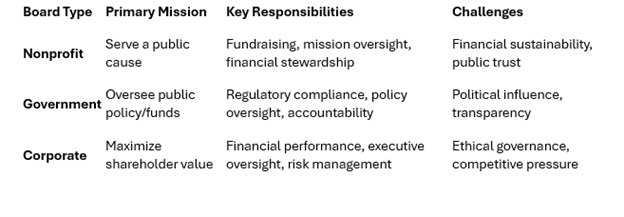
    Nonprofits exist to serve a cause, not to generate profit. Their boards are not accountable to shareholders; they are responsible to donors, grantors, and, most importantly, the communities they serve. That is a heavy responsibility, and it requires a special kind of leadership.

    Unlike corporate boards, where financial returns drive decision-making, nonprofit boards must ensure that every dollar is used effectively to advance the mission. They are responsible for strategic direction, financial stewardship, and supporting the organization’s leadership. In many cases, board members also engage directly in fundraising, advocacy, and community engagement to help secure resources and expand impact.

    Governing a nonprofit is complex. Financial sustainability is always a concern. Balancing short-term needs with long-term viability is a constant struggle, and in a world where one ethical misstep can erode public trust, transparency is everything. A single financial oversight or governance lapse can damage credibility and hinder fundraising efforts.

    Unlike in the corporate world, where revenue is generated through products or services, nonprofits often depend on the generosity of individuals, foundations, and grants. This means boards must be proactive in strengthening financial resilience by diversifying funding sources, building endowments, and ensuring responsible fiscal management. Furthermore, a strong nonprofit board fosters a culture of collaboration, where board members see themselves not just as overseers, but as active ambassadors for the organization’s mission.

    Government and Public Sector Boards: Navigating Policy and Accountability

    Public sector boards operate in a completely different landscape. These boards, whether overseeing higher education institutions, regulatory agencies, or municipal entities, exist to serve the public interest. Their authority often comes from legislative mandates, and their decisions can have wide-ranging impacts on communities, industries, and economies.

    Unlike nonprofit and corporate boards, government boards do not answer to a CEO or a set of stakeholders. They are accountable to the public. That means intense scrutiny, complex regulatory environments, and the challenge of political influence.

    One of the greatest challenges for board members is maintaining independence while operating within a political system. In many cases, board members are appointed by elected officials, such as a governor, which can create pressure to align with political agendas rather than focusing solely on the institution’s long-term needs. However, some boards, such as those governing community colleges and K-12 school districts, are elected by the public, providing a different form of accountability. Additionally, certain boards, such as faculty senates or private institutional boards, may have members who are elected by existing board members or internal stakeholders rather than the general public.

    Regulatory complexity adds another challenge. Laws and policies are constantly shifting, and boards must ensure that the institutions they govern remain compliant while still fulfilling their mission. At the same time, transparency is non-negotiable. Public trust depends on clear, honest communication and responsible financial management.

    Effective governance in the public sector also requires an understanding of bureaucratic processes, where decisions can be slowed by layers of policy and oversight. Strong government boards embrace data-driven decision-making and community engagement to ensure that policy initiatives reflect the actual needs of the people they serve. Additionally, the most effective public sector boards work to depoliticize their decision-making processes, focusing on long-term stability rather than short-term political gains.

    Corporate Boards: Balancing Profitability and Responsibility

    Corporate governance is about strategy, risk, and financial performance. While nonprofits and government boards focus on mission and public service, corporate boards exist to drive shareholder value. The best corporate boards understand that profitability and responsibility are not mutually exclusive. They go hand in hand.

    A corporate board’s primary role is to oversee executive leadership, particularly the CEO. They set strategic direction, ensure financial stability, and position the company for sustainable growth. Their decisions affect not just quarterly earnings but long-term viability.

    Ethical leadership is a major challenge. Scandals, governance failures, or unchecked executive power can destroy trust and erode financial performance. The best boards do not just react to problems, they anticipate them, addressing risks before they become crises.

    Corporate boards also deal with mergers and acquisitions, investor relations, and competitive positioning. Their job is not just oversight but active strategic guidance to keep the company ahead of the curve. Strong corporate governance requires a careful balance of financial discipline, ethical leadership, and long-term strategic thinking.

    One of the hallmarks of an exceptional corporate board is its ability to foster innovation while maintaining stability. This means supporting leadership in taking calculated risks, embracing new technologies, and ensuring the company remains agile in an evolving market. Additionally, corporate boards must recognize their broader role in society, balancing profit motives with social responsibility, environmental concerns, and ethical business practices to build lasting success.

    Stewardship vs. Strategy: Defining the Core Role of Each Board Type

    Over the years, I’ve worked with nonprofit and government boards. One of the biggest lessons I’ve learned is that while governance is universal, its focus varies significantly. At its heart, every board as a whole is responsible for stewardship, the duty to safeguard the mission, resources, and values of the organization. But what that stewardship looks like depends on the sector. Nonprofit boards act as stewards of mission, ensuring that every decision supports the organization’s purpose and community impact. Government boards are stewards of public trust, responsible for making sure institutions remain transparent, accountable, and policy-driven. Corporate boards serve as stewards of shareholder value, balancing financial performance with strategic growth.

    While stewardship is foundational, what sets boards apart is their approach to strategy. In the nonprofit world, strategy revolves around fulfilling the mission, sustaining financial health, and expanding impact. Government boards must think long-term while navigating political realities, regulatory shifts, and public expectations. Corporate boards, on the other hand, operate in a competitive environment, where strategy is about market position, profitability, and risk management. In my experience, the real contrast is how each board defines success. Nonprofits measure success by impact, government boards by accountability, and corporate boards by financial performance. Understanding these differences is key for any board member whether you’re leading, advising, or just stepping into governance for the first time.

    Why Representation and Perspective Matter on Boards

    One of the most significant factors influencing board effectiveness is the range of perspectives at the table. When a board is made up of individuals with different backgrounds, experiences, and professional expertise, better decisions follow.

    In the nonprofit world, ensuring that board members reflect the communities served leads to more inclusive programs and policies, increasing impact.

    In the public sector, incorporating multiple viewpoints into policy decisions reduces blind spots and strengthens public trust. A board that understands the diverse needs of the community it serves is more likely to make equitable and informed decisions.

    In corporate governance, having a wide range of expertise is not just about ethics. It is about results. Studies show that companies with leadership teams who bring different viewpoints to the table outperform those with more uniform perspectives. Varied experiences drive innovation, improve risk management, and make organizations more adaptable to change.

    Broad representation on boards is not just about fairness; it is about equipping leadership teams with the knowledge, strategic insight, and cultural awareness needed to lead effectively in an increasingly complex world.

    Comparing and Contrasting Board Governance

    Despite their differences, all boards share a common responsibility: to lead with integrity, think strategically, and ensure the long-term success of the organizations they govern.

    Summary

    Board governance, whether in the nonprofit, government, or corporate sector, is about leadership, accountability, and strategy. Nonprofit boards must balance mission fulfillment with financial sustainability, government boards navigate public policy and accountability, and corporate boards oversee profitability while maintaining ethical responsibility.

    Strong boards are defined by their ability to think long-term, anticipate challenges, and create a culture of transparency. The most effective boards embrace varied perspectives, ethical leadership, and forward-thinking strategy.

    If you are serving on a board or considering joining one, engage fully. Your leadership matters, and your decisions will shape the future of the organizations and communities you serve.

    A diverse mix of voices leads to better discussions, decisions, and outcomes for everyone. – Sundar Pichai

    —

    If your organization is ready to explore its preferred future using advanced futuring tools or seeks to enhance collaboration between its board of directors and CEO, Aman and Associates is here to support you. We specialize in facilitation for strategic futuring, AI-driven trend analysis, scenario planning, and executive coaching. Let us partner with you to align your vision with actionable strategies, ensuring your organization thrives in a rapidly changing world. Together, we can chart a course for sustainable success.

    Rick Aman, PhD

    208.850.6707

    rick@rickaman.com

    www.rickaman.com/articles

    16437

  • Leading the Future: Visionary Leadership in Community Colleges

    Leading the Future: Visionary Leadership in Community Colleges

    “In times of change, learners inherit the earth, while the learned find themselves beautifully equipped to deal with a world that no longer exists.” – Eric Hoffer

    In today’s rapidly evolving educational landscape, the role of a leader has never been more critical, particularly within community colleges. Visionary leaders do more than manage, they inspire, innovate, and guide their institutions toward a preferred future. By focusing on core elements of educational leadership, such as vision, communication, alignment, innovation, and resilience, these leaders can drive meaningful change that benefits students, staff, and the broader community.

    Community colleges, in particular, face unique challenges and opportunities. These institutions are at the forefront of providing affordable, accessible education, serving diverse student populations, and responding to the ever-changing technical demands of the workforce. Visionary leadership within this context is not just a desirable quality, it is essential for navigating the complexities of modern education and ensuring that these institutions can continue to fulfill their critical role in society.

    1. Visionary Leadership

    At the core of effective leadership is the ability to foresee and articulate a compelling vision for the future. Visionary leaders are not confined to the present; they look ahead, identifying opportunities and challenges that others may overlook. In the context of community colleges, this forward-thinking approach may be referred to as “futuring.” These two-year institutions are often the gateways to higher education, family wage jobs and workforce development, providing knowledge, essential academics, and life skills to students from diverse backgrounds.

    Traditional strategic planning typically starts by aligning with the organization’s mission, vision, and values. In contrast, futuring takes a different approach, beginning with college leadership envisioning and defining what is needed to achieve a “preferred future.”

    A characteristic of a visionary leader is the willingness to project into the upcoming needs of a region and articulate a preferred future from which to work backward. Futuring is a tool for a visionary leader and involves recognizing an ideal future for a college based on its regional needs. The leader can then guide the college toward fulfilling its mission in innovative and impactful ways. It’s about understanding the broader trends shaping higher education and positioning the institution to thrive in a changing environment. Visionary leaders are adept at recognizing shifts in technology, workforce needs, and societal expectations, and they use this awareness to steer their institutions in a planned direction. For community colleges, this often means balancing the pursuit of academic excellence with a commitment to accessibility, equity, and responsiveness to local economic conditions and workforce demands.

    Visionary leadership is also characterized by a willingness to take calculated risks. Leaders must be bold enough to pursue new opportunities and challenge the status quo, even when the path forward is uncertain. This kind of leadership requires courage, creativity, and a steadfast belief in the potential of the institution and its people.

    In the journey of organizational transformation, as highlighted by the core premise of The Great Upheaval by Arthur Levine and Scott Van Pelt, higher education is undergoing a significant transformation driven by profound societal, technological, and economic changes. The authors argue that the traditional model of higher education, which has remained largely unchanged for centuries, is being disrupted by factors such as technological advancements, shifts in the job market, changing demographics, and evolving expectations of students and employers. If Levine and Van Pelt are correct, visionary leaders within community colleges will be essential to shift into this new model of higher education.

    2. Articulation and Communication of Vision

    A vision, no matter how compelling, is only as powerful as its communication. A leader’s ability to clearly articulate a vision to all members of the organization, board members, faculty, staff, students, and stakeholders is critical. Effective communication ensures that everyone understands the direction in which the institution is headed and its role in achieving it.

    In a community college setting, leadership’s vision might center on transforming the institution into a hub for workforce development and lifelong learning. This vision can be communicated through technical advisory committees, public forums, planning sessions, and direct engagement with all levels of the college. These efforts ensure the vision is effectively conveyed to the community, fostering support and alignment among key stakeholders.

    Another aspect of communication is consistency of message. Visionary leaders ensure that their message is consistent across all platforms and interactions, reinforcing the vision and its importance. Consistency builds trust and credibility, which are essential for gaining buy-in from all stakeholders. Good leaders are adept at staying on message.

    3. Alignment and Shared Purpose

    One of the most significant challenges for any leader is aligning their team around a shared purpose. This requires more than just clear communication; it demands the ability to inspire and motivate others to see the value in the vision. A shared purpose creates a sense of belonging and commitment, driving engagement and motivation across the organization.

    In many community colleges, alignment is achieved by fostering a culture of innovation and collaboration. As teaching and learning organizations, faculty buy-in is essential. Faculty can be encouraged to develop new programs that meet local industry needs, supported by the necessary resources for success. By aligning the college’s programs with workforce demands, leadership ensures that everyone is working toward a common goal, reinforcing the institution’s shared purpose.

    Alignment also involves creating a supportive environment where everyone feels that their contributions are valued and that they are integral to the success of the institution. This means recognizing and celebrating achievements, providing opportunities for professional development, and creating spaces for collaboration and shared decision-making.

    Visionary leaders understand that alignment is not a one-time task, but an ongoing process. It requires continuous engagement, feedback, and adjustment to keep the team focused and united. This process is particularly important in community colleges, where the needs of students and the community can evolve rapidly. Leaders must be flexible and responsive, ensuring that the institution remains aligned with its mission and vision even as particular circumstances change.

    In addition, aligning teams around a shared future can help to overcome resistance to change. When people understand how their work contributes to the broader vision and feel connected to a common goal, they are more likely to embrace new initiatives and support efforts to innovate and improve.

    4. Innovation and Adaptation

    Innovation is a hallmark of visionary leadership. Leaders who are not content with the status quo continually seek new ways to improve and adapt their institutions. In the context of education, this might involve integrating new technologies, rethinking traditional teaching methods, innovative methods to deliver training or degrees to meet the needs of non-traditional students or developing new partnerships with local businesses and industries.

    In an era of rapid technological change and shifting workforce demands, the ability to innovate is more important than ever. Visionary leaders must be attuned to emerging trends and willing to experiment with new approaches to education. This might include exploring the potential of online learning, developing programs in high-demand fields like healthcare and technology, or creating flexible learning pathways that accommodate the needs of non-traditional students.

    Presently, one of the most interesting and controversial technology related subjects for discussion within higher ed is that of Artificial Intelligence (AI). Being new and emerging, it’s use within the teaching and learning realms as well as the operational and administrative functions has multiple facets. AI is certainly a provocative topic on most community college campuses. It will be important for visionary leaders to address this topic in a thoughtful manner.

    A community college embracing innovation might adopt a competency-based education model, allowing students to progress at their own pace while mastering the necessary skills. This approach not only better serves students but, also positions the college as a leader in workforce development. Innovation is not just a strategy it becomes a culture cultivated by leadership, ensuring the institution remains relevant and competitive in a rapidly changing world.

    However, innovation is not without its risks. Visionary leaders must be willing to take calculated risks, knowing that not every new idea will succeed. They must create an environment where failure is seen as an opportunity for learning and growth, rather than a setback. This kind of culture encourages creativity and experimentation, which are essential for driving innovation.

    Adaptation is also a critical component of innovation. As the external environment changes, visionary leaders must be able to pivot and adjust their strategies to stay ahead of the curve. This might involve reevaluating the institution’s priorities, reallocating resources, or exploring new opportunities for growth. Adaptability ensures that the institution can thrive even in the face of uncertainty and change. Resilience and adaptability are key. Visionary leaders must navigate these complexities, maintaining their focus on the future while managing the present.

    5. Challenges and Resilience in Leadership

    Finally, visionary leadership is not without its challenges. Maintaining momentum and enthusiasm for the vision, especially in the face of obstacles, is one of the most difficult aspects of leadership. Change often meets resistance, and not everyone will immediately buy into the vision.

    Leaders must remain resilient, keeping their teams focused and motivated even when progress is slow or difficult. Balancing the long-term vision with the day-to-day operations of the institution is another challenge that requires careful delegation and empowerment of others to take ownership of their roles.

    Resilience in leadership involves staying committed to the vision, even when faced with setbacks or opposition. It requires a deep belief in the mission and the ability to inspire others to stay the course, even in challenging times. Visionary leaders are those who can maintain their focus on the future while navigating the complexities of the present.

    Moreover, resilience involves a willingness to learn and grow as a leader. Visionary leaders are constantly seeking feedback, reflecting on their experiences, show a willingness to compromise, and look for ways to hone their leadership skills. This commitment to personal growth not only enhances their effectiveness as leaders, but also sets a powerful example for others to follow.

    Summary:

    The power of visionary leadership lies in the ability to see beyond the present, to inspire and align others around a shared purpose, and to drive innovation and adaptation in response to change. For community colleges, a hallmark is adaptability and service to our students. This type of visionary leadership is essential for not only surviving, but thriving in today’s educational landscape.

    Visionary leadership is not just about having a dream for the future, it is about turning that dream into reality through planning, effective communication, and commitment to mission. Community colleges, with their unique position in the education landscape require leaders who can navigate the challenges of today while preparing for the opportunities of tomorrow. By understanding, embracing and implementing five key leadership themes of: visionary leadership, communication, shared purpose, innovation/adaptation, and resilience — visionary leaders could transform their institutions. Transformation which can create lasting impacts for their students and communities. The future belongs to those who can envision it and are bold enough to lead the way. The journey may be complex, but with visionary leadership, the possibilities are endless, and the impact is profound.

    “A leader’s job is to look into the future and see the organization not as it is, but as it should be.” – Jack Welch

    ———————————–

    If your organization is ready to explore its preferred future using advanced futuring tools or seeks to enhance collaboration between its board of directors and CEO, Aman and Associates is here to support you. We specialize in facilitation for strategic futuring, AI-driven trend analysis, scenario planning, and executive coaching. Let us partner with you to align your vision with actionable strategies, ensuring your organization thrives in a rapidly changing world. Together, we can chart a course for sustainable success.

    Rick Aman, PhD
    208.850.6707
    rick@rickaman.com
    www.rickaman.com/articles

  • The Art of Board Governance: Building a Foundation for Organizational Success

    The Art of Board Governance: Building a Foundation for Organizational Success

    If you want to go fast, go alone. If you want to go far, go together. – African Proverb

    Introduction

    Strong governance is the cornerstone of institutional success. Having served as a community college president, I have witnessed firsthand how an effective board can either propel an institution forward or hinder its progress. I have benefited from insightful guidance from diverse trustees and have worked with a board that provided stability during difficult, sometimes unpopular decisions. Governing boards are not just oversight bodies; they shape strategy, ensure accountability, guide the CEO, and align with the institution’s mission. Their decisions carry lasting consequences for students, faculty, and the community at large. This article explores the essential functions of governing boards—whether elected or appointed, public or for-profit. While the structure and selection of board members may vary, their core responsibilities remain remarkably consistent.

    The Role of the Governing Board

    The governing board is responsible for safeguarding an organization’s mission, vision, and financial health. Various types of boards exist, each serving distinct functions across nonprofit organizations, corporations, educational institutions, and government agencies. Boards may represent regional constituents, corporate shareholders, legislative oversight bodies, or nonprofit stakeholders, and each group carries its own set of priorities and governance structures.

    A high-functioning board does more than approve budgets and policies; it ensures that the organization stays aligned with its strategic objectives. In corporate settings, boards provide strategic direction, uphold fiduciary responsibilities, and protect shareholder interests. Nonprofit boards focus on fundraising, program oversight, and advancing the organization’s mission. Educational boards, such as those governing community colleges or universities, play a critical role in ensuring student success, institutional development, and accreditation compliance.

    Effective governance requires a deliberate balance of strategic planning, oversight, and executive support. Regardless of the type of board, members must avoid micromanaging daily operations and instead focus on high-level governance. This means trusting executive leadership to handle operations while ensuring accountability through clear policies, long-term planning, and performance evaluations. Strong boards operate with integrity, foresight, and a commitment to the organization they serve, ensuring sustained success and adaptability.

    A board’s fiduciary duty extends beyond financial oversight to encompass ethical leadership and a commitment to long-term sustainability. Board members must act in the best interests of the organization, making informed decisions that foster institutional effectiveness and future-readiness. The most effective boards are proactive rather than reactive, anticipating challenges and positioning their institutions for long-term growth. Without this forward-thinking approach, organizations risk stagnation, missing key opportunities, and struggling to adapt to an evolving landscape.

    Core Functions of Board Governance

    Strategic Planning and Vision

    One of the primary responsibilities of a governing board is to define the organization’s strategic direction. This requires ongoing dialogue about the institution’s future and a willingness to adapt to remain relevant.

    For example, during my tenure as a community college president, our board played a pivotal role in deciding to construct a much needed energy, innovation and technology building on campus. Their involvement went beyond simply approving the project; they engaged with students, local employers, elected officials, and community stakeholders to ensure the facility addressed real workforce and academic needs. They also played a key role in securing funding sources, advocating for the project at state and local levels, and articulating the long-term value of the facility to the broader community. Ultimately, their ability to see the bigger picture and align the initiative with future workforce demands ensured the college remained adaptable in the face of economic and demographic shifts.

    Effective boards do more than approve strategic plans; they contribute meaningfully to their development, ensuring leadership decisions align with long-term goals. This engagement involves setting measurable milestones, assessing progress regularly, and adjusting strategies as needed. Over time, our institution refined its approach by integrating futuring techniques which are forward-thinking methodologies into their planning process, moving beyond traditional strategic planning models to anticipate and proactively shape the future of education in our region.

    Accountability and Oversight

    Boards are responsible for ensuring financial sustainability, risk management, and regulatory compliance. To do this effectively, they must ask the right questions: Are we allocating resources effectively? Are we anticipating and managing risks? Are we compliant with federal and state regulations? Are we fiscally sustainable?

    Additionally, boards must evaluate executive leadership performance. A high-performing board doesn’t just hire a CEO and step away—it actively provides guidance, sets clear expectations, and ensures accountability. Regular performance reviews help ensure leadership remains aligned with institutional goals and community expectations. Beyond financial oversight, boards should take a long-term view, balancing short-term financial decisions with a commitment to future viability.

    Mission Fulfillment and Stakeholder Trust

    A governing board’s primary charge is to ensure that every decision, policy, and initiative advances the institution’s mission. Without a clear and unwavering commitment to mission fulfillment, organizations risk drifting into short-term decisions that may ultimately erode their foundational purpose.

    Every successful organization I have encountered can confidently answer the essential question: Why do we exist? This clarity of purpose guides effective governance, ensuring that leadership remains mission-driven rather than simply reactive to external pressures or fleeting opportunities.

    To uphold stakeholder trust, boards must embed mission fulfillment into their strategic decision-making process. This means continuously evaluating whether institutional strategies, financial priorities, and policy frameworks truly contribute to the organization’s long-term impact. Governance should measure success not just through financial health or enrollment numbers but through real-world impact how well the institution serves its students, community, and stakeholders.

    During my presidency, our board prioritized community, student, and employer engagement through open trustee meetings, civic engagement, and advisory committees. These forums provided invaluable insights that informed our decision-making and ensured our strategic priorities remained responsive to the evolving needs of our communities. By actively listening and adapting, the board strengthened trust and built lasting institutional resilience.

    Best Practices for High-Impact Governance

    Board Composition & Diversity

    A high-functioning board reflects a mix of expertise, backgrounds, and perspectives. Having board members with diverse professional experiences such as finance, education, business, and public service enhances decision-making. Additionally, diversity in gender, race, and age ensures a broader range of viewpoints, leading to more informed governance.

    Regular evaluation of board effectiveness and succession planning is essential. Institutions may actively recruit individuals who bring the skills and perspectives needed for the challenges ahead. Board continuity is complex when board members are elected, but in appointed boards, the concept of leadership continuity is valuable. An effective succession plan ensures continuity of leadership and prevents disruptions in governance. Additionally, periodic board self-assessments allow institutions to identify gaps in expertise and areas for improvement.

    Clear Governance Policies & Structure

    Well-defined roles, responsibilities, and term limits enhance accountability and prevent governance drift. Without clear policies, boards risk becoming ineffective or exceeding their authority. Organizing the board into specialized committees such as finance, audit, strategy, or technology enables focused discussions and strengthens oversight. Additionally, maintaining strong relationships with legal counsel and human resources professionals is essential for ensuring compliance, supporting ethical governance, and mitigating the risk of unintended legal or personnel consequences.

    One mistake I have seen boards make is engaging in operational management rather than governance. A strong board empowers the CEO to lead while maintaining clear oversight. This distinction must be reinforced through structured governance practices and ongoing board training. Well-defined governance policies that are regularly reviewed create consistency in decision-making and prevent conflicts of interest. Furthermore, ensuring adherence to ethical standards builds public trust and reinforces institutional credibility.

    Stakeholder Communication & Transparency

    Effective governance requires open communication and transparency with key stakeholders, in the case of educational institutions these can include faculty, staff, students, employers and the broader community. A well-informed board fosters trust and credibility by ensuring that institutional decisions align with stakeholder needs and expectations.

    Regular updates, public board meetings, and clear reporting on institutional priorities, finances, and strategic goals enhance accountability. Additionally, soliciting stakeholder input through advisory councils, town halls, or surveys can strengthen decision-making and reinforce the institution’s commitment to openness.

    Boards that actively engage with stakeholders not only maintain public confidence but also ensure that their governance aligns with the institution’s mission and long-term sustainability.

    Continuous Learning & Engagement

    Board service is not static. The best boards commit to ongoing education on governance best practices, industry trends, and institutional challenges. Regular retreats, professional development opportunities, and strategic discussions keep boards proactive rather than reactive.

    From my experience, the most effective boards held annual retreats to assess their performance and refine their strategies. These sessions allowed board members to realign their efforts and recommit to the institution’s mission. Board development is crucial for members to stay informed about evolving governance practices and emerging challenges. Boards that prioritize continuous learning are better prepared to navigate change and lead with confidence.

    Conclusion: Building a Resilient and Forward-Thinking Board

    Good governance is the art of putting wise thought into prudent action in a way that advances the well-being of those we serve. — Diane Kalen-Sukra

    Institutions thrive when their governing boards are engaged, well-informed, and mission-oriented. High-impact boards foster institutional success through strategic leadership, collaboration, and a commitment to continuous improvement. Effective governance is not a static responsibility, but an ongoing dedication to ethical oversight, adaptability, and long-term vision.

    A well-functioning board acts as a driving force for resilience and innovation. By embracing these best practices, boards do more than make decisions, they shape the future. When leaders govern with clarity, accountability, and stakeholder engagement, they ensure their organizations remain sustainable, relevant, and equipped to navigate toward a preferred future.

    ————

    If your organization is ready to explore its preferred future using advanced futuring tools or seeks to enhance collaboration between its board of directors and CEO, Aman and Associates is here to support you. We specialize in facilitation for strategic futuring, AI-driven trend analysis, scenario planning, and executive coaching. Let us partner with you to align your vision with actionable strategies, ensuring your organization thrives in a rapidly changing world. Together, we can chart a course for sustainable success.

    Rick Aman, PhD
    208.850.6707
    rick@rickaman.com
    www.rickaman.com/articles

    15850

  • Anticipating Disruption: Leveraging AI and 9 Technologies to Prepare for the Unknown Future of Education

    Anticipating Disruption: Leveraging AI and 9 Technologies to Prepare for the Unknown Future of Education

    In The Great Upheaval, Levine and Van Pelt argue that higher education is facing its most profound transformation since the Industrial Revolution. As society transitions into a new digital environment, higher education must evolve to meet the demands of this rapidly changing landscape. Predictions about the future of higher education fall into two broad categories: the “adaptive” and the “disruptive” approaches. The adaptive approach suggests that the traditional campus-based university model will endure, gradually evolving to integrate new methods and technologies. Advocates of this view believe that, while higher education will change, it will maintain its core structure, adapting incrementally to the new demands of students, employers, and society.

    The disruptive approach calls for a radical transformation, suggesting that the traditional higher education model is no longer sustainable in its current form. Levine and Van Pelt define “higher education” as the traditional, campus-based learning experience, whereas “postsecondary education” encompasses a much broader landscape. This includes not only traditional universities but also a growing array of alternative institutions—both for-profit and non-profit—that are breaking away from conventional practices. These alternatives prioritize flexibility, digital technologies, affordability, competency-based education, and industry-recognized certifications, offering students varied pathways to success.

    Colleges may not have the luxury and funding to take a leisurely track into the adaptive model of change. As colleges and universities look to shape their preferred future, they must consider a range of factors that influence their trajectory. Central to this future is the role of artificial intelligence (AI) and nine other transformative technologies. It is important to note that these nine technologies are just examples of the many that could potentially enhance teaching and learning processes. Together, these nine are reshaping the educational landscape, offering unprecedented opportunities to enhance learning, streamline operations, and meet the evolving needs of the workforce. By embracing these advancements, institutions can anticipate and navigate disruptions, ensuring they remain relevant and effective in preparing students for the demands of the future economy.

    This article delves into how AI, combined with nine other key technologies, is driving this fundamental shift in education. It provides insights into how colleges can leverage these tools not just to adapt to change but to lead it, creating an educational environment that is agile, student-centered, and aligned with the emerging realities of the global workforce. Through strategic adoption of these technologies, higher education can move beyond survival and position itself at the forefront of innovation, crafting a preferred future that empowers students and society alike.

    The Role of AI in Shaping the Future of Education

    Artificial Intelligence is not just another technological trend; it represents a fundamental shift in how we understand and deliver education. AI’s capabilities extend far beyond simple automation. Its real potential lies in its ability to personalize learning experiences, analyze vast amounts of data for insights, and predict future trends.

    AI and Personalized Learning Experiences

    AI-powered platforms are revolutionizing personalized learning by adapting educational content to meet individual student needs. Traditional classroom settings often employ a one-size-fits-all approach, where all students follow the same curriculum at the same pace. AI challenges this paradigm by enabling adaptive learning systems that adjust to each student’s learning style, pace, and knowledge level.

    Using AI for Predictive and Learning Analytics

    AI’s role in predictive analytics is crucial for anticipating disruptions in education. By analyzing data on student performance, enrollment patterns, and industry trends, AI can help institutions make informed decisions about curriculum design, student support services, and resource allocation. For example, learning analytics can identify students at risk of dropping out by analyzing their engagement levels, participation in coursework, and performance metrics. Early intervention strategies can then be implemented to support these students, improving retention rates and overall educational success.

    AI can also predict future skill demands by analyzing job market trends and industry developments. Institutions can leverage this information to develop programs and courses that align with the evolving needs of the workforce. This proactive approach ensures that students graduate with relevant skills, making them more employable in a rapidly changing job market.

    Beyond AI: Nine Technologies Shaping the Future of Education and Workforce Training

    While AI is a driving force, it is part of a broader ecosystem of technologies transforming education. Here are nine other technologies that may shape the delivery of college education and workforce training over the next five years:

    1. Virtual Reality (VR) and Augmented Reality (AR)

    VR and AR are immersive technologies that create realistic simulations, allowing students to practice skills in a controlled environment. In fields such as healthcare, engineering, and technical education, these technologies enable hands-on training without the need for physical resources. For example, medical students can use VR to simulate surgeries, gaining valuable experience without risking patient safety. AR, on the other hand, enhances the real-world environment by overlaying digital information, providing interactive learning experiences. In technical fields, AR can guide students through complex processes by displaying real-time instructions and visual cues. This immersive learning approach enhances understanding, retention, and skill mastery, preparing students for real-world challenges.

    2. Learning Analytics

    Learning analytics involve the use of data to gain insights into student learning behaviors, performance, and outcomes. By leveraging data and AI, institutions can assess skill gaps, predict academic success, and identify at-risk students. Learning analytics provide educators with actionable insights that can be used to tailor instruction, develop targeted interventions, and improve overall learning outcomes. To illustrate, an analysis of student engagement data in online courses can reveal patterns indicating which students are likely to struggle. In response, educators can provide additional support, such as personalized tutoring or supplementary resources, to help these students succeed. Moreover, learning analytics can inform curriculum design, ensuring that courses remain relevant and aligned with industry needs.

    3. Blockchain Technology

    Blockchain technology offers a secure and tamper-proof method of tracking student credentials, certifications, and educational achievements. In the current education system, verifying credentials can be a cumbersome process, often involving manual verification and paper-based records. Blockchain simplifies this process by providing a decentralized ledger that securely records and verifies credentials. This technology not only benefits students by providing a permanent and easily accessible record of their achievements, but also helps employers verify qualifications efficiently. Furthermore, blockchain can facilitate the transfer of credits between institutions, supporting more flexible and modular approaches to education.

    4. 5G Connectivity

    The rollout of 5G networks will significantly enhance online learning experiences by providing faster and more reliable internet access. In remote and underserved areas where connectivity has been a barrier to education, 5G will enable seamless access to high-quality educational content. This increased connectivity will support data-intensive applications such as VR, AR, and live-streamed lectures, making advanced learning experiences more accessible to a broader audience. To illustrate, 5G, institutions can deliver interactive, real-time learning experiences, such as virtual labs and remote fieldwork simulations. This expanded access to high-speed internet will democratize education, allowing students from diverse backgrounds to participate in advanced learning opportunities.

    5. Internet of Things (IoT)

    The Internet of Things (IoT) refers to the network of interconnected devices that collect and exchange data. In education, IoT can create smart classrooms and connected learning environments that enhance engagement and interaction. To give you an example, IoT-enabled devices can monitor student engagement in real-time, providing educators with immediate feedback on student participation and comprehension. Connected labs and learning spaces equipped with IoT sensors can facilitate collaborative learning, where students can interact with digital content and physical objects simultaneously. This real-time feedback loop helps educators adapt their teaching strategies to meet the needs of individual students, creating a more dynamic and responsive learning environment.

    6. Gamification

    Gamification involves the integration of game elements, such as leaderboards, achievements, and challenges, into the learning process. By making learning more engaging and interactive, gamification helps keep students motivated and encourages mastery of skills. In workforce training, gamification can simulate real-world scenarios, allowing learners to practice problem-solving and decision-making in a risk-free environment. For example, a business management course might use gamified simulations to teach students about market dynamics, resource allocation, and strategic planning. By competing in a virtual marketplace, students can apply theoretical knowledge to practical situations, enhancing their understanding and preparing them for real-world challenges.

    7. AI-Powered Chatbots and Virtual Assistants

    AI-powered chatbots and virtual assistants are increasingly being used to automate administrative tasks and provide instant support to students. Chatbots can handle routine inquiries, such as answering questions about course schedules, application processes, and campus services, freeing up faculty and staff to focus on more personalized interactions. To illustrate, Virtual assistants can also support learning by providing reminders, suggesting resources, and offering personalized feedback on assignments. By acting as an always-available source of support, these AI-driven tools enhance the student experience and help institutions operate more efficiently. AI-powered chatbots can even employ the Socratic method of instruction—a teaching approach that engages students in dialogue by asking and answering questions to stimulate critical thinking and explore underlying concepts.

    8. Microlearning Platforms

    Microlearning platforms break down educational content into small, manageable modules, making it easier for students and workers to acquire new skills quickly. This approach is particularly valuable for lifelong learning and workforce adaptability, as it allows learners to focus on specific competencies without committing to lengthy courses. Specifically, a professional looking to learn data analysis can use a microlearning platform to complete short modules on specific topics, such as data visualization or statistical analysis. This flexibility enables learners to build skills incrementally, fitting education into their busy schedules.

    9. Adaptive Learning Systems

    Adaptive learning systems use AI and machine learning to tailor educational content to each student’s unique learning path. These systems continuously assess student performance and adjust the difficulty, pacing, and type of content to match individual needs. This personalized approach ensures that students receive the right level of challenge, promoting deeper learning and skill mastery. For instance, an adaptive learning platform for language learning can adjust vocabulary exercises based on a student’s progress, offering more complex sentences as their proficiency improves. This ongoing assessment and adjustment create a dynamic learning experience that supports optimal student outcomes.

    Preparing for the Unknown Future of Education

    The convergence of AI with these transformative technologies is driving a paradigm shift in education. Institutions that embrace these advancements will be better equipped to anticipate disruptions, adapt to changing demands, and prepare students for the future workforce. However, this requires a proactive and strategic approach, focusing on innovation, agility, and a willingness to rethink traditional educational models.

    Creating a Future-Ready Education Ecosystem

    To prepare for an uncertain future, institutions need to build a learning environment that promotes innovation and lifelong learning. Colleges of the future should prioritize leveraging faculty for the vital personal interactions and teaching methods that are unique to the educational experience. By utilizing some of the tools discussed in this article, colleges can collaborate with faculty to automate routine and repetitive tasks through technology. As colleges envision their preferred future, here are some options to consider:

    • Investing in Technology: Allocating resources to adopt and integrate AI, VR, AR, IoT, and other technologies into future educational best practices.

    • Developing Flexible Learning Pathways: Offering modular, competency-based programs that allow students to acquire skills in a flexible, personalized manner.

    • Focusing on Skill-Based Training: Aligning curricula with industry needs to ensure students graduate with relevant, in-demand skills. The classic example of this is internships and workplace learning opportunities.

    • Cultivating a Culture of Lifelong Learning: Encouraging continuous skill development to prepare students for a changing and uncertain job market. This is an area with critical skills (soft skills) are vital to a job ready graduate.

    Conclusion: Charting a Course Through the Future of Education

    The convergence of AI with these nine transformative technologies marks the dawn of a new era in education. This paradigm shift presents both an opportunity and a challenge for institutions striving to remain relevant in a world where the pace of technological and economic change shows no signs of slowing. As we navigate this uncertain future, it is clear that traditional educational models can no longer operate in isolation. Instead, they must evolve and integrate these technologies to anticipate disruptions, address the diverse needs of learners, and prepare students for the dynamic demands of the future workforce.

    To achieve this, institutions must adopt a proactive and strategic approach that places innovation, agility, and student-centered learning at the forefront. This means going beyond merely incorporating technology into existing structures. It involves a fundamental rethinking of how education is designed, delivered, and experienced. AI and the nine other transformative technologies VR, AR, learning analytics, blockchain, 5G, IoT, gamification, chatbots, microlearning, and adaptive learning systems offer the tools needed to build an educational ecosystem that is not just responsive to change but actively shapes it.

    Navigating this new terrain also requires a careful consideration of the ethical, social, and economic implications of these technologies. It requires close collaboration with faculty and instructional designers to ensure that the student-faculty relationship is preserved and not overshadowed by technology. Educational institutions must address challenges such as data privacy, digital equity, and the potential for technology to inadvertently widen existing disparities. A commitment to ethical implementation and inclusive access is essential to ensure that the benefits of this technological transformation are shared broadly and equitably.

    This article concludes my first element of this series: AI-Enhanced Futuring. Colleges need to “skate to where the puck will be” – Wayne Gretzky. These articles described how college leadership might predict the environment, trends and technologies into which their institution is headed.” The upcoming series of four articles will delve into the concept of “Strategic Visioning”, offering insights and guidance on how to identify and leverage the unique elements of your institutional mission (value proposition). This series will explore how college leadership can use a well-defined vision to navigate uncertainty, shape a preferred future, and ensure their institution remains relevant and resilient in a changing landscape.

    ————————

    If your organization is ready to explore its preferred future using advanced futuring tools or seeks to enhance collaboration between its board of directors and CEO, Aman and Associates is here to support you. We specialize in facilitation for strategic futuring, AI-driven trend analysis, scenario planning, and executive coaching. Let us partner with you to align your vision with actionable strategies, ensuring your organization thrives in a rapidly changing world. Together, we can chart a course for sustainable success.

    Rick Aman, PhD
    208.850.6707
    rick@rickaman.com
    www.rickaman.com/articles

  • Navigating Role Clarity: Governing Boards vs. Executive Leadership

    Navigating Role Clarity: Governing Boards vs. Executive Leadership

    “Good boards create clarity by setting the destination; great CEOs make the journey possible.” – Unknown

    When organizations progress toward their desired future, it is often due to the harmonious interplay between a visionary governing board and a capable CEO. Governing boards serve as the strategic compass, steering the organization toward its long-term goals, ensuring financial stability, establishing and revising policy, supporting and evaluating the CEO and safeguarding the mission. They are entrusted with big-picture responsibilities in the realm of accountability to their stakeholders. By focusing on governance, each board ensures the organization remains future-focused and aligned with its purpose, even as the landscape evolves.

    In contrast, the CEO drives the organization’s daily tactical operations, ensuring that short-term actions align with long-term strategic objectives provided by the governing board. While the board sets the destination, the CEO determines the best path to get there. The CEO and executive team are responsible for turning strategic vision into actionable plans, leading teams, managing resources, and making operational decisions that keep the organization running efficiently. Unlike the board’s governance-oriented role, the CEO is deeply involved in execution, addressing immediate challenges while adapting strategies to meet organizational goals.

    The interplay between these two roles is crucial. A governing board without a strong CEO may struggle to see its vision come to life, while a CEO without a clear and engaged board risks operating without a coherent direction. Understanding and respecting these distinct yet complementary roles is the foundation for effective collaboration and organizational success. Together, the board and CEO provide the leadership and execution needed to sustain and grow their organization into an uncertain future.

    Roles Defined: Governance vs. Management

    Governing boards and CEOs serve as the organizational backbone, but their responsibilities differ significantly. The governing board operates at a high level, focusing on strategy, oversight, and accountability representing their constituent group. Boards are stewards of the organization’s long-term vision, ensuring financial health and mission alignment. They shape policies, oversee resource allocation, and provide a strategic framework that guides the organization into the future and supervise one employee.

    CEOs, on the other hand, are responsible for the day-to-day execution of the board’s vision. CEOs manage operations, supervise and lead the full staff, and act as the bridge between the board and the organization’s stakeholders. The CEO translates the board’s strategic goals into actionable plans, aligning teams and resources to achieve success. They provide regular updates and status reports to the governing board normally through the board chair.  

    At its core, the distinction lies in governance versus management. The board provides the vision, outlining the organization’s broader goals, while the CEO translates that vision into actionable steps, ensuring day-to-day efforts align with the long-term objectives, financial sustainability, and mission fulfillment. For example, the board might decide to expand services in underserved areas, and the CEO would execute this by recruiting talent, opening facilities, or securing partnerships. When these roles are clearly defined, the board and CEO can function as a cohesive team, each complementing the other’s strengths while maintaining focus on their distinct responsibilities.

    Common Role Clarity Challenges
    Despite their complementary roles, blurred boundaries between boards and CEOs can lead to inefficiencies and conflict. Below are three common challenges that arise from unclear role distinctions:

    1. Micromanagement by the Board
    Micromanagement occurs when boards delve too deeply into operational details, bypassing the CEO’s authority to engage directly with staff or make day-to-day decisions. This often stems from a lack of trust or a misunderstanding of the board’s responsibilities. Micromanagement can stifle innovation and undermine the CEO’s authority, creating confusion within the organization. For example, when board members attempt to direct specific program initiatives, talk with staff directly about program specifics, or critique operational decisions as individuals, it can disrupt the organization’s chain of command. These actions, even if well-intentioned, can leave the CEO feeling disempowered and staff uncertain about whom to follow. Clarifying operational boundaries and reinforcing trust in the CEO’s leadership is essential to prevent these issues.

    2. Board Disengagement
    On the other end of the spectrum, disengaged boards rubber-stamp decisions, fail to provide strategic input, or participate minimally in governance activities. There is a professional expectation that board members will be prepared for meetings and come ready to support both the board chair and CEO.
    Signs of disengagement include missing meetings, failing to review materials, or relying entirely on the CEO for organizational updates. This lack of involvement can lead to missed opportunities, weak accountability, and a diminished capacity to navigate challenges. Boards must prioritize active engagement, regular communication, and ongoing education about their roles to ensure they provide value and maintain oversight.

    3. CEO Overreach or Underperformance
    CEOs may also contribute to role confusion. Overreach occurs when CEOs bypass the board in general or the board chair on major decisions, such as signing contracts, changing policies, or setting strategic priorities without approval. This diminishes the board’s governance role and can lead to significant risks, including legal or financial repercussions.

    Conversely, underperformance arises when CEOs fail to execute the board’s vision effectively or neglect transparent communication. When the CEO does not deliver measurable results or keep the board informed, the entire organization suffers. Clear performance metrics, regular updates, and a collaborative relationship between the CEO and board chair can help address these issues and foster mutual accountability.

    The Key to Success: Role Clarity and Communication

    An approach to overcome these challenges lies in establishing role clarity and maintaining open communication between boards and CEOs. Below are strategies for fostering this clarity:

    1. Setting Expectations from the Start

    Clearly defined roles and responsibilities should be established during the onboarding of both board members and CEOs. Governance charters and board handbooks can outline these expectations, ensuring all parties understand their duties and boundaries. For instance, boards should focus on long-term vision, mission alignment, and financial oversight, while CEOs are responsible for operational management, staff leadership, and strategy execution. Setting these expectations early helps prevent misunderstandings and creates a solid foundation for collaboration.

    2. Clear Communication Channels

    Effective communication is the cornerstone of a strong board-CEO relationship. Establishing regular communication channels, such as scheduled reports, standing meetings, and informal check-ins, ensures that both parties stay aligned. Transparency is key. CEOs should provide the board with clear, concise updates on organizational performance, challenges, and progress toward strategic goals. Similarly, boards should communicate their expectations and provide constructive feedback to the CEO. In most board chair and CEO relationships the prime responsibility of the CEO is to ensure the chair is never surprised, especially when issues become public.

    3. The Importance of Boundaries

    Boundaries prevent role overlap and foster collaboration. Boards should refrain from intervening in day-to-day operations, while CEOs should avoid making strategic decisions without board input. Governance policies, like delegation frameworks, can delineate decision-making authority. For illustration, financial decisions over a certain threshold might require board approval, while smaller operational expenses remain under the CEO’s jurisdiction.

    Practical Strategies for Maintaining Balance

    Boards and CEO know that the hard work of collaboration lie at the center of overcoming these challenges. Success in mission fulfillment comes from establishing role clarity and maintaining open communication between boards and CEOs. Below are a couple strategies for fostering this clarity:

    1. Training and Education

    Ongoing training for board members on governance best practices and for CEOs on leadership development is essential for fostering mutual understanding and alignment. Workshops, webinars, and retreats offer valuable opportunities to clarify roles, align expectations, and strengthen relationships. Many institutions, non-profits, and government entities benefit from national organizations that support both governing boards and CEOs, offering resources such as hiring assistance during leadership transitions, professional development opportunities, and national conferences. These organizational conferences provide expert advice, guidance, and networking opportunities, equipping boards and CEOs to work together effectively while staying informed on emerging trends and best practices in governance and leadership.

    2. Performance Evaluations

    Structured evaluation processes for both the board and CEO ensure accountability and continuous improvement. Performance metrics should be clearly defined and tied to the organization’s strategic goals.

    For example, a CEO’s performance might be measured by enrollment growth, financial sustainability, or program outcomes, while a board’s effectiveness could be assessed by attendance, participation, and the quality of strategic input.

    3. Delegation Frameworks

    Delegation frameworks clarify decision-making authority, ensuring each party knows where their responsibilities begin and end. These frameworks can specify areas such as financial approvals, policy decisions, and operational autonomy.

    4. Clarity of Communications

    In many boards, both public and private, an agreement as to communication protocols is vital. At the highest level, an agreement of who publicly speaks for the organization to news media or for official reasons. It would be common that either the board chair or CEO have the primary responsibility to speak on behalf of the organization. This is where there is trust and alignment are critical between the board chair and CEO. Within most boards, individual members may have personal opinions, but only the board chair will speak on behalf of the board. Conversely, staff members will have personal opinions, but only the CEO will formally speak on behalf of the organization. Agreement between the CEO and board chair adding clarity as to when staff or board members should delegate tasks or communicate on operational topics.

    5. Collaborative Planning

    Annual board planning and organizational strategic planning are traditional and well understood. Joint planning Involving both the board and CEO in strategic planning ensures alignment and buy-in from both parties. Tools like dashboards and key performance indicators (KPIs) allow boards to track progress without overstepping into operations.

    6. Fostering Mutual Respect

    Ultimately, trust and respect are the foundation of an effective board-CEO relationship. Both parties should actively listen, provide constructive feedback, and work collaboratively to achieve the organization’s mission. Healthy organizations tend to have good working relationships between board chairs and CEOs. Trust is the key factor as well as transparency are essential.

    The Long-Term Benefits of Role Clarity

    When roles are clearly defined and communication is strong, organizations thrive. Clear boundaries enhance decision-making, foster stronger leadership, and ensure that both boards and CEOs remain focused on their respective responsibilities. Role clarity also builds resilience, enabling organizations to navigate challenges confidently. Additionally, effective governance inspires trust and collaboration throughout the organization, creating a positive and productive culture.

    Conclusion

    Navigating role clarity between boards and CEOs is essential for organizational success. When the roles of governance and execution are clearly defined, organizations are better equipped to maintain strategic focus, drive operational efficiency, and respond effectively to challenges. Boards serve as the strategic compass, guiding long-term vision and ensuring accountability, while CEOs translate that vision into actionable plans and oversee day-to-day operations.

    Establishing and maintaining role clarity requires deliberate effort, including well-documented policies, regular discussions about expectations, and consistent performance evaluations. Open communication between the board chair and CEO is vital to fostering trust, addressing potential conflicts, and ensuring alignment on priorities.

    By fostering mutual respect and understanding, boards and CEOs can establish a partnership that seamlessly integrates governance and execution. This collaboration creates a unified governance and leadership team that drives organizational success, supports adaptability, and ensures a persistent focus on achieving its mission.

    “Governance provides the framework for purpose, and leadership provides the engine to drive it forward.” – Rosabeth Moss Kanter

      ———-

    If your organization is ready to explore its preferred future using advanced futuring tools or seeks to enhance collaboration between its board of directors and CEO, Aman and Associates is here to support you. We specialize in facilitation for strategic futuring, AI-driven trend analysis, scenario planning, and executive coaching. Let us partner with you to align your vision with actionable strategies, ensuring your organization thrives in a rapidly changing world. Together, we can chart a course for sustainable success.

    Rick Aman, PhD
    208.850.6707
    rick@rickaman.com
    www.rickaman.com/articles