Author: Rick Aman

  • Ikigai – Finding Your Preferred Future

    Ikigai – Finding Your Preferred Future

    “The future depends on what you do today.” — Mahatma Gandhi

    Strategic plans often fail for reasons that have little to do with effort, intelligence, or commitment. Most organizations work hard. They gather data, hire consultants, hold retreats, and produce thoughtful plans. Yet many of those plans lose momentum within a year or two. Failure is rarely execution. It is far more often a loss of clarity. When an organization lacks a shared sense of identity and corresponding mission, even carefully articulated strategies become a list of aspirations rather than a living direction.

    This is where Ikigai for Organizations becomes an especially powerful tool. Throughout this series, I have described Ikigai as a way to clarify organizational identity and, at the governance level, protect mission. In this final article, I want to move Ikigai one step further. Ikigai is not only a lens for oversight or decision-making. When used well, it becomes the foundation for defining an organization’s preferred future.

    Why Preferred Futures Break Down Without Identity

    Many mission statements (preferred future) statements fail because they attempt to describe outcomes before clarifying identity. Leaders jump quickly to questions of scale, growth, innovation, and reputation without first anchoring who the organization is becoming. The result is a future that sounds attractive but lacks gravitational pull. It is easy to support in theory and difficult to sustain in practice.

    Without a shared center, futures become additive. New priorities are layered on top of old ones. Initiatives multiply, metrics proliferate, energy disperses. Over time, the organization becomes busy, well-intentioned, and unfocused. The future exists on paper, but the day-to-day work of the institution pulls in multiple directions.

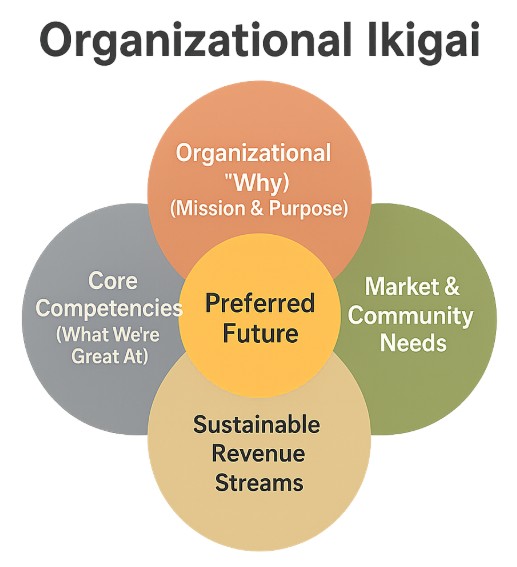
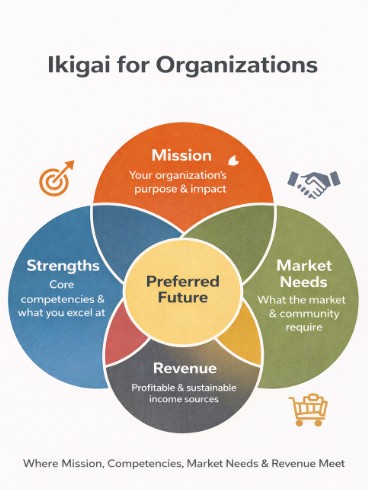
    Ikigai addresses this problem at its root. By clarifying what the organization is deeply committed to, what it does exceptionally well, what the community truly needs, and what can be sustained financially, Organizational Ikigai creates a coherent center. That center gives the future weight. It slows decision-making in productive ways making it more deliberate. It introduces discipline before ambition. Most importantly, it answers a foundational question that many planning processes skip: who are we becoming?

    You cannot design a preferred future without first clarifying identity. Futuring not grounded in identity tend to drift. Futuring grounded in Ikigai has a better chance to endure.

    Ikigai as the Anchor of the Preferred Future

    Organizational Ikigai should not sit alongside strategic planning as a parallel exercise. It belongs in the beginning and at the center. When placed there, it naturally shapes everything that follows. The preferred future statement becomes an expression of identity rather than a marketing narrative. Key initiatives emerge as commitments rather than hope. Measures begin to reflect direction rather than activity. Alignment across teams and budgets becomes easier because decisions reference a shared center instead of competing priorities.

    In practice, this shift changes the tone of leadership conversations. Instead of asking whether an initiative is innovative or timely, leaders ask whether it strengthens who the organization is becoming. Instead of debating tradeoffs in isolation, teams evaluate options through a consistent identity lens. Strategy becomes less about enforcement and more about coherence.

    One of the most important outcomes of placing Ikigai at the center is that alignment stops being a goal in itself. When identity is clear, people understand why certain priorities matter and others do not. Budgeting conversations become less adversarial. Tradeoffs become defensible. Leaders no longer need to rely on authority to drive alignment; the logic of identity does the work.

    From Identity to Direction: Stating the Preferred Future

    A preferred future is not a forecast. It is not a prediction of market conditions or enrollment trends. It is a declaration of intent grounded in identity. Ikigai ensures that this declaration is authentic, relevant, and sustainable.

    Authentic futures reflect who the organization truly is, not who it wishes it were. Relevant futures respond to real community needs rather than abstract trends. Sustainable futures acknowledge financial realities and institutional capacity. When these three conditions are present, the future becomes credible. Importantly, leadership, staff, and constituents can see themselves in it. They understand their role in bringing it to life.

    One of the most useful prompts I offer leadership teams is simple: if we grew into our Ikigai (preferred future), what would be unmistakably true three years from now? This question shifts the conversation from tactics to trajectory. It invites leaders to imagine the organization as a coherent whole rather than a collection of initiatives moving into an unknown future.

    From this clarity, key initiatives begin to narrow. Ikigai does not encourage doing more. It encourages doing less with greater intention. Initiatives become expressions of identity rather than reactions to trends. Fewer initiatives create clearer ownership and stronger outcomes. Energy is conserved rather than dissipated. Over my career I have seen strategic plans with fifty-plus individual items.

    Ikigai does not answer the question of what should we do next. It answers a more demanding question: what must we do to become who we say we are? According to the authors of The Great Upheaval, Levine and Van Pelt, that distinction changes everything.

    Measuring Progress Toward Identity

    Traditional metrics are necessary. They help leadership understand and operationalize performance, efficiency, and compliance. But they are insufficient when the goal is long-term direction. Ikigai-aligned organizations measure progress toward identity, not just activity and head count.

    This shift does not imply abandoning dashboards or data. It requires reframing what success looks like. Boards and CEOs begin to look for confidence in trajectory rather than perfection in execution. Measures emphasize depth over breadth, coherence beyond growth, and alignment over volume. For example, instead of tracking how many initiatives are underway, leaders ask whether the work is becoming more focused. Instead of celebrating growth alone, they examine whether growth reinforces identity. Instead of measuring activity across every domain, they pay attention to where the organization is becoming unmistakably strong and relevant.

    What gets measured signals what the organization truly values. When measures reflect Ikigai, they reinforce identity rather than distract from it.

    Closing Reflection: Choosing the Future from the Center

    “Efforts and courage are not enough without purpose and direction.” — John F. Kennedy

    Organizational Ikigai becomes the bridge between identity and a preferred future. It is not a slogan and not a planning tool in the narrow sense. It is a steady reference point that allows organizations to adapt without losing focus. In times of disruption, this matters more than optimization. Organizations that know who they are can change without panic. Those that do not will optimize themselves into irrelevance.

    Organizations do not drift into strong futures. They choose them, and the strongest choices are made from a clear center.

    Ikigai as the Bridge

    My articles over the past four weeks included:

    • Week 1: Why Ikigai matters now

    • Week 2: Organizational Ikigai

    • Week 3: Governance and identity

    • Week 4: Ikigai as the bridge from identity to a preferred future

    —–

    Aman & Associates works with governing boards and CEOs to clarify organizational Ikigai before strategy, plans, and initiatives are set. Building on the Organizational Ikigai frameworks explored in this series, we facilitate focused board and leadership sessions that strengthen decision quality, reduce mission drift, and support long-term sustainability. As a new year begins, a short board or leadership retreat can be a timely way to reconnect organizational identity with a preferred future. Aman & Associates offers a half-day Zoom session designed specifically for organizational Ikigai alignment. If this would be useful for your board or leadership team. Feel free to message me.

    Rick Aman, PhD Aman & Associates   

    rick@rickaman.com | rickaman.com/articles
     

  • Ikigai – Governing Board’s New Work: Mission and Identity

    Ikigai – Governing Board’s New Work: Mission and Identity

    Without a clear sense of identity, organizations drift toward whatever is easiest or most rewarded — Margaret J. Wheatley, Leadership and the New Science

    In working with governing boards, most mission drift does not happen because leaders lose sight of purpose. It happens because good intentions accumulate faster than clarity. New programs are added, partnerships are approved, initiatives stack up, and before long the organization is busy, well-meaning, and unfocused. The board is doing its job, but the institution’s identity has quietly blurred. This is where Ikigai becomes especially powerful at the governance level. Not as a feel-good exercise or a strategic retreat activity, but as a disciplined lens for decision-making. When used well, Ikigai helps boards protect institutional identity, prevent mission sprawl, and elevate the quality of boardroom conversations from operational review to generative leadership.

    Ikigai as a Board-Level Discipline

    Boards are uniquely positioned to steward identity. Unlike management, they are not responsible for day-to-day execution. That distance is a strength. It allows boards to ask questions that cut across programs, budgets, and structures and get to the deeper issue of who the organization is and is not meant to be.

    Ikigai provides a simple but demanding framework for this work. When applied at the board level, it asks trustees to continually test decisions against four framework realities: What the institution is deeply committed to, What it does exceptionally well, What the community truly needs, and What can be sustained financially over time.

    When these elements are aligned, identity is clear. When they drift apart, confusion follows. Used this way, Ikigai is not about inspiration. It is about discipline. It gives presidents and boards a shared language for saying yes, for saying no, and just as importantly, for saying not now.

    Preventing Mission Sprawl

    Mission sprawl is one of the most common challenges I see in higher education and nonprofit governance. It rarely shows up as a single bad decision. More often, it is the result of many reasonable decisions made without a consistent identity filter. A grant opportunity appears attractive. A partnership seems aligned with a neighboring institution. A new program promises growth. Each decision, evaluated on its own merits, makes sense. Taken together, they stretch leadership capacity, dilute focus, and strain resources.

    Ikigai helps boards slow this pattern down. It gives trustees permission to ask a different kind of question before approving something new: Does this strengthen who we are, or does it simply add activity? Does this sit at the center of our purpose, or at the edge of our capacity? Boards that adopt this posture begin to shift from expansion thinking to identity thinking. They stop measuring success by how much the organization is doing and start measuring it by how coherent the work has become.

    Clarifying What to Stop Doing

    One of the most difficult governance responsibilities is deciding what to stop. Boards in conjunction with presidents are often far more comfortable approving new initiatives than sunsetting existing ones. Yet clarity of identity requires subtraction as much as addition. Ikigai makes this conversation possible without turning it into a critique of effort or history. Programs and initiatives can be honored for the role they once played, while still being acknowledged as no longer central to the institution’s purpose. The question is not whether something was valuable. The question is whether it still belongs at the center of the mission today. When boards use the four frameworks of Ikigai as a reference point, stopping becomes a strategic act rather than a reactive one. It creates space. It reduces noise. And it signals to the organization that focus is a form of leadership, not a failure of imagination.

    Improving Generative Board Conversations

    Many boards spend much of their time in fiduciary and operational review. This is necessary work, but it is not sufficient. The most effective boards also engage in generative conversations, discussions that explore meaning, direction, and long-term implications.

    Ikigai naturally elevates board dialogue. It shifts conversations from reports to reflection. Instead of asking only whether a program is performing, boards begin to ask whether it belongs. Instead of focusing solely on metrics, trustees explore alignment. Instead of reacting to proposals, they frame them within a shared understanding of identity. I have seen boards become more confident, more engaged, and more strategic when they adopt this approach. Trustees stop feeling like passive reviewers and start acting as stewards of purpose. The quality of questions improves. The tone of meetings changes. And decisions gain coherence over time.

    Testing New Programs Through an Identity Lens

    When boards evaluate new programs through Ikigai, the conversation changes immediately. Rather than asking whether a program is innovative or marketable, trustees ask whether it fits. Does this program reflect what we do best, or does it pull us into unfamiliar territory without clear advantage? Does it meet a genuine community need, or simply follow a trend? Does it strengthen long-term sustainability, or create hidden dependencies? These questions do not slow innovation. They sharpen it. Programs that survive this level of scrutiny tend to be clearer, stronger, and better supported once launched.

    Evaluating Partnerships with Greater Clarity

    Partnerships can accelerate mission, but they can also blur identity if not carefully considered. Boards often approve partnerships based on opportunity rather than alignment. Ikigai offers a way to evaluate partnerships without defaulting to enthusiasm or fear. Trustees can ask whether a partnership amplifies the institution’s strengths or compensates for weaknesses in ways that create long-term risk. They can examine whether the partnership deepens community impact or distracts from core commitments. When boards use Ikigai in this way, partnerships become intentional extensions of identity rather than tactical arrangements.

    Framing Strategic Priorities

    Strategic planning often struggles because organizations confuse priorities with lists. Ikigai helps boards narrow focus by grounding priorities in purpose. Rather than asking what the institution should do next, boards begin by clarifying who the institution is becoming. Strategic priorities then emerge naturally as expressions of that identity. This approach reduces initiative overload and creates alignment across leadership, budgeting, and execution.

    Identity Matters More Than Optimization

    In times of disruption, organizations are often tempted to optimize. Improve efficiency. Streamline processes. Do more with less. These efforts matter, but they are secondary. What matters most in uncertainty is identity. Organizations that know who they are can adapt without losing coherence. Those that do not will optimize themselves into irrelevance. Ikigai helps boards anchor leadership in identity rather than activity. It provides a steady reference point when the environment is volatile. And it reminds trustees that their highest responsibility is not oversight alone, but stewardship of purpose.

    A Closing Reflection

    If you have more than three priorities, you don’t have any. — Jim Collins, Good to Great

    As you prepare for your next board meeting, consider this simple shift. Before approving something new, before debating metrics, before reviewing performance, pause and ask: Does this decision strengthen who we are? That single question, asked consistently, has the power to transform governance. Ikigai can be considered risk management for identity, a concept boards increasingly care about.

    —–

    Aman & Associates partners with governing boards and CEOs to protect organizational mission and identity before strategy and initiatives are set. Using an Ikigai-based framework, we facilitate focused board and leadership sessions that sharpen decision-making, reduce mission sprawl, and support long-term sustainability. As this year closes and another begins, a brief board or leadership retreat can be a timely moment to reaffirm institutional identity. Aman & Associates offers a short, half-day Zoom session designed specifically for organizational Ikigai alignment. If this approach would be helpful for your board or leadership team, DM me on LinkedIn to explore next steps.

    Rick Aman, PhD Aman & Associates   

    Futuring | Strategy | Board Development rick@rickaman.com | rickaman.com/articles
  • Ten S-Curves Shaping the Future of Community Colleges

    Ten S-Curves Shaping the Future of Community Colleges

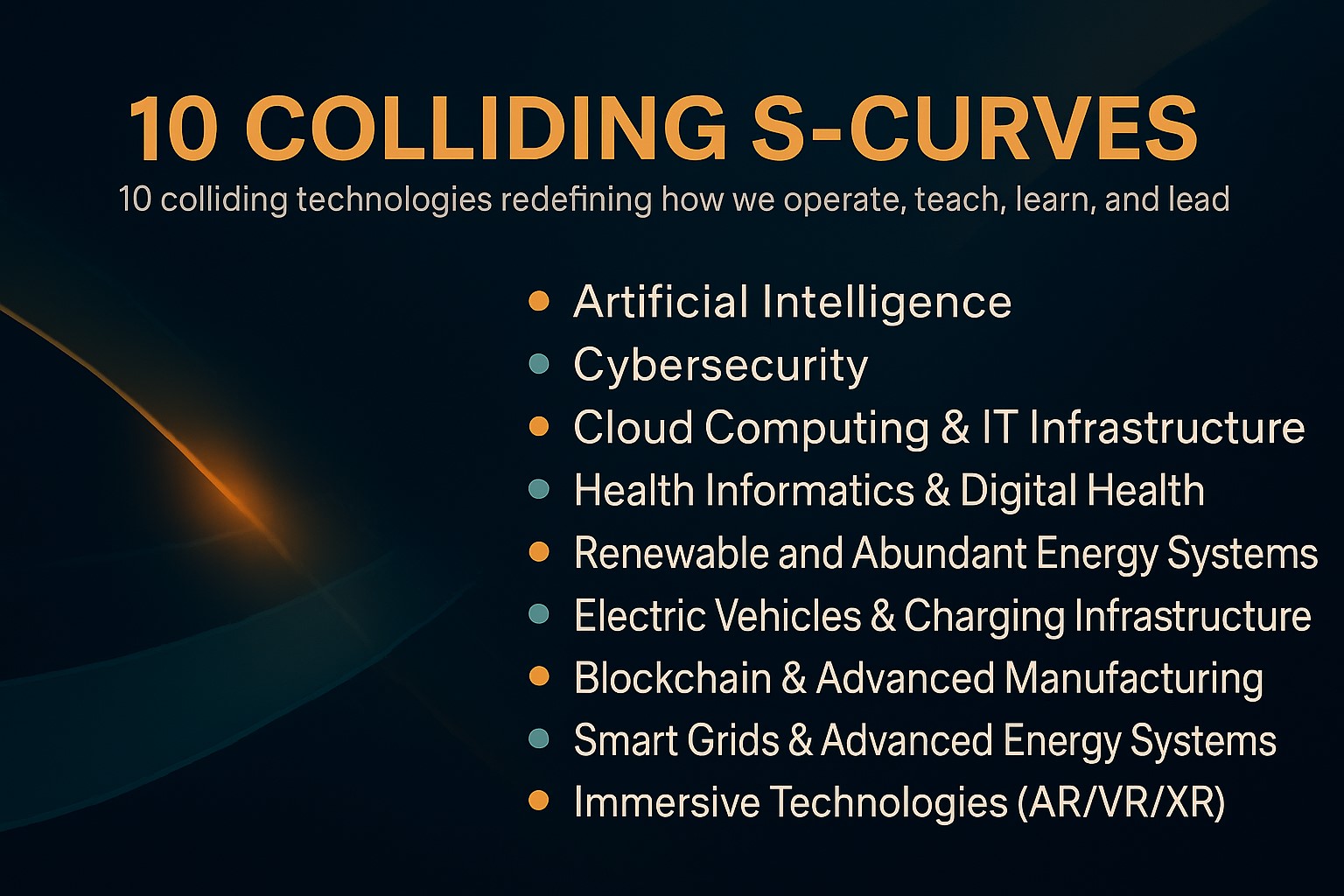
    Ten emerging technologies redefining how we operate, teach, learn, and lead

    The greatest danger in times of turbulence is not the turbulence; it is to act with yesterday’s logic — Peter Drucker

    Change in higher education no longer moves in straight lines. It advances in overlapping waves, each one gathering speed as another begins to slow. The hardest part of leadership isn’t managing a single disruption; it’s guiding an organization through the intersections where multiple forces collide. In my work with governing boards, I’ve seen how these moments test not only strategy but also trust where clarity, communication, and shared vision become the real measures of leadership.

    Today, those intersections are everywhere. Artificial intelligence, immersive learning, blockchain credentials, and cloud infrastructure are reshaping how colleges operate and how students prepare for work that doesn’t yet exist. Add to that the accelerating curves of renewable energy, advanced manufacturing, cybersecurity, and digital health, and the pace becomes exponential. The future isn’t arriving in sequence it’s arriving all at once.

    For community and technical colleges, this convergence defines a new strategic frontier. As Arthur Levine and Scott Van Pelt describe in The Great Upheaval, higher education is being reshaped by forces that challenge its very identity, who it serves, how it teaches, and what credentials mean. Relevance will depend not only on adapting to each S-curve but on seeing how they interact where one technology amplifies another, and where traditional models of teaching, funding, and credentialing begin to bend. Understanding these ten technology-driven S-curves is the first step toward shaping a preferred future rather than reacting to someone else’s.

    The Ten Technology S-Curves Shaping the Workforce and Society

    None of these technologies stand alone, they amplify one another. AI drives analytics: analytics depend on cloud infrastructure; broadband enables immersive learning; and cybersecurity underpins them all. These collisions create turbulence but also immense possibility.

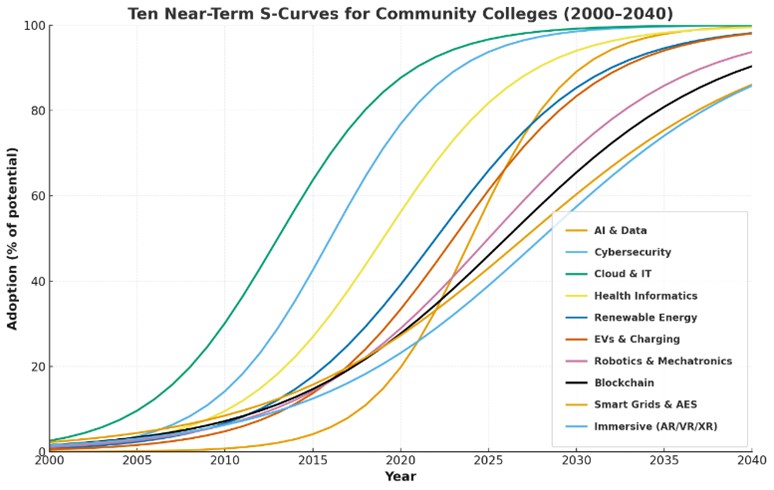
    During board retreats, I often illustrate this visually: layered S-curves rising and intersecting across time. Each curve represents a domain of change in teaching, infrastructure, workforce, or skills. The responsibility of leadership is not to ignore the curves but to recognize where they converge, that’s where strategy lives.

    1. Artificial Intelligence and Automation AI is redefining productivity and problem-solving across every sector, creating a world where continuous learning, adaptation, and ethical use of intelligent systems determine competitiveness.

    2. Cybersecurity and Digital Ethics As society becomes fully digital, safeguarding data and integrity has become a civic responsibility, anchoring public trust and protecting the infrastructure of modern life.

    3. Cloud and IT Infrastructure Global connectivity and distributed computing form the backbone of economic resilience, demanding leaders who can balance access, efficiency, and security at scale.

    4. Health Informatics and Digital Health Data-driven healthcare is transforming longevity and quality of life, requiring a workforce fluent in analytics, telemedicine, and ethical management of personal health data.

    5. Renewable and Abundant Energy Systems AI adoption is driving the need for vastly greater energy production. Clean-energy innovation and energy storage is reshaping geopolitics and economies, calling for technically skilled workers who can build and maintain resilient energy infrastructure.

    6. Electric Vehicles and Charging Infrastructure The shift to electrified mobility will redefine transportation networks, manufacturing, and urban planning creating millions of new technical and service roles.

    7. Blockchain Credentials and the Tokenization of the World Decentralized verification is building a new layer of digital trust, enabling individuals to own and exchange value, identity, and credentials securely across society.

    8. Robotics and Advanced Manufacturing
      Automation and collaboration between people and machines are reshaping industry; future roles will prize adaptability, oversight of automated systems, and digital craftsmanship.

    9. Data Analytics and Predictive Insights In every field, the ability to translate complex data into strategic foresight will guide smarter decisions, policies, and innovations across society.

    10. Immersive Technologies (Augmented and Virtual Reality) Immersive platforms are redefining how people learn, design, and connect, blending creativity and technology to shape experiences across education, commerce, and culture.

    Opportunity or Threat?

    Every S-curve carries both promise and peril. On the ascent, it offers innovation and growth; on the descent, obsolescence. Whether technology becomes opportunity or threat depends on how leaders engage it. Colleges that experiment thoughtfully gain early insight and workforce advantage. Those that wait for certainty often find themselves catching up at double the cost. Curiosity, not caution, is the competitive edge.

    The simple discipline I share with boards is the insight to review each technology through a SWOT (Strengths, Weaknesses, Opportunities, Threats) lens. What are our strengths in adoption? What weaknesses limit us? Which opportunities align with mission? What threats demand attention? The future rewards those who keep that conversation alive.

    The Board’s Role: Environmental Scanning and Sense-Making

    Governing boards are uniquely positioned to see these patterns first. Their distance from operations provides perspective, but only if it’s informed. That’s why environmental scanning is now a core competency of modern governance.

    A comprehensive scan looks across political, economic, social, technological, environmental, and legal trends (the PESTEL model). When coupled with institutional analytics, it becomes a strategic radar system detecting early signals that should shape budgets, partnerships, and academic focus.

    Boards should dedicate at least one annual session to technology foresight: Which emerging tools align with our mission? Which demand faculty development? Where can shared infrastructure reduce costs and increase access? Futuring is not prediction—it’s preparedness.

    Navigating the Intersections: A Leadership Framework

    To guide colleges through converging technologies without being overwhelmed:

    1. Identify the Forces. Map the emerging S-curves shaping your institution: AI, automation, robotics, blockchain and visualize how each influences mission and operations. Clarity builds shared understanding across leadership levels.

    2. Find the Intersections. Spot where these forces overlap—AI with analytics, broadband with workforce, secure systems, use of automation for efficiency, and design to reveal opportunities and tensions that demand attention.

    3. Assess Readiness and Define the Preferred Future. Evaluate where to lead, where to collaborate, and where to build capacity. Then describe what success looks like three to five years ahead if technology, mission, and workforce needs align.

    4. Align Resources to the Vision. Budgets, ethics, policies, and partnerships should follow the preferred future—not drive it. True innovation emerges when governance, strategy, and resources move in concert.

    Colleges that embed adaptability into their systems not just their programs will remain relevant regardless of how the next wave of disruption unfolds.

    Closing Reflection

    The challenge before community colleges isn’t mastering any single technology, it’s managing their intersections. Each innovation carries risk; together they define a moment of extraordinary possibility. Our task as leaders is to help boards, faculty, and communities see the full picture to connect the dots before they connect themselves. Futuring isn’t about forecasting gadgets; it’s about framing choices. When change arrives, it should find a college already in motion—aligned, adaptive, and anchored in purpose.

    —-

    At Aman and Associates, we help boards and executive teams navigate these converging S-curves through Futuring Retreats and Preferred Future Planning. If your college is ready to map its own technology landscape and identify the intersections that matter most, I’d welcome a conversation. Together, we can turn disruption into direction.

    Rick Aman, PhD Aman and Associates | rick@rickaman.com | rickaman.com/articles


  • Ikigai for Organizations: Why Purpose Must Precede Goals

    Ikigai for Organizations: Why Purpose Must Precede Goals

    Institutions that thrive will be those that clearly understand who they are and why they exist. — Arthur Levine (The Great Upheaval)

    As the calendar turns toward a new year, college and nonprofit leaders and their boards feel a familiar pressure. Trustees approve goals. Presidents finalize plans. Executive teams line up initiatives. There is a quiet urgency to be ready for what comes next. Yet activity is not the same as purpose, and goals are not mission.

    For generations, individuals have used Ikigai to align purpose, values, and daily work. The idea entered the modern conversation through Ikigai: The Japanese Secret to a Long and Happy Life by Héctor García and Francesc Miralles, whose work drew global attention to Okinawa and other Blue Zones where longevity is closely linked to clarity of purpose.

    That same concept has something important to say to institutions, especially at a time when mission drift and reactive strategy are common. Centering is the discipline of returning to why the organization exists before deciding what it will do next. Ikigai, often translated as “reason for being,” offers boards and CEOs a practical lens for this work. It reinforces the board’s role as steward of mission and values, and the CEO’s responsibility to translate that purpose into coherent strategy and culture. When leadership is centered, decisions become clearer, tradeoffs more intentional, and strategy more durable.

    What stands out in this research is not longevity alone, but clarity of purpose. Individuals with a clear sense of Ikigai wake up knowing why their lives matter. They make decisions from a grounded sense of meaning rather than reacting to every external pressure. Their lives are not free from complexity, but they remain aligned. Ikigai was never intended to be a productivity hack or a self-help trend. It is a discipline of alignment.

    Over time, I began to recognize something familiar in this idea. Institutions behave much like individuals. When they are centered, decisions feel coherent. When they are not, strategy becomes reactive, fragmented, and exhausting. This is especially true for community colleges navigating significant disruption.

    Why Centering Matters Before Goal Setting

    Most strategic plans do not fail because they are poorly written. They are ineffective because they start in the wrong place. They begin with goals instead of purpose. In my years as a community college president and now working with boards and CEOs, I have seen institutions work incredibly hard while slowly losing coherence. New initiatives launch. Metrics multiply. Committees stay busy. Yet beneath the activity is a persistent feeling that the organization is reacting rather than choosing a preferred future.

    This is not a leadership failure. It is an alignment problem.

    Community colleges are operating in an environment of constant pressure. Demographic shifts, workforce realignment, emergence of artificial intelligence,  technology acceleration, political scrutiny, and financial constraint are no longer episodic challenges; they are the context. In response, institutions often expand programs, pursue new funding sources, connect with legislators and chase opportunities as they arise. Each decision may make sense on its own. Collectively, they can pull the institution away from its core.

    Without a clear center, strategy becomes a list of responses instead of a set of choices. Ikigai offers a way to pause before planning. It does not replace strategic planning, budgeting, or accreditation processes. It precedes them. It asks leaders to clarify identity before direction.

    From Ikigai for Individuals to Ikigai for Institutions

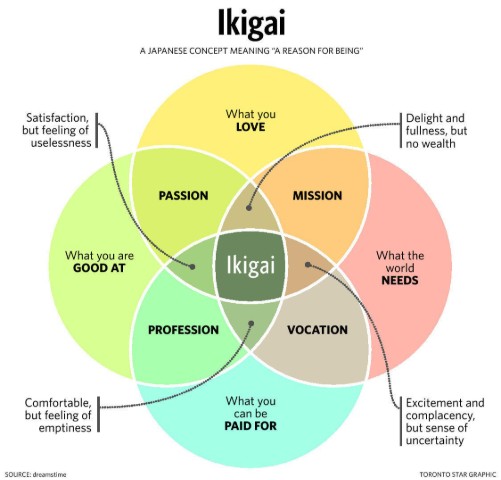
    At the individual level, Ikigai is often described through four intersecting questions:

    What do I love? What am I good at? What does the world need from me? What sustains me economically? 

    When these questions align, individuals experience clarity. When they do not, people feel stretched, unfocused, or disconnected from their work. The same dynamic exists inside institutions. Colleges and non-profits can drift into doing work they no longer love, offering programs they are not particularly strong at, misreading what their region truly needs, or relying on revenue models that quietly erode mission. None of this happens overnight. It happens gradually, often in response to well-intended decisions made without an anchoring framework.

    Ikigai translates naturally into an institutional context, especially for community colleges. When adapted thoughtfully, it provides a language for purpose that boards and presidents can hold together.

    Why Strategy So Often Misses the Mark

    I often ask presidents and trustees a deceptively simple question: “Why does your college exist today, not ten years ago?” An alternative question is: “What does your degree mean to the student, employers and the community?”

    The answers are thoughtful, but they are rarely crisp. Mission statements are recited. Values are referenced. Yet when we explore how those ideas shape actual decisions, gaps begin to appear. Goals are approved before identity is clarified. Initiatives are launched before alignment is tested. Strategy becomes additive rather than intentional.

    This is where Ikigai becomes useful, not as a model to diagram, but as a discipline to practice. Ikigai does not ask, “What should we do next year?” — It asks, “Who are we, and why does that matter now?” When that question is left unanswered, even strong leadership teams struggle to maintain focus.

    Boards and Presidents as Stewards of Purpose

    Ikigai resonates at the institutional level because it aligns naturally with the shared responsibility of boards and presidents. Presidents and CEOs lead the organization day to day. Boards govern with a longer horizon. Both are stewards of purpose. Boards, in particular, are positioned to hold the center. Their distance from operations is a strength. They are not meant to manage, but to ensure alignment between mission, strategy, and community need. Ikigai provides a language for that work.

    Instead of beginning conversations with goals, boards can ask whether the institution remains centered on why it exists. Presidents benefit from this clarity as well. When purpose is clear, leadership decisions become more principled. Trade-offs feel less personal. Saying no becomes easier.

    Four Questions Worth Considering at Year End

    At the institutional level, Ikigai translates into four questions that boards and executive teams should be willing to sit with before approving goals or launching new initiatives.

    What do we love? This is not sentimentality. It is about where the institution’s energy truly lives. Which students, programs, and outcomes draw genuine commitment? Where does the college show up at its best? What is the unique value your institution brings.

    What are we genuinely good at? Not what we aspire to be good at, and not what peers are doing. This question requires honesty about distinctive strengths. Institutions that try to be everything to everyone often dilute what they do best.

    What does our region need from us now? This grounds purpose in place. Workforce needs, access gaps, demographic change, and civic trust all matter. Ikigai keeps the institution outward-facing.

    What sustains us financially? Purpose without sustainability is fragile. This question is not about commercialization of mission, but about ensuring the institution can continue to serve over time without erosion or burnout. These questions are not meant to be answered quickly. When they are, it is usually a signal that deeper work remains.

    A Year-End Invitation

    Mid-December is a natural moment for reflection. Boards are approving budgets, presidents are setting direction, and leadership teams are preparing to move from planning to action. Before finalizing goals for the year ahead, this is an opportunity to step back and clarify the institution’s north star, its reason for being, not as inherited language or an aspirational slogan, but as a clear expression of purpose grounded in today’s realities, regional needs, and institutional strengths.

    Used this way, Ikigai becomes a centering discipline for organizations. It does not prescribe strategy; it creates alignment. That alignment allows boards to steward mission with confidence and enables CEOs to translate purpose into coherent strategy and culture. In the weeks ahead, I will explore how Ikigai’s four guiding questions can be applied practically in community colleges, how boards can use Ikigai as a governance lens, and how this framework directly informs a clearly articulated preferred future. Strategy follows purpose. It always has.

    —-

    This is the work I do through Aman & Associates. I partner with boards and executive teams to apply these four Ikigai principles to their unique organization, helping leaders center on mission, sharpen strategic clarity, and align future decisions around purpose. For institutions ready to do this work together, I offer a focused half-day Zoom retreat designed to translate Ikigai from concept into practical strategic insight and movement toward a preferred future. DM me with any questions.

    Rick Aman, PhD Aman & Associates   Futuring | Strategy | Board Development rick@rickaman.com | rickaman.com/articles
  • Ikigai for Organization: The Four Questions

    Ikigai for Organization: The Four Questions

    Strategy without purpose is motion. Purpose without discipline is sentiment. — Roger Martin, adapted from Playing to Win

    Ikigai has traditionally been used as a personal centering practice. It helps individuals clarify meaning, direction, and purpose in their lives. At its core, Ikigai answers a simple but profound question: Why do I do what I do? What is often overlooked is that colleges and nonprofit organizations need centering just as much as individuals do. Institutions drift when activity outpaces purpose. When applied at the organizational level, Ikigai becomes a disciplined way for boards and leadership teams to re-center on mission and clearly define their why before setting goals, approving initiatives, or reallocating resources.

    In higher education today, the pressure to act is relentless. Demographics are shifting. Workforce demands are evolving. Technology is accelerating. Funding is tightening. In response, colleges often layer initiative upon initiative, believing momentum itself will produce relevance. But motion without meaning rarely delivers impact. The institutions that remain strong are not simply those that move quickly, but those that remain centered.

    Ikigai offers a framework for that centering. Adapted for organizations, it invites boards and executives to examine four intersecting questions. None stand alone. Together, they form a powerful governance lens for clarity, alignment, and sustainability.

    What Do We Love to Do?

    Mission energy versus mission drift

    This first question is not about sentimentality or tradition. It is about energy. In organizations, love shows up where commitment is sustained over time. It is visible in faculty engagement, staff pride, and student success. It is present where people believe the work matters.

    Mission drift often begins quietly. A new grant opportunity appears. A promising partnership emerges. A program is added to solve a short-term problem. Each decision may be reasonable on its own. Over time, however, the institution begins to feel stretched, fragmented, and fatigued. What once felt purposeful starts to feel heavy.

    Boards play a critical role here. Trustees are uniquely positioned to step back from daily operations and notice where mission energy is strong and where it has dissipated. Programs aligned with the heart of the mission tend to generate momentum naturally. Programs that have drifted often require constant explanation, emergency funding, or heroic effort to sustain.

    A useful board-level question is simple: Where do we see genuine energy, and where are we compensating for its absence? Protecting mission energy is not a soft governance issue. It is central to long-term effectiveness.

    What Are We Truly Good At?

    Distinctiveness, not aspiration

    This question is frequently misunderstood. Many institutions answer it by listing what they hope to be good at rather than what evidence shows they already do well. Being good at something requires proof. Completion rates. Job placement. Transfer success. Employer confidence. Community reputation. Distinctiveness emerges where performance is consistent and visible, not where ambition is loud.

    I often see boards and presidents tempted to approve initiatives designed to make their college resemble a peer institution across town or across the state. The risk is subtle but significant. When colleges imitate rather than differentiate, they dilute their identity and stretch resources thin. Aspiration replaces evidence, and focus erodes. Boards add real value when they insist on clarity. The question is not Could we do this? but Do we already demonstrate excellence here? Distinctiveness is an institutional asset. It deserves intentional protection.

    What Does Our Region Need From Us?

    Workforce, access, and regional  trust

    Colleges exist in relationship with place. Regional need is not static, and it extends well beyond workforce metrics alone. Yes, employers matter. Skills alignment matters. But so do access, affordability, and public trust. I often ask boards to imagine their community five years from now. What pressures will families face? Which industries will struggle to find talent? Where will opportunity gaps widen if no one intervenes?

    Listening is not optional governance work. It is essential. Boards that remain insulated from regional voices risk approving strategies that make sense internally but miss the moment externally. Employer roundtables, civic partnerships, K–12 relationships, and community conversations are all sources of insight trustees should value.

    A powerful test is this: If our college disappeared tomorrow, what would our region lose that could not be easily replaced? The answers often reveal the institution’s true role more clearly than any labor market dashboard.

    The counter narrative is also worth considering. Just because a large employer or community segment wants something, such as sports, that may not be core to where the college mission rests or in alignment with mission focus. Saying “not now” can be prudent in times of financial pressure.  

    What Sustains Us Financially?

    Financial sustainability without mission erosion

    Financial sustainability is not the same as chasing revenue. Sustainable funding models reinforce mission rather than distort it.

    In challenging environments, pressure builds to pursue any revenue that keeps the doors open. The danger is that short-term financial fixes can quietly pull institutions away from their core purpose. Programs launched solely for margin often struggle once initial enthusiasm fades.

    Boards must consistently ask whether a revenue source strengthens who the institution is becoming or simply delays a harder conversation. Sustainability is about durability over time. It requires alignment between mission, capacity, and funding. One helpful governance question is: If this revenue disappeared in three years, would we still be glad we built the program? If the answer is no, the institution may be trading identity for cash.

    The Intersection Is Where Strategy Lives

    None of these questions stand alone. Institutional Ikigai exists only at the intersection of all four.

    When a college does work it loves, does well, meets regional need, and is financially sustainable, momentum builds naturally. When one or more elements are missing, friction follows. Staff feel stretched. Students experience inconsistency. Boards sense confusion but struggle to name it.

    This intersection test gives boards a shared language. It allows trustees to move beyond subjective debates and ask disciplined, mission-centered questions. It also helps CEOs explain why certain initiatives should move forward while others should pause or end.

    I have seen this framework change trustee and president conversations. Instead of approving long lists of initiatives, boards begin asking which proposals truly belong at the center of the institution’s identity. Strategy becomes clearer because purpose is no longer assumed.

    Ikigai as a Governance Discipline

    Ikigai is not a replacement for strategic planning. It precedes it. It clarifies the why before leaders argue about the how.

    For boards, this framework is especially useful in retreats, strategic visioning, and CEO evaluation. It provides a consistent lens for decision-making across time, not just during planning cycles. When trustees and presidents share a common understanding of institutional Ikigai, alignment improves and execution accelerates.

    In uncertain times, colleges rarely suffer from a lack of activity. They suffer from a lack of centering. Ikigai offers a way back to purpose. Before asking what to build next, boards would be wise to pause and ask who they are and who they are becoming.

    —

    At Aman &  Associates, we work with presidents, executive teams, and governing boards to help institutions re center on purpose before strategy, structure, or initiatives are set. Using an Ikigai based approach, we facilitate focused leadership sessions that clarify mission, strengthen decision making, and support long term sustainability. As one year closes and another begins, a board or leadership retreat can be a timely moment for organizational centering. Aman and Associates offers a short half day Zoom session focused on Ikigai alignment for institutions. If this framework would be helpful for your organization, DM me on LinkedIn for more details.

    Rick Aman, PhD Aman & Associates   

    Futuring | Strategy | Board Development rick@rickaman.com | rickaman.com/articles
     

  • AI Arbitrage for Better Decisions: The Power of Early Pattern Recognition

    AI Arbitrage for Better Decisions: The Power of Early Pattern Recognition

    “You’ve got to think about big things while you’re doing small things, so that all the small things go in the right direction.” — Alvin Toffler

    Higher-education leaders are making decisions at a time when historical data no longer predicts what comes next. The rules are shifting faster than most institutions were designed to adapt. What AI offers presidents and trustees is not certainty, but earlier visibility. It helps us see pattern changes sooner, test assumptions with more confidence, and act with clarity while the future is still taking shape. Early adopters gain a timing advantage and in leadership, timing compounds.

    Drawing on my years leading complex institutions, I’ve learned that good leadership isn’t about perfect information. It’s about recognizing early signals and acting while uncertainty is still unfolding. When I work with boards and presidents today, the question I hear most often is, “How do we make the right decision when everything is changing?” AI can’t eliminate uncertainty, but it can reveal what’s forming inside it.

    Why Decision-Making Must Change

    Most institutional decisions rely heavily on the past; last year’s enrollment, last year’s budget, and workforce reports that lag real employer needs by years. Dashboards summarize where we’ve been, not where we’re heading.

    That backward-looking model no longer matches the world we operate in.

    • Disruption moves faster than our planning cycles.

    • Demographic cliffs are reshaping demand.

    • Staffing shortages challenge long-standing operational assumptions.

    • Workforce needs are shifting faster than curriculum processes can respond.

    • Public expectations for urgency and foresight continue to rise.

    AI shifts this dynamic. It can synthesize siloed data that no leadership team has the time or capacity to process manually. It can flag slipping FAFSA completions, surface early retention risk, detect pressure on academic programs, and highlight stress in the financial model long before a quarterly report shows it.

    Leaders are understandably uneasy about AI, especially around job disruption and the future of knowledge work. But in higher education, the risk isn’t moving too soon. It’s moving too late. The future is already here; it’s simply unevenly distributed. The advantage now belongs to institutions willing to learn early.

    Pattern Recognition Before Disruption Arrives

    One of AI’s most valuable contributions is its ability to detect early patterns while people are busy running the institution. It’s not about replacing judgment; it’s about ensuring leaders see what matters in time to respond.

    AI is already being used to spot enrollment shifts weeks before census, track emerging regional workforce skills, flag programs beginning to show signs of strain, surface weak signals in environmental scans, detect changes in FAFSA or retention patterns, and identify which partnerships or industry credentials are accelerating—or quietly stalling.

    Earlier in my career, we often discovered disruption only after it landed, an unexpected workforce surge or a demographic shift that seemed obvious in hindsight. AI-assisted pattern recognition changes that. Leaders move from reacting to anticipating. Instead of asking, “What just happened?” we begin asking, “What’s about to happen—and what do we do now?” That shift alone can reclaim months of leadership capacity.

    Scenario Testing and Risk Sensing Before Decisions Harden

    When uncertainty rises, leaders often slow down: gather more data, revisit the issue next semester, wait for clearer signals. AI helps flip that instinct.

    Presidents and boards can model scenarios quickly, such as:

    • What if funding drops by five percent?

    • What if state policy shifts from access to outcomes-based completion?

    • What if nursing seats expand by twenty percent—do we have faculty capacity?

    • What if regional employers pivot to EV technology faster than expected?

    Scenario modeling increases confidence in direction, strengthens board understanding of risk, and helps faculty connect planning to actual conditions rather than speculation.

    Proactive leaders don’t wait for clarity; they model it. AI enables teams to see the downstream effects of decisions while those decisions are still reversible.

    Better Governance, Faster Alignment

    Governing boards today face institutions operating in exponential change. That responsibility becomes harder when information arrives late, incomplete, or too complex to interpret quickly. AI supports stronger governance by elevating what matters: signal over noise, trends over snapshots, alignment over assumption. When boards and CEOs see the same emerging picture, trust strengthens and meetings shift from presentation to prioritization. Conversations become clearer and more actionable: “Here’s the trend we’re seeing. Here’s what it means. Here’s the move we recommend.”

    Those were the board conversations that drove real progress. AI doesn’t define strategy; it clears the fog so strategy can move with purpose.

    What Trustees and Executive Leadership Should Focus On Right Now

    Trustees don’t need to become AI experts. They do need to ensure the institution isn’t waiting for certainty that will never fully arrive.

    Good oversight starts with four questions:

    Clarity: Why are we doing this? Capacity: Do we have the readiness to execute responsibly? Impact: Will this meaningfully strengthen mission or student success? Ethics: Are transparency and fairness built into the work?

    If the answer is yes, it’s enough to begin. Start small. Learn together. Build confidence through use—not theory.

    Closing Reflection

    AI won’t make the hard decisions for us. It won’t replace judgment, mission, or values. But it will help leaders see risks and opportunities earlier and that matters.

    This three-week AI arbitrage framework comes down to: Week 1: Act before the window closes — Week 2: Build internal capacity—policy, operations, and learning and — Week 3: Use foresight to stay ahead of disruption.

    Across my presidency and now in consulting, one truth has remained constant: Institutions don’t thrive because they avoid change. They thrive because they meet change with clarity and anticipation.

    We can’t predict the future. But with AI, we can see it forming. And that changes how we lead.

    ——

    If your board or executive team is ready to use AI-assisted foresight to strengthen decision-making, I’d be glad to help. Aman & Associates offers customized leadership retreats, including a focused half-day session designed to help presidents, trustees, and executive teams align strategy, clarify priorities, and apply practical AI insights to real decisions. These retreats connect AI, mission, and governance in a way that is accessible, actionable, and tailored to your institution.

    If you’d like to explore a retreat or inquire about consulting support, DM me directly.

    Rick Aman, PhD Aman and Associates rick@rickaman.com | rickaman.com/articles

     

  • The Three Pillars of AI Arbitrage: A Framework for Higher Ed and Non-Profits

    The Three Pillars of AI Arbitrage: A Framework for Higher Ed and Non-Profits

    “Colleges and universities are being asked to operate in a world for which they were not designed.” — Arthur Levine & Scott Van Pelt, The Great Upheaval (2021)

    AI arbitrage is already reshaping higher education. In simple terms, arbitrage is the advantage gained when leaders act before others do. In the AI era, speed creates early benefit, but clarity, guardrails, and readiness determine whether that advantage lasts. Over the past year I’ve worked with boards, CEOs, and nonprofit leaders who all feel the same tension: we know AI is here, but we’re unclear about how to begin. My encouragement – Start where you can make real progress: establish clear expectations, reduce friction, and elevate teaching and learning. Those three priorities become the pillars of durable AI adoption.

    This week, I want to offer a practical framework leaders can use immediately, one that I’ve already seen improve operations, strengthen academic quality, and reduce anxiety across teams. Whether you’re leading a college, overseeing a nonprofit, or chairing a governing board, these three pillars create the structure needed to move from hesitation to confident action.

    1. Policy and Ethics — Setting the Guardrails for Trustworthy Innovation

    Every institution wants the benefits of AI, but very few want to learn those lessons the hard way. Policies are not meant to slow innovation; they create the confidence that allows innovation to flourish. In my consulting work, the most effective leaders establish clear expectations early. They aren’t writing long manuals; they give teams clarity on questions that matter: data handling, privacy, transparency, academic integrity, and comfort around experimentation.

    When these guardrails are in place, people stop guessing. Staff feel safer trying new tools, students understand expectations, faculty have a consistent baseline, and boards gain confidence that the institution is moving responsibly.

    Leverage – Institutions move faster when these elements are clear:

    • Privacy and Data Protection — Clear expectations for data handling, consent, and boundaries on model use.

    • Transparency and Disclosure — When and how AI involvement must be acknowledged.

    • Fairness and Bias Mitigation — Processes that identify bias and promote fair outcomes.

    • Academic Integrity — Expectations around originality, attribution, and use of AI in assignments.

    • Responsible Experimentation — Guidance for pilots, risk management, and alignment with mission and values.

    Outcome: A climate where innovation is supported, safe, and aligned with institutional purpose.

    2. Operational Efficiencies — Reclaiming Time, Reducing Friction, and Improving Service

    The first visible benefit of AI appears in operations. Every college and nonprofit has processes that drain time: email responses, scheduling, repetitive communication, routing documents, drafting HR language, preparing reports. These tasks consume hours  and AI can remove that friction immediately.

    I’ve seen admissions teams streamline intake workflows, advising departments use AI-generated triage responses, IT help-desks cut ticket backlogs, and presidents use AI to summarize complex reports and environmental scans. All of these small efficiencies add up to significant regained capacity.

    When teams spend less time on routine tasks, they have more time for service and problem-solving the work that actually strengthens student and community experience.

    Leverage – Where early adopters see the fastest gains:

    • Enrollment intake, admissions workflows, and document routing

    • Orientation, onboarding, and student communication flows

    • Advising triage, scheduling, and information support

    • Financial aid FAQs and status updates

    • Course scheduling and room optimization

    • IT help-desk ticketing and knowledge-base responses

    • Compliance reporting and policy lookups

    • HR onboarding, job descriptions, and routine correspondence

    • Institutional Research dashboards, summaries, and environmental scans

    • Grants writing and compliance support

    Outcome: Less friction, faster service, and more time for what matters – student success, staff support, and mission impact.

    3. Teaching, Learning, and Employability — Preparing Students and Faculty for an AI-Enabled Future

    “We need to prepare students for jobs that do not yet exist and technologies that have not yet been invented.” — Diana G. Oblinger, former President of EDUCAUSE, EDUCAUSE Review (2012)

    The core of higher education always lies in teaching and learning. AI is not replacing the human role; it’s changing what good teaching and learning look like. Faculty gain time. Students gain tools. Graduates gain employability advantage.

    Colleges are beginning to use AI to accelerate curriculum development, support more personalized learning, and equip students with the skills employers now demand. This is the pillar where AI arbitrage becomes mission-aligned: faculty teach better, students learn faster, and graduates leave more prepared for the world they are entering.

    For Faculty (Teaching) – AI improves instructional quality while freeing time for mentoring and engagement.

    • Rapid syllabus, assignment, and rubric creation

    • AI-generated case studies, examples, and simulations

    • Accessibility tools: captions, translation, alt text

    • Structured comments and grading assistance

    • Insights into learning patterns and performance

    • Workforce-aligned instructional materials

    Outcome: Faculty spend more time teaching and less time drafting documents and managing repetitive tasks.

    For Students (Learning) – AI supports mastery, not shortcuts. It offers personalized guidance, structured feedback, and accessible resources.

    • Ethical use guidelines for writing and research

    • Critical evaluation of AI output for accuracy

    • Personalized study plans and adaptive tutoring

    • Real-time feedback for writing, coding, and problem solving

    • Translation and reading simplification tools

    • Practice quizzes, flashcards, and concept review materials

    Outcome: Students gain deeper understanding, improved confidence, and stronger study habits.

    For the Workforce (Employability) – Employers expect AI fluency. Colleges that teach responsible use give their graduates a measurable advantage.

    • Workflow productivity using AI responsibly and transparently

    • Understanding ethical boundaries and data-handling expectations

    • AI-assisted research with proper validation and citation

    • Clear communication of AI-assisted work to supervisors

    • Mapping AI skills to local labor-market needs

    • Career exploration tied to emerging roles and skill clusters

    Outcome: Graduates become trusted, capable contributors, a competitive edge for both students and the institution.

    Pulling the Three Pillars Together

    When these three pillars work in concert; clear policy, streamlined operations, and strengthened academic quality the institution begins to move differently. Staff feel supported. Faculty gain time for teaching. Students see better learning environments. Boards become more confident. And CEOs can lead with clarity instead of reacting to uncertainty.

    AI arbitrage is not a high-tech strategy reserved for large universities. Community colleges, nonprofits, and mission-driven organizations can move quickly and responsibly. The advantage belongs to leaders who start early, learn openly, and align innovation with purpose.

    Closing Reflection

    Across my leadership roles, I’ve learned that institutions don’t thrive because they avoid change. They thrive because they face change with clarity and alignment. AI is no exception. Begin with guardrails. Reduce friction. Strengthen teaching and learning. Do these things well, and the institution gains momentum that compounds over time.

    —-

    If your board or leadership team is ready to explore practical steps toward AI readiness, I’d welcome a conversation. At Aman and Associates, I help organizations use AI-assisted futuring to create clarity, alignment, and purpose. Whether you’re beginning adoption, identifying opportunities, or shaping a preferred future, I’m ready to support that work.

    I also offer a half-day digital executive retreat for boards and senior leadership teams who want to understand AI arbitrage, reduce uncertainty, and align around early, practical steps. Feel free to DM me for ideas.

    Rick Aman, PhD

    Aman and Associates – rick@rickaman.com | rickaman.com/articles


  • The Window of AI Arbitrage

    The Window of AI Arbitrage

    Introducing AI Arbitrage and Why It Matters Now

    The greatest danger in times of turbulence is not the turbulence; it is to act with yesterday’s logic — Peter F. Drucker, “Managing in Turbulent Times”

    Arbitrage is a simple idea with powerful implications. In its most basic form, arbitrage describes a moment when something has not yet reached equilibrium. There is a temporary mismatch that creates opportunity for those who act before the system adjusts. A familiar example is airline ticketing: when seats first open for sale, early buyers get the best fares because they move before demand pushes the price up. The advantage fades as more people enter the market, and eventually the window closes. Timing creates the benefit.

    AI arbitrage works the same way. As artificial intelligence enters everyday use, there is a brief period when early adopters benefit from the gap between what the technology can already do and how slowly most organizations respond. During this opening, leaders who are willing to test and learn gain time, capacity, and insight well before others begin. Once adoption spreads, the early advantage shrinks. Eventually the opportunity narrows.

    This moment is especially relevant to higher education because the sector is historically slow to adopt new practices. Governance processes, committee structures, and accreditation cycles often guide the pace of change, while AI is advancing at a speed that outpaces old timelines. That creates a unique window for boards and CEOs with vision. Institutions willing to learn now will build capabilities that strengthen their mission and relevance. Those who wait may find themselves trying to catch up after the early advantage has passed.

    With AI arbitrage, the question is not whether this technology has potential, it does. The real question is whether leaders will use this early period to reduce friction, expand capacity, and shape the future before the window begins to close.

    A Moment When the Rules Shift

    Every so often, leaders encounter a moment when the rules change faster than institutions can respond. This is one of those moments. You can feel it in boardrooms and conferences something is shifting, and organizations that choose to explore early will gain advantages that cannot be replicated later.

    During my presidency at College of Eastern Idaho, I watched similar patterns unfold in earlier waves of technology. It was never the tool itself that created advantage. It was timing. Those who experimented early developed skills and judgment that multiplied their impact.

    In 2017, CEI was newly created as Idaho’s fourth community college, just as Idaho National Laboratory and the region’s hospitals faced a widening shortage of technically skilled talent. This created a clear moment of arbitrage, a temporary imbalance where employer demand far outpaced local training capacity. Our founding trustees moved early to fill that gap through new programs and targeted partnerships. Acting before the market reached equilibrium positioned CEI as the region’s technical-skills engine and accelerated its early growth.

    Today the curve is even steeper. AI expands capacity more quickly than any tool we have seen in our sector. My concern is not that leaders will misuse AI. My concern is that many will wait too long and miss the benefits available during this early window.

    Leaders often tell me they want to adopt AI but need more clarity before taking the first step. The instinct to be careful is understandable. Yet in periods of disruption, the greater risk is waiting for certainty that will never fully arrive. AI adoption is not a technical decision; it is a posture of curiosity and learning. The early movers are not the ones with every policy in place, they are the ones willing to begin. In every emerging innovation, “The winner takes most.”

    Why Early Learning Creates Advantage

    AI arbitrage is about recognizing how early learning compounds. When new technology enters a system, early users gain more than late users. They reclaim time. They reduce friction. They see patterns sooner. They build confidence and skills that influence every part of their work.

    I’ve watched individuals save hours each week with AI, drafting documents, summarizing research, examining data, and preparing for presentations. Some faculty use AI to accelerate course design and personalize instruction. Some presidents and CEOs use it to explore scenarios, understand thematic trends, and support strategic thinking. None of this replaces human judgment. It strengthens it.

    The earliest benefits often appear in organizational learning. Teams become more curious. They notice what no longer needs to be manual. They identify places where friction slows student progress or staff work. They begin to build shared language around ethical use and responsible policy. This internal learning becomes a long-term asset that late adopters cannot recreate easily.

    Leaders should never use AI to decide what to do; that remains a leadership responsibility. AI creates arbitrage when it is used to determine how to execute once direction is set, spotting pressures early, modeling options, and moving faster than others. This is the first-mover advantage of AI arbitrage: better timing, sharper insight, and quicker action grounded in human judgment.

    More importantly, early adopters who align their work with the emerging future gain opportunities unavailable to mid- or late-cycle adopters. They see budget pressures sooner. They anticipate enrollment patterns. They watch workforce trends unfold before they affect programs. They make decisions with better insight and more confidence. This is the deeper meaning of arbitrage. It is not about tools. It is about positioning.

    Leading While the Window Is Still Open

    For community colleges and nonprofits, the urgency is even greater. These institutions support the workforce, serve local communities, and prepare students whose lives will be shaped by AI-driven change. If colleges do not engage early, they risk losing alignment with their region and the students they serve.

    The window of AI arbitrage will not remain open. As more organizations adopt similar tools, the advantage disappears. Late adopters may eventually use the same technology, but they will not have the same cultural readiness, internal skills, or organizational agility. They will be reacting rather than leading. The cost of waiting shows up not only in dollars but in lost momentum and diminished relevance.

    Application of AI Arbitrage

    I encourage boards and CEOs to start small and learn in the open. Give teams room to test ideas. Use AI to remove friction from daily work and redirect time toward deeper service. Apply it to explore the future instead of guessing about it. This is the essence of AI arbitrage—a brief window where early learning creates disproportionate benefit.

    Leaders who act now gain the first-mover advantage and shape the institutions that will thrive in the next era. Those who wait will find themselves inheriting decisions rather than creating them. Higher education rarely lacks ideas; it lacks timing. Arbitrage favors the institutions that move when the window is open, not after it closes.

    —–

    Aman & Associates As you navigate this moment of rapid change, I’m ready to support your leadership team.

    At Aman & Associates, I help boards, CEOs, and executive teams build clarity, alignment, and purpose through AI-assisted futuring and strategic visioning. If your institution is ready to explore early adoption, identify opportunities, or design a preferred future, I’d welcome a conversation. I also offer a half-day mini leadership retreat to help teams understand AI arbitrage and position themselves as first movers.

    Together, we can prepare your organization to lead with confidence.

    Rick Aman, PhD

    Aman and Associates – rick@rickaman.com | rickaman.com/articles

  • Leading the Next S-Curve: From Futuring to Strategic Action

    Leading the Next S-Curve: From Futuring to Strategic Action

    Technology is a useful servant but a dangerous master — Christian Lous Lange

    In this final article of the Colliding S-Curves series, I turn from awareness to application — from seeing the patterns to leading through them. Higher education stands at a moment when technology, workforce, and society are reshaping each other faster than any strategic plan can track. The question for leadership is no longer what will change, but how we will prepare.

    Through my work with governing boards, CEOs, and professional organizations, I’ve seen how futuring can transform not only how we plan, but how we think. It reframes leadership as an act of anticipation rather than reaction to what is happening, a practice of envisioning and steering toward a preferred future rather than defending the status quo.

    From Awareness to Action

    Futuring is more than a thought exercise; it’s a discipline of looking ahead to guide decisions today. The institutions I work with often begin with a familiar story, a comprehensive strategic plan that once looked impressive, but now is adding 3% to last year. It feels outpaced by reality. The world moved, but the plan didn’t.

    That’s why I encourage boards and CEOs to view strategy as a living system rather than a static document. The process begins by identifying early signals of change, demographic shifts, emerging technologies, new learner expectations, and testing how those signals might impact mission, programs, and people. BTW, futuring doesn’t replace strategic planning; it precedes it. It sets the tone and direction for what’s likely ahead.

    In one leadership retreat I facilitated, trustees were asked a single question: “What does your institution look like three years from now when it is fully aligned with the next wave of workforce and learning demand?” The discussion that followed reshaped how they viewed their priorities. Budget assumptions changed. Program development accelerated. Conversations moved from managing the present to designing the future.

    The transition from awareness to action begins when leaders stop trying to predict the future and start preparing for multiple possibilities. Futuring gives them the tools and the language to do both.

     How AI Will Influence the Next Workforce Shift

    Across industries, a major realignment is underway. Artificial intelligence is moving up the value chain, automating work that once required advanced credentials or years of experience. What began as automation in logistics and manufacturing is now reshaping law, accounting, design, and management.

    White-collar employees, long protected from automation, are now facing task erosion. Large language models and AI agents are handling research, drafting, analysis, and administrative processes with increasing precision. The next workforce transformation will not only affect factory workers; it will redefine professional work itself.

    This isn’t solely a story of job loss; it’s a story of job redesign. As AI takes on routine and rules-based functions, the human advantage shifts toward judgment, creativity, empathy, and strategic reasoning. The future belongs to those who can partner with technology, not compete against it.

    At the same time, skilled trades and technical professions are entering a resurgence. Electricians, welders, healthcare technologists, and energy specialists perform complex, hands-on tasks that require adaptability and context, areas where AI has limited reach. These workers are essential to building and maintaining the very systems that enable digital transformation.

    A few years ago, I worked with a community college that recognized this transition early. Enrollment in general associate degrees was strong due to dual credit and college transfer, but demand in advanced manufacturing, cybersecurity and renewable energy was rising faster. The board made the strategic decision to reinvest in technical programs aligned with regional industry needs. Within two years, graduates were in high-wage, high-demand jobs, and the college had reclaimed its position as a workforce anchor. That’s what strategic foresight looks like in practice, seeing the shift before it becomes a headline.

    AI will not replace the human workforce, but it will reshape it. Institutions that prepare both knowledge workers and skilled professionals, those who think deeply and those who build boldly, will thrive on the next S-curve.

    Governing Boards, CEOs, and Professional Organizations: Leading with Foresight

    The collision of innovation and technological S-curves is not an abstract concept; it’s a leadership test. Strategic foresight must now sit alongside finance, policy, and compliance as a core responsibility.

    Boards that govern effectively are expanding their field of view. Beyond budgets and enrollment, they’re scanning for signals of relevance, what employers need, how students learn, and how technology is transforming work itself. CEOs are doing the same, often using AI-assisted labor analytics and scenario modeling to anticipate regional shifts.

    In one retreat I facilitated, a college board reviewed workforce data showing that automation would disrupt many of their traditional business and office programs. Instead of waiting for enrollment to fall, they took action, repositioning the business program around data analytics, logistics, and entrepreneurship. The board’s courage to pivot preserved relevance and opened new opportunities. That kind of foresight changes the leadership conversation. Instead of asking, “Which programs should we cut?”, the question becomes, “Where is our next relevance?”

    For CEOs, this means cultivating cultures of experimentation, testing small pilots, measuring outcomes, and scaling what works. For professional organizations, it means preparing members for new roles that blend human capability with digital fluency. And for boards, it means embedding anticipation into governance: reviewing trend data and scenario outcomes as part of every strategic discussion.

    The leaders I work with who excel in this space treat adaptability as a fiduciary duty. They understand that leadership isn’t about holding the line, it’s about helping the organization evolve before the curve steepens.

    Governance at the Edge of Change

    Governing in this environment requires dual focus: stability for today and transformation for tomorrow. Boards and CEOs must ensure fiscal discipline and compliance while also investing in innovation, talent, and technology.

    A simple futuring framework helps make this balance real:

    • Scan the horizon for signals of emerging change.

    • Imagine multiple plausible futures.

    • Select a preferred direction aligned with mission and opportunity.

    • Translate that vision into actionable, measurable initiatives.

    • Measure and adapt as new data emerges.

    When boards use this process regularly, planning becomes continuous rather than episodic.  Governance at the edge of change is not about predicting perfectly; it’s about preparing consistently. The institutions that practice disciplined anticipation will be those that shape the future, not just survive it.

    Summary: Vision as the Ultimate Advantage

    Strategy is about making choices, trade-offs; it’s about deliberately choosing to be different  — Michael Porter

    The Colliding S-Curves series has explored how technology, human capacity, and institutional vision intersect. The ultimate lesson is this: the future doesn’t reward certainty, it rewards clarity of purpose and readiness to act.

    For governing boards, CEOs, and professional organizations, vision must now function as the central organizing principle. It guides not just what an institution hopes to achieve, but how it prepares to evolve.

    AI will continue to redefine white-collar work while skilled trades rise in value. The challenge for higher education is to prepare both the innovators who design the systems and the builders who make them real. The work of higher ed leadership is to unite those converging curves with vision to anticipate change, alignment to stay true to mission, and resolution to act before the future arrives.

    —–

    Aman & Associates Insight At Aman & Associates, we help governing boards, CEOs, and professional organizations move from vision to measurable action through AI-assisted futuring and strategic leadership frameworks.

    Ask us about a half-day Futuring Mini-Retreat—a focused session for boards, leadership teams, or employer groups exploring how to align mission with the emerging technological S-curves reshaping work, learning, and leadership.

     rick@rickaman.com | www.rickaman.com/articles


  • Colliding S-Curves: How Community Colleges Navigate the Next Wave of Change

    Colliding S-Curves: How Community Colleges Navigate the Next Wave of Change

    Week 1 | Understanding Colliding S-Curves — The Shape of Change

    Why every college leader needs to recognize the pattern of disruption before it arrives.

    Introduction — Seeing the Pattern Before the Pivot

    Experience has taught me that disruption rarely announces itself with fanfare. It builds quietly beneath our feet, forming a new curve of growth just as the old one begins to flatten. One semester a program is thriving; the next, it’s stagnant while something entirely new begins to accelerate elsewhere. Leadership today demands that we see those patterns before the pivot.

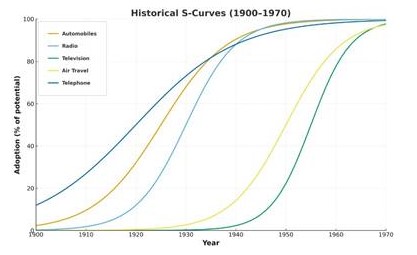
    The S-curve has long been used to describe this process. Every innovation, whether electricity, telephone, automobile, or personal computers follows a similar trajectory: slow adoption, rapid acceleration, and eventual maturity. The insight is simple yet profound: growth is never infinite. Each curve levels off, and another inevitably begins. Consider that when the automobile overtook the horse-drawn carriage, one curve rose as the other faded, progress that felt magical to some and intimidating to others. For most of higher-education history, we faced only one or two S-curves at a time. There was time to adjust. Change came sequentially. Today, however, we are witnessing colliding S-curves, multiple waves of innovation and social change rising simultaneously and intersecting unpredictably.  

    Arthur C. Clarke once said, “Any sufficiently advanced technology is indistinguishable from magic.”

    To many presidents, boards and executive teams, AI already feels like that kind of magic, both wondrous and unsettling. The challenge for community college leaders is not simply to watch the show, but to learn the science behind it to understand how to read the curves before they collide. I would like to spend the next few weeks exploring the magic of S-Curves, their value to colleges in predicting themes and trends, but mostly to help project organizations into a preferred future which uses these innovations as tools.

    The Original S-Curve: Innovation, Maturity, and Renewal

    The classic S-curve represents the life cycle of any idea or industry. It begins slowly, accelerates as adoption grows, and finally matures before decline. Each new curve builds on the one before it.

    A graph showing different colored lines

AI-generated content may be incorrect.Previous bodies of research always become the basis for fresh thinking at the fringe. That insight captures why innovation is rarely born in isolation. What’s mainstream today started years ago on the edge of someone’s imagination.
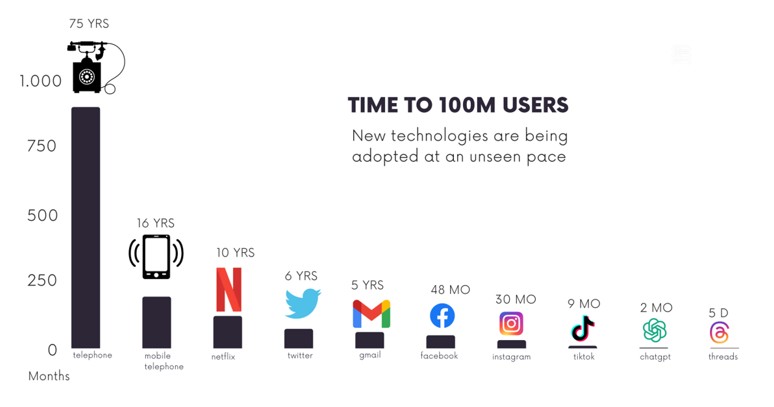
    American colleges have lived this pattern repeatedly. The post-WWII access revolution was one curve with veterans returning home, the GI Bill fueling growth, campuses springing up in every region. A generation later, workforce programs and applied-technology degrees caused the emergence of community colleges, marked another steep ascent as industry demanded skilled technicians. The rise of online learning formed the next curve, expanding access and redefining delivery. That movement, accelerated by the COVID-19 pandemic, pushed colleges to adopt digital, hybrid, and flexible models at scale transforming what began as an experiment in distance learning into a permanent dimension of higher education.

    Leaders who anticipate the next inflection point don’t abandon success; they extend it. Every success carries the seed of its own decline. The question isn’t whether a curve will flatten, it’s whether we’ll recognize the inflection point early enough to prepare for the next ascent.

    When Curves Collide: Exponential Growth and the Speed of Adoption

    In earlier decades, the time between curves gave institutions breathing room. The adoption of electricity, radio, and television spanned generations. Strategy could evolve slowly. Not anymore.  Consider how quickly new technologies reach a baseline of 100 million users:

    • Telephone: 75 years

    • Television: 50 years

    • Internet: 7 years

    • Instagram: 2 years

    • ChatGPT: 2 months

    In the twentieth century, society was shaped by only one or two dominant S-curves at a time. The industrial economy unfolded through electricity, automobiles, and radio, each building upon the last.

    Today, we face multiple transformative drivers converging at once:

    • Artificial Intelligence & Automation — redefining work, learning, and the skills required to thrive

    • Demographic Decline — shrinking youth cohorts and an aging workforce reshaping labor markets

    • Digital Infrastructure — expanding cloud computing, broadband access, and cybersecurity needs

    • Energy Transition — building entirely new workforce pipelines to power a sustainable economy

    Public Trust & Value Perception — questioning the cost, relevance, and return on higher education

    When curves collide, volatility spikes, but so does opportunity. Early adopters gain disproportionate advantage. As Wayne Gretzky advised, “Skate to where the puck will be.” For college leaders, that means positioning programs, partnerships, and budgets not for today’s demand curve, but for the next one forming just ahead.

    Forecasting isn’t fortune-telling; it’s pattern recognition. By studying trends, leaders can glimpse where momentum is built and allocate resources accordingly. The advantage of forecasting the future is simple: organizations that see trends early can prepare to take advantage of them.

    Futuring invites leaders to think beyond immediate pressures. It asks, what developments at the edge might soon reshape our core? Sometimes those signals appear in unrelated industries, a new technology in logistics that later transforms manufacturing, or an AI innovation in healthcare that soon affects education. Trends and themes help shape the broader context of a region or sector by revealing how developments in seemingly unconnected fields will affect us all.

    When I work with boards today, I remind them that the goal of futuring isn’t to predict which technology will win. It’s to cultivate awareness, to create the capacity to notice when the next curve begins to bend upward. Because once exponential growth starts, catching up is nearly impossible.

    Why Community Colleges Are the First Responders

    Community colleges have long been the nation’s shock absorbers in times of change. When industries collapse, we retrain the workforce. When technology advances, we translate complexity into curriculum. When economic shocks hit, our doors open wider. Community Colleges tend to be counter cyclical in times of unemployment.

    That agility positions us uniquely to navigate colliding S-curves, but only if we pair responsiveness with foresight. Rapid adaptation without direction can lead to mission drift; foresight turns reaction into strategy. Forecasting helps colleges anticipate trends. It enables boards and presidents to ask forward-leaning questions:

    • What are the emerging industries our region doesn’t yet recognize?

    • Which of our programs are approaching maturity and which are climbing?

    • How might AI or demographic change alter the very definition of student success?

    By asking these questions early, leaders create strategic margin the time and flexibility to act before necessity forces reaction. Our proximity to local communities gives us another advantage: we hear signals early. Employers mention new technologies before they hit headlines. Adult learners inquire about credentials that don’t yet exist. Civic leaders discuss workforce gaps that data won’t reveal for another year. Those whispers are the leading edge of the next curve. Still, awareness must be intentional. Futuring isn’t a luxury it’s a discipline.

    Summary and Application — Awareness Before Action

    The S-curve teaches that progress is cyclical: growth, maturity, renewal. What’s different today is both the speed and the convergence of change. Multiple curves are rising and intersecting at once, creating what I call the collision zone, a place of risk for those unprepared, but of reinvention for those who see it early.

    For community colleges, understanding these curves is more than theory, it’s a survival strategy. The institutions that thrive will be those that recognize the early signals of new demand, adapt their programs accordingly, and align mission with movement.

    These ideas capture the essence of futuring in higher education: to make sense of innovations before they overwhelm us and to position ourselves where the next opportunity will emerge. Awareness precedes readiness. Readiness produces resilience. And resilience will define the next generation of financially sustainable community colleges.

     —–

    At Aman & Associates, we help presidents, boards and executive teams develop foresight capacity to anticipate emerging S-curves, integrate futuring into strategy, and align decisions with mission and regional relevance. If your organization is ready to look beyond today’s horizon, I’d welcome the conversation.

    Rick Aman, PhD – Aman & Associates
    rickaman.com/articles

    © 2025 Aman & Associates. All rights reserved