Author: Rick Aman

  • When the Machines Learn, Humans Must Evolve

    When the Machines Learn, Humans Must Evolve

    The great aim of education is not knowledge, but action. — Herbert Spencer

    Last week’s article explored The AI S-Curve, how automation and intelligent systems are transforming the nature of work. The speed of technology adoption has never been greater, and the implications for human capability are profound.

    Leaders now face two distinct curves: Technology Adoption and Human Adaptation. The technology curve rises sharply; the human curve lags behind. The space between them, the adaptation gap, is where organizations either stagnate or reinvent themselves.

    Technology accelerates change. Only humans can give that change meaning. Boards and CEOs must focus not on resisting automation but on preparing their people to thrive within it.

    The Workforce Transformation Imperative: Higher Education on the Next S-Curve

    Higher education stands at a pivotal point. The same forces transforming industry, automation, artificial intelligence, and digital disruption are now reshaping education itself. Colleges and universities can no longer operate at the top of an old S-curve while the next one accelerates beneath them.

    The 2025 Future of Work with AI Agents study from Stanford’s Digital Economy Lab and SALT Lab (Shao et al., 2025) confirms what many already sense: AI will automate an increasing share of tasks across nearly every field. Yet this is not a story of job loss, it’s a story of job redesign. Routine work is giving way to roles that demand judgment, empathy, creativity, and complex reasoning.

    This shift demands a parallel transformation in how higher education prepares learners. Institutions must evolve from credentialing past skills to curating future capabilities, integrating technical fluency, human insight, and adaptive learning models.

    The lesson of every S-curve is clear: growth follows experimentation, not preservation. The institutions that lead the next era will be those that recognize when their current model has plateaued and have the courage to leap to the next curve before being forced to.

    The role of higher education is no longer to merely respond to change, but to anticipate it, shaping learners and organizations to thrive amid continuous innovation.

    The New Currency: Skills; Not “Butts in Seats”

    For more than a century, higher education has measured learning in hours, credits, and degrees. While those measures still matter, degrees remain vital for advanced practice, leadership, and credibility; they are no longer sufficient.

    Industry now evaluates readiness through demonstrated competency: Can this person perform at the level the job requires? That question transcends transcripts.

    Today’s workforce values competency-based models that verify what learners can do, not just what they have completed. Micro-credentials, digital badges, and stackable certificates enable individuals to demonstrate market relevant skills. These credentials give employers evidence of capability and provide workers with portable proof of value.

    Higher education must build ecosystems where degrees and competencies coexist. Degrees anchor theory and depth; credentials capture agility and application. Together, they form the new currency of employability.

    Learning Velocity and Adaptability

    Adaptability has become a competitive advantage. The most resilient organizations are not those with the newest tools, but those that learn at about the pace of the environment changes.

    Learning velocity depends on more than professional development budgets, it requires a culture where curiosity, experimentation, and reflection are encouraged. The ability to unlearn and relearn may soon define career longevity as much as technical skill. If an organization’s learning rate falls below the rate of technological change, obsolescence begins. Investing in human capability is no longer a cost, it’s a strategic hedge against disruption.

    The Competency Model Mindset

    To build adaptive systems, leaders must shift from knowledge transmission to competency demonstration. A competency model defines the specific skills, behaviors, and mindsets required for success and creates clear pathways for development.

    Strong models do more than list skills, they Align workforce development with strategic goals, Clarify expectations and define excellence, Support stackable growth, linking learning to mastery and credentials, and Enable rapid reskilling as technology evolves.

    Boards and CEOs who champion competency frameworks send a powerful message: performance and potential are measured by contribution, not seat time.

    Human Infrastructure as a Strategic Asset

    Digital transformation captures headlines, but human transformation determines whether technology delivers value. Closing the adaptation gap requires deliberate investment in people systems.

    Key priorities include:

    1. Reskilling and Upskilling Pipelines – Continuous learning systems aligned to verified regional labor data.

    2. Micro-Credential Pathways – Embedded short-cycle credentials within degree programs so learners can stop, start, and advance fluidly.

    3. Faculty and Staff Readiness – Time and support to master emerging technologies and flexible delivery models.

    4. Culture of Lifelong Learning – Model adaptability from the top; create safe spaces for experimentation and iteration.

    Human infrastructure determines whether institutions can pivot when disruption hits. The organizations that thrive will plan their human curves as intentionally as their technology curves.

    Leadership and Board Implications: Building Human Capacity for the Next Curve

    As organizations invest in technology and innovation, the question is shifting from what to fund to how leadership sustains and integrates those investments. Leadership must serve as the bridge between acceleration and understanding.

    Boards and CEOs can no longer view workforce development as a routine expense, it is the frontline of relevance and strategic risk management for higher education. In a changing economy with emerging technologies, even the most advanced systems hold little value if graduates and employees lack the skills and adaptability to use them.

    Traditionally, universities viewed a degree as a journey of the mind; cultivating wisdom, character, and civic responsibility. Today, many students see it as a strategic investment, a path to employability, financial security, and relevance in a shifting economy.

    Higher education now stands between these expectations: preserving the ideals of intellectual formation while ensuring that graduates leave with the skills and flexibility the workforce demands.

    The measure of success is not just retention or completion but application, what learners and employees can do with what they know. When human capacity catches up to the technology curve, institutions are prepared for the next one.

    I often close board retreats with a Preferred Future Statement exercise, asking leaders to describe their organization three years ahead when people and technology are in sync. That shared vision becomes the anchor for decisions on budgets, programs, and partnerships. It helps boards see success not only as technological progress but as human advancement, the truest sign of readiness for the next curve.

    Closing the Adaptation Gap
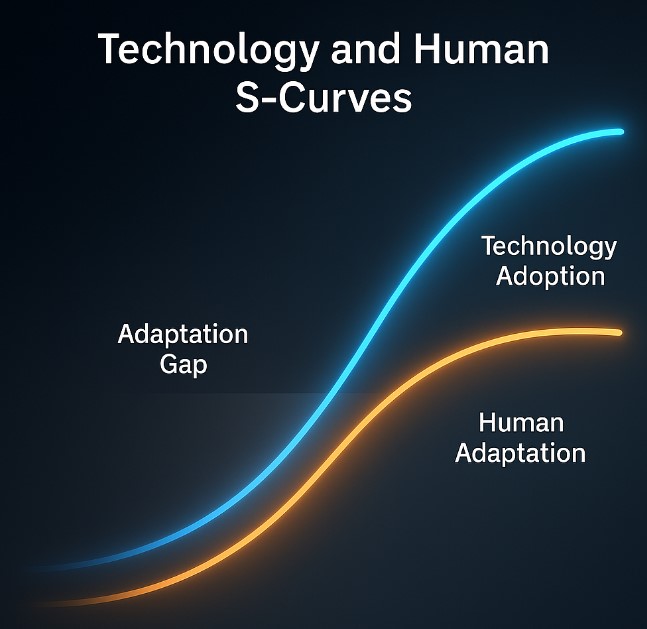
    Consider again the two S-curves: one representing the rapid rise of technology, the other the slower but essential rise of human adaptation. The space between them, the adaptation gap, holds both anxiety and opportunity. The work of leadership is to close that gap through deliberate investment in competencies, learning systems, and culture. The faster the human curve rises, the greater the organization’s resilience and value.

    Technology may disrupt jobs, but leadership can redefine work. Every board and executive team should ask three questions:

    1. What skills are fading? Which competencies no longer create advantage?

    2. What must be learned next? Which emerging skills will sustain relevance and revenue?

    3. How will we prove it? What evidence will demonstrate real capability and readiness?

    These questions form the blueprint for the Human S-Curve.

    Summary

    Week 5 of the Colliding S-Curves series explores The Human S-Curve, the arc of skills, adaptability, and competency that must rise to meet accelerating AI and automation. Boards, professional organizations and CEOs can close the adaptation gap by investing in reskilling systems, micro-credentials, and cultures of lifelong learning that turn disruption into advantage.

    Source: Shao, Y., Zope, H., Jiang, Y., Pei, J., Nguyen, D., Brynjolfsson, E., & Yang, D. (2025). Future of Work with AI Agents: Auditing Automation and Augmentation Potential across the U.S. Workforce. Stanford Digital Economy Lab & SALT Lab. https://arxiv.org/pdf/2506.06576.pdf

    —–

    Aman & Associates Insight

    At Aman & Associates, we help boards, executive teams, and professional organizations align their human and technology curves through AI-assisted futuring, mission-focused strategy grounded in Ikigai principles, and strategic leadership development. Our work centers on building adaptive institutions prepared for the AI and technological s-curve disruption already underway.

    Every organization faces colliding curves. The goal isn’t to slow the technology line; it’s to accelerate the human one.

    © 2025 Aman & Associates rick@rickaman.com | www.rickaman.com/articles
  • The AI S-Curve: Redefining Work and Learning

    The AI S-Curve: Redefining Work and Learning

    Every great transformation from electricity to the internet created new industries and displaced old ones. Artificial Intelligence is different because it touches them all.

    If each era of progress has had its own defining curve of growth and adoption, AI is the general-purpose curve. It accelerates every other S-curve, economic, technological, and societal simultaneously. Rather than viewing it as another innovation to manage, leaders should see it as the accelerant that steepens the slope of change across everything we do.

    For boards and CEOs, this creates both opportunity and responsibility. The question is no longer whether AI will transform your institution; it’s how you will guide that transformation with wisdom, ethics, and purpose.

    Understanding the AI S-Curve

    Artificial Intelligence is not a single technology; it is a capability layer that amplifies every function it touches. Like electricity in the industrial age, AI powers other systems rather than standing alone. It enhances automation, accelerates creativity, and extends human decision-making.

    We are already seeing compounding effects: productivity gains from automation, design tools that co-create content, and research models that process information faster than any human team could. The pace of adoption is unprecedented. The telephone took 75 years to reach 100 million users, the internet seven, and ChatGPT just two months.

    We are living in the steep middle of the S-curve, where adoption is outpacing our comprehension. Leaders who focus on how AI accelerates, rather than what AI replaces, will shape the next stage of institutional relevance.

    Implications for Work and Learning

    A recent Future of Work Stanford study underscores this acceleration: more than 80 percent of U.S. occupations have at least moderate exposure to AI augmentation. In short, the vast majority of work will be reshaped, not removed. Every technology curve produces a human curve. AI is no exception, but its speed and scale make the response urgent.

    Jobs are being redefined around collaboration with intelligent systems. AI takes over repetitive tasks and frees people to focus on creativity, empathy, and judgment. Accountants supervise analytics tools; healthcare providers use generative models to summarize complex data; engineers design with AI partners. The real skill gap ahead is not between degrees of acceptance, it is between those who know how to use AI and those who do not.

    Higher education must evolve in parallel. The emphasis is shifting from content mastery to cognitive adaptability, learning how to think with AI. Students need to frame better questions, validate outputs, understand the ethics of AI use, and apply discernment to machine-generated insight. Faculty must model adaptability, evolving from delivering knowledge to orchestrating intelligence. Boards and CEOs should reexamine what a degree signifies in the age of AI. Likewise, business and industry must define what level of AI competence they expect from today’s graduates.

    Just as the printing press democratized access to information, AI democratizes access to expertise, but at far greater speed. Learning institutions must become agile laboratories, embedding AI as a tool for higher-order thinking rather than a threat to it.

    For community colleges and universities, this is a once-in-a-generation opportunity to redefine relevance. Regional economies need AI-readiness hubs, trusted organizations that help individuals and industries thrive alongside intelligent systems. A perfect niche for local higher ed institutions. That means developing AI-literacy programs across disciplines, creating micro-credentials in applied AI, and investing in faculty readiness that pairs ethics with experimentation. Institutions that move early will meet workforce demand and strengthen their social contract as engines of opportunity in an AI-driven economy.

    Evidence from the Future of Work Stanford Study

    The Future of Work with AI Agents (June 2025) report from the Stanford Digital Economy Lab and SALT Lab offers one of the clearest pictures yet of how AI is reshaping the U.S. workforce. Researchers examined more than 900 occupations, mapping which are most susceptible to automation, and which are ripe for augmentation.

    Their findings reveal a nuanced landscape: about 84 percent of jobs contain tasks that can be augmented by AI, while only a small fraction face full automation. The highest-impact sectors include management, healthcare, education, finance, and administrative services.

    To illustrate this diversity of impact, Stanford organized the workforce into four quadrants based on AI capability (automation potential) and worker desire (willingness to adopt AI tools):

    1. High Automation / High Augmentation – Green Light Zone: Roles such as financial analysts, software developers, and data scientists, where AI boosts productivity while relying on human oversight. Ideal for responsible deployment.

    2. High Automation / Low Augmentation – Red Light Zone: Routine, rule-based jobs; data entry, payroll, and administrative processing, face displacement risk from high AI capability but low worker desire.

    3. Low Automation / High Augmentation – R&D Opportunity Zone: Professions emphasizing human judgment and empathy; educators, healthcare providers, and managers, show strong worker interest but limited AI tools, calling for targeted innovation.

    4. Low Automation / Low Augmentation – Low Priority Zone: Roles requiring manual dexterity or local context such as construction, hospitality, and food service where AI’s near-term impact is modest.

    Current investment, especially among startups, is over-concentrated in the Red Light and Low Priority zones, chasing efficiency rather than human-centered value. The real opportunity lies in the Green Light and R&D zones, where AI can augment human capability and strengthen social benefits.

    The insight is pivotal: AI is not a job destroyer; it is a work re-designer. It shifts value from repetition to interpretation. As AI handles routine analysis and retrieval, humans are freed to focus on creativity, empathy, and leadership.

    For higher education, the implications are profound. Curriculum must integrate AI as a literacy, not a specialty. Career pathways should align with augmentation-oriented roles; AI-enabled nursing, precision manufacturing, and data-informed teaching. Colleges must also partner with employers to reskill professionals who will collaborate with AI rather than compete against it.

    Viewed through a governance lens, these are strategic imperatives. Boards must ensure their institutions are equipped to lead by asking hard questions about policy, data ethics, digital infrastructure, faculty readiness, and responsible adoption.

    (Source: Shao, Y., Zope, H., Jiang, Y., Pei, J., Nguyen, D., Brynjolfsson, E., & Yang, D. (2025). Future of Work with AI Agents: Auditing Automation and Augmentation Potential across the U.S. Workforce. Stanford Digital Economy Lab & SALT Lab. https://arxiv.org/pdf/2506.06576.pdf)

    The Executive and Governance Lens: Policy, Ethics, and Capacity

    Last week I attended the WCET Conference in Denver. WCET (WICHE Cooperative for Educational Technologies) is a national organization advancing the effective use of technology in higher education by connecting institutions, leaders, and innovators to improve teaching, learning, and student success.

    I presented on organizational futuring, and like many sessions, conversations centered on AI, policy, and agility. Executive teams, departments, and workforce boards now stand at the intersection of innovation and integrity, guiding adoption responsibly while balancing agility with accountability.

    Policy must align AI use with institutional mission and values, addressing privacy, intellectual property, and transparency. The goal isn’t to slow innovation but to create ethical guardrails that allow it to flourish.

    Ethics call boards to confront algorithmic bias, data misuse, and the tension between efficiency and equity. Trustees must see AI ethics not as compliance, but as leadership. The most trusted institutions will be those that pair technological progress with moral clarity.

    Capacity requires investment in infrastructure, training, and governance. Faculty development, AI steering committees, and digital readiness are no longer optional, they’re strategic necessities.

    Ultimately, how an institution approaches AI reveals what it truly values. Adoption isn’t just a technology decision, it’s a decision about identity.

    Summary

    AI isn’t just another wave of innovation, it’s the tide lifting every other S-curve of change. The Future of Work Stanford study shows that more than 80 percent of U.S. jobs will be augmented, not automated, redefining how we work, learn, and lead.

    For colleges, universities, and governing boards, the challenge is to guide this transformation responsibly aligning ethics, policy, and capacity to ensure relevance in an AI-driven economy. Institutions that act now will become trusted hubs of AI literacy and workforce readiness.

     —–

    At Aman & Associates, we guide boards and executive teams through AI-assisted futuring and strategic visioning retreats. Each session helps leaders identify emerging forces, craft a Preferred Future Statement, and align initiatives with mission, ethics, and capacity. Our facilitation blends foresight tools, AI insights, and practical strategy to prepare organizations for relevance in an AI-driven world.

    Rick Aman, PhD Aman & Associates   Futuring | Strategy | Board Development rick@rickaman.com | rickaman.com/articles

    © 2025 Aman & Associates. All rights reserved

  • Three Forces Shaping the Future: Technology, Society, and Institution

    Three Forces Shaping the Future: Technology, Society, and Institution

    There is every indication that the period ahead will be an innovative one, one of rapid change in technology, society, economy, and institutions. — Peter Drucker

    In the first two articles of this series, I explored what is changing due to colliding S-Curves of innovation, the visible shifts shaping the future of community colleges and the organizations they serve. This week, I want to focus on how those changes interact across systems. Understanding the patterns beneath disruption is the next step in moving from awareness to strategic action. Disruption is rarely a single event; it’s a collision of forces moving at different speeds. Technology may trigger change, but institutions and societies determine whether it becomes progress.

    To make sense of this complexity, I use a framework called – The Three Forces Shaping the Future—Technology, Society, and Institution. Each move at its own pace, but together they form the ecosystem in which every organization must lead. Seeing these forces together helps boards and executive teams avoid reacting to isolated issues and instead understand the larger system at work. These forces also represent the landscape where the major S-curves of innovation, the accelerating waves of change, collide with the mission of higher education.

    Technology

    The first force, Technology, represents the tools and engines of disruption: artificial intelligence, automation, increasing demand for energy, digital health, and cybersecurity. These technologies follow familiar S-curves of innovation: they start slowly, accelerate exponentially, and then mature. The challenge for presidents and boards is recognizing when a curve is entering that rapid growth phase and ensuring institutional strategy keeps pace. Multiple S-curves are rising at once, AI redefining knowledge work, automation transforming industries, and clean energy reshaping infrastructure.

    These advances move fast, often faster than staff and systems can adapt. For governance boards, this force demands both curiosity and accountability. It requires asking: Are our technology investments forward-looking or reactive? Do we have the infrastructure and workforce readiness to adapt? Where are we responsibly experimenting, and where are we lagging? Technology is no longer a support function; it’s the catalyst behind nearly every operational and educational shift we face.

    Institutions that thrive will be those that invest not only in hardware or systems but also in digital fluency across leadership. The ability to interpret data, integrate AI ethically, and leverage automation wisely has become a board-level competency. Yet while this force accelerates innovation, it can also widen the gap between those prepared to adapt and those who maintain the past. Technology represents the front line of change, but beneath its speed are slower forces that determine whether it leads to opportunity or mediocrity.

    Society

    The second force, Society, represents the human context in which change unfolds. It includes demographic shifts, access, economic realignment, public trust, and evolving learner expectations. Unlike technology, societal change moves gradually, often over decades of cultural transformation and generational turnover. Yet it is this force that defines why innovation matters.

    For boards and CEOs, understanding the societal force means looking beyond dashboards to the people behind the numbers. Demographics is destiny and workforce trends tell us about who we will serve next. How are economic changes reshaping pathways to employment? Are our programs designed for the current students coming to us, or for those we once served?

    Societal change often rises slowly but carries enduring influence. The aging of America’s population, declining birth rates, and the shift from degrees to credentials are reshaping higher education’s purpose. A generation motivated by flexibility and seeking return on educational investment is redefining value. Boards must view these shifts not as threats but as indicators of where to align mission with emerging demand.

    Institution

    The third force, Institution, is the slowest to evolve but perhaps the most pivotal. It represents how colleges and organizations adapt internally through governance, funding, policy, and culture. Institutional forces reflect cycles of maturity and renewal, how we grow, plateau, and reinvent. Progress depends not only on what we do but on how we decide.

    I have asked boards to reflect on three questions: How fast can we move from insight to action? Do our structures encourage adaptability or reinforce stability? Are we built for iteration or preservation? When public institutions lag, innovation stalls. Even strong strategies can fail when filtered through outdated decision-making processes.

    The institutions that adapt best are those that continually examine their systems, rethinking committee structures, streamlining decision cycles, and aligning funding with strategic priorities rather than legacy programs. Institutional agility isn’t about chasing trends; it’s about creating the conditions for innovation to succeed.

    When leadership and boards view all three forces together, patterns emerge. Technology drives possibility. Society defines purpose. Institutions determine pace. The future won’t be shaped by any single force but by our ability to understand how they interact. Disruption is rarely a surprise to those who look across systems. The signals are usually visible, emerging in workforce data, cultural attitudes, and organizational behavior, but too often they’re analyzed in isolation. The challenge for leadership is to connect the dots and see across systems.

    Summary

    For trustees and CEOs, the call to action is clear: before acting, chart your system. Identify where your institution resides within each of the three forces. Determine where you lead and what lags. That simple act of mapping provides clarity for prioritizing resources, aligning strategy, and governing with foresight. Boards that understand these dynamics can move from reacting to anticipating, from maintenance to momentum.

    Understanding these interactions allows boards to see not just what is changing, but how change behaves. That’s the essence of futuring, not prediction, but preparation. The future belongs to institutions that learn faster than their environment changes. By considering these three forces shaping our future and understanding how the major S-curves of innovation intersect with our mission we can lead with confidence, seeing the system rather than the silos. The future won’t be shaped by any single force but by our ability to understand how they interact.

     —–

    At Aman & Associates, we help boards and CEOs look beyond the plan and see the future. Through facilitated board retreats, strategic futuring, and executive mentoring, we create clarity, unity, and momentum. Our approach blends foresight, governance expertise, and practical leadership experience to help organizations move from maintenance to transformation.

    Let’s shape your preferred future—together.

    Rick Aman, PhD Aman and Associates | rick@rickaman.com | rickaman.com/articles

  • The Power of Three: Why Leaders Should Keep It Simple

    The Power of Three: Why Leaders Should Keep It Simple

    The triangle is a perfect figure because it is the simplest form that encloses space. The power of three is the power of stability. – G.K. Chesterton – The Orthodoxy

    As a higher ed consultant working with boards, presidents and leadership teams, I’ve learned that complexity is the greatest enemy of focus. Rooms I’ve stepped into, whether a board retreat, an executive session, or a strategy workshop tend to be filled with competing priorities, endless initiatives, and too many voices vying for attention.

    Over time, I found a simple, but powerful tool to cut through the noise: The power of Three.

    The number three shows up everywhere in our lives if you are looking. Across disciplines, traditions, and cultures. It carries a rhythm and weight that feels both natural and complete. Consider how often it appears:

    Literature & Storytelling: The three-act structure; fairy tales with three trials, wishes, or bears; poetic triads such as — “Friends, Romans, countrymen.”

    Family: The timeless image of father, mother, and child as the foundation of family.

    Spiritual Life: The Trinity — Father, Son, and Spirit; the three virtues of faith, hope, and love;

    Government & Society: Three branches of government — executive, legislative, judicial; three levels of civic life — local, state, and national.

    Science & Nature: Newton’s three laws of motion; three states of matter—solid, liquid, gas; three dimensions of space.

    Art & Design: Three primary colors; the rule of thirds in visual composition.

    Culture & Everyday Life: Three meals a day; red-yellow-green traffic lights; sayings like- “third time’s the charm.” 

    Business & Leadership: Three lenses of the future- possible, probable, preferred; Three anchors of strategy- mission, vision, values; Three measures of trust – competence, consistency, care

    Why does three keep surfacing? Because it represents balance, clarity, and completeness. Leaders who embrace it discover a rhythm that sharpens focus, simplifies complexity, and inspires follow-through.

    Three Creates Memorability: Balance

    In leadership, being remembered is half the battle. In a world of information overload, long lists get lost, but threes endure. One idea feels thin, two ideas feel unfinished, but three strikes balance. That’s why phrases like life, liberty, and the pursuit of happiness or faith, hope, and love are etched in our minds. They balance depth with simplicity. For organizational resilience there are: mission, vision, values.

    In my own work, I’ve seen boards latch onto three themes or three priorities with surprising staying power. Months after a retreat, people can still recite them without notes. That balance is what makes strategy memorable, and memorability is what makes vision stick.

    Three Brings Clarity: Clarity

    Clarity is often the hardest outcome for leadership teams to reach. I’ve sat in meetings where boards tried to juggle ten priorities. By the time the tenth was discussed, no one remembered the first. When we narrowed the conversation to three, the approach changed. The board began to wrestle with what truly mattered. What would they stand behind? What could they put aside? Choosing three requires discipline, but it also created freedom. With clarity came focus, and with focus came energy. Remember there is a difference between “no” and “not now.”  I’ve watched institutions achieve far more with three strategic initiatives than with sprawling plans of a dozen goals. Clarity comes not from doing everything, but from choosing what matters most.

    Three Drives Persuasion: Completeness

    Three is persuasive because it feels complete. Audiences instinctively trust it. I’ve witnessed this in board retreats where strategy was framed around three big themes. Trustees didn’t just understand it they adopted it. They repeated it, used it in their own circles, and rallied around it. The completeness of three gave them ownership.

    In business, I’ve seen the same principle. A CEO who once tracked dozens of metrics realigned his team around three: financial sustainability, customer satisfaction, and operational efficiency. The shift was dramatic. Conversations sharpened, meetings became more productive, and people spoke the same language. Completeness brought alignment.

    The Power of Three in Leadership

    The power of three is more than a clever communication device, it is a way of leading. When leaders discipline themselves to frame strategy, goals, and messages in threes, the atmosphere shifts. Complexity begins to dissolve, and what emerges is direction that feels balanced, clear, and complete.

    The same holds true in higher education. In my work with colleges on strategic planning, I often encouraged leaders to discipline themselves to identify just three themes that would shape their preferred future. Instead of generating a laundry list of ten or twenty goals, most of which would be forgotten or ignored, I encourage they select three strategic initiatives that captured the heart of where they wanted to go. The effect can be striking. Faculty and staff could recall them without looking at a document. Students and community partners could repeat them in conversation. Trustees could carry them with confidence into their own circles of influence. That kind of clarity created momentum. Strategy no longer lived on paper; it became something people talked about, remembered, and acted upon.

    The reason this works is both practical and deeply human. One idea feels too thin; two often feels incomplete. But three has rhythm. It balances simplicity with completeness, broad enough to feel whole without being overwhelming. Leaders who frame their vision in threes give people a map that is easy to hold in their heads and hearts, guiding both daily decisions and long-term direction. In doing so, they tap into something timeless. Three feels natural, memorable, and enduring. “The number three has a peculiar charm, a resonance in the mind beyond other numbers.” — H.G. Wells, A Short History of the World

    Three Ways to Apply the Power of Three

    1.      Frame strategy in three themes. Whether in a strategic plan or a board retreat, identify the three priorities that will carry the organization forward.

    2.      Limit dashboards to three metrics. In business or higher ed, choose three measures that reflect true success and use them consistently to align teams.

    3.      Communicate vision in three phrases. A vision that can be repeated in three short, memorable statements is far more likely to inspire and endure.

    Leadership is not about saying more; it’s about saying what matters in a way that endures. The number three provides the rhythm to do just that. It creates balance, sharpens clarity, and communicates completeness. As I look back on my years as a president and now as a consultant, I’ve seen the power of three make the difference between confusion and direction, between scattered energy and focused momentum.

    Three values, clearly stated and consistently lived, can align an organization better than a hundred policies. — Stephen Covey – Principle-Centered Leadership.

    —–

    At Aman & Associates, we help boards and executive teams cut through complexity and define the three things that matter most. When an organization finds its three, it finds balance, clarity, and completeness and with that, the energy to pursue its preferred future.


     Rick Aman, PhD – Aman and Associates

    rickaman.com/articles

    © 2025 Aman & Associates. All rights reserved


  • Objectives and Key Results (OKRs): The Discipline of Focus in Leadership

    Objectives and Key Results (OKRs): The Discipline of Focus in Leadership

    Discover how a simple framework used by Google and Intel can help boards and CEOs focus on what truly matters.

    High-performance organizations home in on work that’s important and are equally clear on what doesn’t matter.  — John Doerr, Measure What Matters

    Introduction

    The idea of OKRs – Objectives and Key Results did not begin in Silicon Valley boardrooms or glossy leadership books. It started at Intel in the 1970s, when Andy Grove sought a disciplined way to drive focus and accountability inside a rapidly growing tech company. John Doerr, who learned the framework at Intel, later carried it into Google in 1999. There, OKRs became part of the culture and helped the company scale from a promising start-up to a global leader. Since then, organizations of every kind, Fortune 500 firms, start-ups, nonprofits, and even colleges, have used OKRs to create clarity amid complexity. What makes the framework endure is its simplicity: a clear objective that states where you are going, paired with a small set of key results that tell you if you are on the right track. For boards, CEOs, and executive teams, OKRs offer more than a management tool; they offer a way to align vision, discipline, and accountability in a world that constantly demands more.

    Through many years in military and college leadership roles, I saw how easily leadership teams could lose focus. Strategic plans often ballooned with dozens of priorities, each carrying its own urgency. OKRs, by contrast, force us to narrow in on what matters most and to measure progress with honesty. They answer two essential questions: Where are we going? and How will we know we are getting there?

    Objectives Give Vision

    Objectives are the “north star.” They are qualitative, directional, and inspiring. They do not live in spreadsheets, nor do they simply replicate a budget line. A strong objective motivates people at every level of the organization.

    In higher education, an objective might read: “Become the first-choice community college for rural and underserved students in our region.”  Without percentages or timelines, the statement highlights an aspirational vision that inspires action. The board, CEO, or president sets the tone by naming this kind of bold objective, one that speaks to purpose and mission.

    In consulting I talk to CEOs and board about defining an objective this way: “Reimagine technical education to meet Idaho’s emerging workforce needs.” That statement is more likely to inspire faculty, trustees, and community partners because it wasn’t just a task list; it was a call to action.

    For corporate leaders, the same lesson applies. Objectives should not get lost in the noise of quarterly performance metrics. They should tell your people why the work matters and where the organization is headed.

    Key Results Drive Accountability

    Objectives inspire, but key results keep everyone honest. They are specific, measurable, and time bound. Key results ensure that objectives don’t float away as lofty ideas.

    Returning to the community college example, the objective of becoming the first choice for rural and underserved students might include these key results:

    • Raise first-year retention from 68% to 75% within two years.

    • Launch three new industry partnerships in advanced manufacturing by year-end.

    • Enroll 200 additional students from rural counties by the next fall semester.

    These results are measurable. Either they are achieved, or they are not. Boards and trustees find this clarity valuable because it shifts the conversation away from activity reports toward outcomes. Leaders no longer talk about how busy they were but instead about the progress made toward what truly matters.

    As a consultant I find OKRs valuable when working with executive teams. Each vice president could connect their efforts to the same objectives, making cabinet meetings sharper and giving trustees confidence that we were aligned and accountable.

    Business leaders can use the same approach. Imagine a CEO setting the objective “Deliver an unmatched customer experience.” The key results might be: achieve a Net Promoter Score of 70, resolve 90% of customer issues within 24 hours, and reduce service-related churn by 15%. The combination of ambition and measurement ensures progress is more than a matter of opinion.

    OKRs Build Alignment Across the Organization

    Alignment is often where leadership fails. Boards set direction, executives translate, and teams execute, but along the way, messages fragment. OKRs solve this by cascading objectives and key results down through the organization.

    In a college setting, the board might establish the institutional objective “Be the regional leader in workforce innovation.” The president would then develop key results, perhaps launching new short-cycle credentials or signing a certain number of industry partnerships. Deans and faculty could align their goals directly to those results, seeing clearly how their day-to-day work advanced the board’s direction.

    In business, OKRs prevent silos. Marketing, operations, and customer service can all point to the same overarching objective and see how their key results connect. Alignment builds momentum, and momentum builds trust.

    The Discipline of Focus

    Perhaps the greatest gift of OKRs is their insistence on focus. Leadership often suffers from the temptation to pursue too many priorities. Boards and executives want to respond to every opportunity and threat. Yet in doing so, they dilute impact.

    OKRs allow leaders to say: “These three things matter most right now.” They reduce the clutter of competing initiatives, provide a clear rhythm for accountability, and ensure that when resources are scarce, as they often are, the most important goals still advance.

    OKRs are typically reviewed quarterly or annually. This cadence creates an organizational rhythm, keeping everyone attentive to progress without drowning in reports. The framework builds discipline into leadership, which in turn builds trust.

    Conclusion

    Looking back in my leadership roles, both as a president and now as a consultant, I recognize that the seasons of greatest success were not those filled with endless initiatives. They were the times when leadership narrowed in on a few bold objectives, attached them to measurable key results, and aligned the organization behind them.

    OKRs are more than a management framework. They are a leadership discipline. For CEOs, boards, and executive teams, they provide a way to translate vision into measurable progress, and measurable progress into culture.

    The challenge for leaders today is not doing more. It is choosing what matters most and measuring it well.

    —–

    At Aman & Associates, we work with boards, CEOs, and executive teams to bring clarity and alignment through tools like OKRs. Whether it’s in higher education, nonprofits, or business, our focus is helping leaders define bold objectives and measure meaningful results. If your organization is ready to sharpen its focus and build accountability, let’s start a conversation about a leadership retreat that uses OKRs to guide you toward your preferred future.

    Rick Aman, PhD – Aman and Associates

    rick@rickaman.com | rickaman.com/articles

    © 2025 Aman & Associates. All rights reserved

  • Leading with Clarity: The Eisenhower Matrix

    Leading with Clarity: The Eisenhower Matrix

    You cannot overestimate the unimportance of practically everything. – John Maxwell

    Leadership is not about doing everything; it’s about choosing what matters most. During my years as a community college president, I faced days filled with urgent requests: student crises, budget adjustments, facilities issues, and meetings stacked from morning to evening. Each item felt pressing, but not all of it shaped the long-term health of the college.

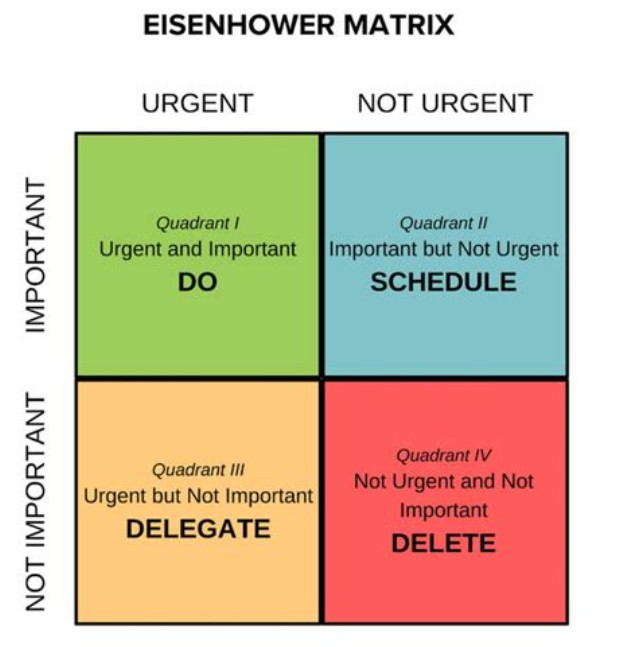
    Dwight D. Eisenhower once said: “What is important is seldom urgent, and what is urgent is seldom important.” His wisdom gave rise to the Eisenhower Matrix, a simple but powerful tool to help leaders prioritize decisions. It pairs well with my early reflections on the classic Pareto Principle, or 80/20 rule, which reminds us that 80% of results often come from 20% of actions. Used together, these frameworks guide leaders away from busyness and into effectiveness. They challenge us to focus less on reacting to the many urgent tasks of the day and more on investing in the vital few that truly shape the future.

    Urgent vs. Important: Knowing the Difference

    The Eisenhower Matrix forces us to ask two questions of every task:

    Is it urgent?

    Is it important?

    Urgent tasks are time-sensitive, they demand attention now. Important tasks are value-driven—they shape the future. The problem in leadership is that urgency often disguises itself as importance.

    My day could be consumed by urgent fires: a facilities breakdown, a last-minute meeting with legislators, or a student issue that went viral on social media. They were urgent, but not all were truly important to the institution’s mission. Contrast that with important but not urgent work: cultivating industry partnerships, strengthening the leadership pipeline, or investing in new learning technologies. These tasks don’t appear on your calendar screaming for attention, but they carry outsized weight for the future. Here’s where the Pareto Principle applies. Out of 100 tasks, maybe only 20 truly move the needle. Those 20 live mostly in the “important” quadrants of the Eisenhower Matrix. Recognizing them is the first discipline of leadership.

    Quadrant 2: The Vital Few That Shape the Future


    The Eisenhower Matrix has four quadrants:

    1. Do Now (Urgent + Important) – crises and deadlines.

    2. Plan (Not Urgent + Important) – strategy, relationships, innovation.

    3. Delegate (Urgent + Not Important) – tasks others can handle.

    4. Eliminate (Not Urgent + Not Important) – distractions and busywork.

    Most leaders get trapped in Quadrant 1, constantly reacting. That’s where burnout lives. The best leaders discipline themselves to invest in Quadrant 2: important but not urgent. In my presidency, Quadrant 2 was where transformation happened: scheduling a strategic planning retreat, building partnerships with regional employers, or supporting faculty in experimenting with new delivery models. None of these had immediate deadlines, but they positioned the college for growth and resilience. This is also where the Pareto Principle has its greatest power. If 20% of your actions generate 80% of your results, most of those actions are in Quadrant 2. They don’t shout for your attention, but they yield the greatest long-term return.

    Example: At the college level, student services often reveal the tension between urgent and important work. Imagine a Student Success Center responding to advising needs. The urgent and important tasks are clear: a group of students at risk of dropping out because of financial aid complications requires immediate attention to keep them enrolled. Yet the important but not urgent work is less visible designing a proactive advising system that uses analytics to identify at-risk students early and connect them with mentoring resources. At the same time, there are urgent but not important responsibilities, such as processing routine transcript requests or scheduling appointments, that should be delegated to staff or automated systems. Finally, every college has not urgent and not important activities that need elimination, standing meetings without outcomes, repetitive reports no one reviews, or outdated paperwork that slows progress. The Eisenhower Matrix reminds leaders that while the urgent tasks may dominate attention, real transformation in student success comes when we invest in the important, non-urgent quadrant.

    Delegate and Eliminate: Freeing Capacity for the 20%

    Quadrants 3 and 4 are where leaders reclaim their time. Quadrant 3 (Urgent + Not Important): Delegate. These tasks demand action but don’t require the leader’s direct touch.

    Delegation here is not neglect; it’s empowerment. It gives others ownership while freeing the leader to focus on higher-level priorities. Quadrant 4 (Not Urgent + Not Important): Eliminate. This is the land of busywork: meetings without outcomes, endless reporting cycles, or tasks that no longer align with mission. Eliminating them requires courage, but every “no” in Quadrant 4 creates a “yes” for Quadrant 2.

    Lesson for leaders: Student services show how easy it is to spend every day in Quadrant 1, reacting to urgent crises. But the institution only moves forward when leaders design systems in Quadrant 2, delegate Quadrant 3 tasks, and eliminate Quadrant 4 distractions. Here again, the Pareto Principle adds clarity. The “trivial many” consume most of our time but yield little impact. By delegating and eliminating them, we create margin for the “vital few” that shape student success.

    Conclusion: Leading with Clarity and Focus

    The Eisenhower Matrix and the Pareto Principle are simple on their own, but together they create a powerful leadership compass. They remind us that:

    -Urgency is not the same as importance.

    -The future is built in Quadrant 2, not in endless firefighting.

    -20% of activities deliver 80% of results, and those activities almost always live in the important quadrants.

    -Delegating and eliminating the trivial many creates margin for the vital few.

    —–

    At Aman and Associates, we help boards, presidents, and executive teams cut through urgency to focus on what is truly important. Using tools like the Eisenhower Matrix, we guide leaders in prioritizing wisely, delegating effectively, and creating space for strategic vision. Our retreats and leadership sessions emphasize clarity, trust, and actionable focus, equipping organizations to spend more time building the future rather than reacting to the present.

    Rick Aman, PhD – Aman and Associates
    rick@rickaman.com | rickaman.com/articles

  • The Five Agreements: Building Trust, Unity, and Purpose in Teams

    The Five Agreements: Building Trust, Unity, and Purpose in Teams

    “Remember that what people say and do is much more about them than it ever is about you.” — Seth Godin

    Teams succeed not only because of their strategies or skills but because of the agreements that shape how they interact. Over the years, I’ve discovered that simple frameworks often carry the deepest wisdom. One of the most practical tools I’ve come across is The Five Agreements, from Don Miguel Ruiz, a Mexican author and teacher known for blending Toltec wisdom with modern insight. His book has been read around the world as a guide to personal freedom, and I’ve found it equally powerful when applied to the work of teams.

    At first glance, these agreements look like personal guidelines for living with integrity. But when applied to teamwork, they become powerful tools for leadership, collaboration, and culture-building. I’ve seen them transform the way teams listen to one another, resolve conflict, and move forward with clarity.

    A Look at the Five Agreements – Ruiz

    1. Be Impeccable with Your Word
    Our words create culture. When we speak with honesty and respect, we set a tone that encourages trust and openness. Teams thrive when words align and uplift, not divide.

    2. Don’t Take Anything Personally
    Feedback and behavior from others often reflect their own experiences, not our worth. By not taking things personally, we create space for dialogue instead of defensiveness. Teams that practice this principle stay focused on the work, not ego.

    3. Don’t Make Assumptions
    Assumptions are shortcuts that often lead us astray. Asking clarifying questions prevents misunderstandings and strengthens collaboration. Clear communication reduces wasted effort and keeps teams aligned.

    4. Always Do Your Best
    Doing our best doesn’t mean perfection — it means consistent effort with integrity. Our best shifts with circumstances, but showing up with focus builds trust and momentum. Resilient teams hold to this standard, even under pressure.

    5. Be Skeptical, but Learn to Listen
    Healthy skepticism invites us to question ideas without sliding into cynicism. Listening with respect ensures new perspectives are valued and innovation has room to grow. Teams that practice this balance avoid groupthink while staying open to growth.

    Themes that Emerge: Trust, Unity, and Purpose

    When practiced consistently, the Five Agreements give rise to three outcomes every team needs.

    Trust is the foundation. Impeccable words, fewer assumptions, and separating identity from critique build an environment where people feel safe to contribute. Without trust, even the best strategies stall.

    Unity is the alignment of diverse strengths. Unity doesn’t mean everyone thinks alike, it means moving in the same direction. The agreements provide language for handling conflict and respecting differences. Practiced well, they harmonize voices and create collective momentum.

    Purpose is the compass. Even trusting and unified teams risk drifting without it. Purpose gives meaning to progress. The agreements remind us to bring our best, test ideas with curiosity, and keep words and actions aligned with the mission. Purpose ensures the trust and unity we build drive the team somewhere worthwhile.

    Together, trust, unity, and purpose create the conditions for teams to thrive in disruption.

    Applying the Five Agreements: From Principle to Practice

    The culture of a strong team or board isn’t built on posters of principles but on daily practice. The agreements become powerful only when applied.

    Take gossip. It may feel harmless, but it drains trust and fractures unity. Choosing words carefully — in meetings, hallways, or emails — creates an environment where people feel safe and respected. Clarity, not just agreement, is what keeps teams aligned. A group that merely agrees without real understanding can falter quickly; a group that seeks clarity builds something lasting.

    Feedback is another moment where the agreements prove themselves. In healthy teams, feedback isn’t a personal indictment but a contribution to better work. I often remind myself and others: “This is about the work, not me.” That shift transforms defensiveness into accountability. When leaders model openness in the face of critique, trust grows, and even difficult conversations become opportunities for connection.

    Consistency also matters. Teams don’t need perfection — they need reliability. When each person commits to doing their best day in and day out, the culture becomes one of steady accountability. People begin to count on one another, not because everyone is flawless, but because effort is steady and visible. That predictability builds resilience.

    Balance comes from blending skepticism with listening. Too much agreement slips into groupthink; unchecked skepticism stalls momentum. When teams learn to question thoughtfully and listen genuinely, they sharpen ideas without eroding relationships. Curiosity and respect together fuel innovation and unity.

    Living the agreements in this way creates an atmosphere where trust replaces suspicion, gossip gives way to clarity, and accountability feels shared rather than imposed. It is less about applying five separate rules and more about weaving them into a culture that calls people — and their work — to their best.

    Closing Reflection

    In higher ed or non-profits, strategy charts the course, but agreements fuel the journey. Trust allows people to believe in one another, unity keeps them rowing in the same direction, and purpose ensures the destination matters.

    The Five Agreements are more than personal wisdom; they are a toolkit for leaders and teams who want to thrive. By weaving trust, unity, and purpose into daily practice, teams build not just effectiveness but enduring cultures. I’ve seen how these principles change the tone of meetings, strengthen collaboration, and renew a sense of mission.

    If you are leading a team or serving on one, consider bringing these agreements into the conversation. You may find, as I have, that they provide both the language and the discipline to transform not just how teams work, but who they become together.

    —–

    At Aman and Associates, we help boards and CEOs move beyond oversight to alignment, vision, and momentum. In our retreats and leadership training, we emphasize clarity, trust, and purposeful action to strengthen governance. Using futuring and strategy tools, we guide organizations in clarifying identity and charting a preferred future.

    Rick Aman, PhD – Aman and Associates

    rick@rickaman.com  |  rickaman.com/articles


  • The Vital Few: Using 80/20 Principles to Guide Boards and Presidents

    The Vital Few: Using 80/20 Principles to Guide Boards and Presidents

    Efficiency is doing things right; effectiveness is doing the right things. The Pareto Principle teaches us that effectiveness comes from focusing on the small number of things that really make a difference. – Peter Drucker

    This article begins a new series on leadership and governance tools. Over the years I have discovered that leaders are often less in need of more information and more in need of clarity. Author Dennis Prager has said, “Clarity over Agreement.”  We live in a time when disruption is constant, and the ability to focus on what matters most has never been more important. Each article in this series will explore a leadership tool that helps CEOs and boards cut through complexity and guide their organizations with greater impact.

    The first tool is the Pareto Principle, also known as the 80/20 rule. Simply put, 80 percent of results often come from 20 percent of effort. When applied well, this principle is not just about efficiency, it is about leadership discipline and focus.

    I saw this firsthand during a trustee retreat when the agenda included nearly twenty items. At first, the board wanted to move evenly across each one. But when asked which three would most shape the future of the college the point was made. The conversation changed. Instead of twenty competing items all seemingly of the same value, trustees gave their time to the few that truly carried weight. That is the heart of 80/20.

    The 80/20 Rule as a Strategic Lens

    The Pareto Principle was first observed in economics, but it has proven useful across many fields. A classic example comes from retail: in a typical grocery store, 20 percent of the items account for 80 percent of the value of inventory. The few products that sell the most carry the bulk of the store’s revenue, while the rest, though useful, contribute far less.

    The same imbalance shows up everywhere in higher education. A handful of programs enroll the majority of students. A few donors provide most of the funding. And in student success, barriers like childcare or financial aid explain the majority of attrition. These patterns remind leaders that while everything matters, only a few things truly determine outcomes.

    For CEOs and boards, the value of the 80/20 lens is not simply in recognizing imbalance, but in asking where leadership attention should rest. The principle brings focus. It reminds leaders that while everything has some importance, only a few things have enduring impact.

    Applying 80/20 to Futuring Decisions

    Futuring is the practice of looking ahead, recognizing patterns, themes and preparing for what is coming. The difficulty is that the future contains too much information. Technology, demographics, policy shifts, and global change all compete for attention.

    At a recent board retreat, I watched a leadership team generate a list of more than thirty possible opportunities for new programs and services. The brainstorming was energetic, but the sheer volume of ideas quickly felt overwhelming. I paused and asked, which three or four of these will matter most in shaping the college over the next three years? The participants grew more focused. Instead of preparing for thirty different futures, the team began concentrating on the vital few. Not surprisingly, retention, completion, and the rise of artificial intelligence rose to the top of the list.

    This is where 80/20 is most useful. Not every trend will shape the future equally. Artificial intelligence, demographic shifts, and workforce realignment may account for the majority of disruption facing colleges today. Dozens of other trends exist, but only a few will alter the path of an institution in meaningful ways.

    Using 80/20 as a filter allows leaders to avoid paralysis. Futuring is not about reacting to everything, it is about preparing intentionally for the small set of forces that will define tomorrow.

    Governance and Leadership through the 80/20 Lens

    Boards and presidents both benefit from applying the principle, but they use it differently.

    For boards, the challenge is to focus oversight on the handful of issues that determine long-term viability and represent constituents. Mission, financial health, reputation, and leadership succession are part of that 20 percent. The rest, while important, should not consume the majority of board time. I worked with one chair who regularly asked, “Is this one of the vital few?” That single question kept the board anchored on strategy rather than drifting into operations, with a flying analogy – 30,000 feet vs. in the weeds.

    For presidents, the challenge is time and attention. A college leader can easily become consumed by the flow of meetings and reports. Yet the true leverage of the presidency lies in vision, culture, and partnerships. These are the few responsibilities that no one else can carry. When I was serving as president, I learned that unless I gave my best hours to those areas, the college would miss opportunities to shape its future. The 80/20 lens gave me permission to release the less vital tasks and invest in what mattered most.

    Building a Preferred Future with 80/20 Discipline

    Futuring is about defining a preferred future, not predicting the exact future. The Pareto Principle helps leaders move toward that preferred future with discipline.

    It reminds boards and CEOs to identify the 20 percent of today’s decisions that will shape most of tomorrow’s outcomes. It guides them to invest in the programs and partnerships with the greatest leverage. It also highlights the 20 percent of risks that, if ignored, could undermine nearly everything else.

    When I facilitate retreats for boards and leadership teams, I often ask three questions:

    • What 20 percent of our strategy will deliver the greatest leverage in shaping our future?

    • What 20 percent of trends deserve the majority of our attention in planning?

    • What 20 percent of risks could derail our progress if left unattended?

    The answers provide clarity. They allow leaders to cut through the clutter of reports and competing priorities and focus on the vital few.

    Closing

    For boards and CEOs, the 80/20 lens is not just about efficiency, it is about clarity. It frees leaders to focus their limited time and attention on what shapes the preferred future. In an era of disruption, the discipline of the vital few is what allows organizations to move forward with confidence and purpose.

    As I launch this series on leadership tools, I begin with 80/20 because it shapes both governance and leadership. It provides a simple, powerful discipline for futuring. By identifying the vital few, leaders position their organizations not only to survive disruption, but to move with confidence toward a preferred future.

    —–

    Aman and Associates partners with boards and CEOs to bring clarity to leadership and governance. Through purposeful retreats and leadership training, we help boards move beyond oversight to alignment, vision, and momentum. Using proven futuring and strategy tools, we guide leaders in clarifying organizational identity and charting a preferred path forward. The result: boards and executives equipped to lead with clarity, confidence, and purpose.

    Rick Aman, PhD – Aman and Associates rick@rickaman.com | rickaman.com/articles


  • When Disruption Strikes, Identity Guides the Organization Forward

    When Disruption Strikes, Identity Guides the Organization Forward

    Innovation is not about saying yes to everything. It’s about saying no to all but the most crucial things. — Steve Jobs

    Over the past several weeks, I have been writing about how governing boards can lead differently in an era of disruption. The framework is simple but powerful: Vision — Questions — Tools — Identity.

    In Week 1, I described why boards must shift from oversight to vision. Oversight will always matter, but boards that stop there are steering through the rearview mirror. Strategic vision is what allows an institution to anticipate change, stay relevant, and align with purpose.

    In Week 2, I focused on the power of questions. The best boards do not succeed because they have all the answers. They succeed because they know how to frame the right questions, questions that surface blind spots, challenge assumptions, and invite new thinking.

    In Week 3, I introduced futuring tools that elevate board conversations. Frameworks like PESTEL and SWOT, Community listening, and vision-focused retreats boards and CEO a structured way to move from opinion to insight, from guesswork to strategy.

    But tools alone are not enough. Questions alone are not enough. Even vision is not enough. Every board needs an anchor. And that anchor is Identity. I have learned through both my presidency and my consulting work that when organizations drift, the cause is often not a lack of energy, intelligence, or resources. The cause is fuzziness around identity. Before a board can shape a future, it must be clear about who the institution is and what it exists to do.

    When Activity Outpaces Purpose

    In times of disruption, boards and CEOs often find themselves approving new programs, expanding services, and adding initiatives, moves that appear to demonstrate innovation and responsiveness. Yet when growth is driven more by urgency than by vision, activity can overshadow identity. Core principles risk being diluted, and the organization’s sense of purpose begins to blur. True progress requires more than motion; it requires clarity about who we are and why we exist.

    This challenge is not limited to higher education. Nonprofits, cultural institutions, and community organizations all face the same temptation. Under pressure, it is easy to confuse activity with progress. Boards launch initiatives to chase revenue, presidents expand programs to show responsiveness, teams multiply projects to prove relevance. On the surface, it looks like forward motion. But beneath the surface, the core mission grows cloudy.

    When activity outpaces purpose, strategy drifts. The organization works harder but feels less successful. Resources scatter. Leaders make decisions in reaction to the moment instead of in alignment with long-term direction. And eventually, trust erodes among students, employees, donors, and the community.

    In these moments, the most important work a board and CEO can do is pause and return to the central question: Who are we? Without clarity of identity, vision cannot hold. But with identity as the anchor, the organization can navigate disruption with focus, alignment, and trust.

    The Power of Identity Questions

    Boards that want to reclaim focus must begin with a different kind of inquiry. Not “What should we do next?” but “Who are we at our core?” I often guide boards through a series of identity questions that help anchor strategy and prevent mission drift.

    1. What is ours to do and not do? Every organization faces the temptation to say yes to every opportunity. But clarity often comes from drawing boundaries as much as from setting direction. A board that can name what falls outside of its mission sends a powerful signal to leadership and staff about focus and discipline. This prevents mission creep and allows resources to be invested where they have the greatest impact.

    2. Who do we serve, and why? Beyond demographics, this is about transformation. Are we here primarily for traditional students, adult learners, regional employers, or the broader community, and what change do we exist to deliver for them? When a board revisits this question, it ensures that strategy aligns with real human needs, not just institutional habits. The “why” creates a path from mission statement to program design to student or client outcomes.

    3. What promise do we make? An institution’s identity comes alive in the promises it makes and keeps. A promise might be access, affordability, workforce readiness, or transformational education, but it must be specific and lived out consistently. When boards help articulate this promise, it becomes a standard for accountability and a compass for decision-making. Every new initiative should be tested against the question: Does this fulfill our promise?

    4. What strengths truly set us apart? It is easy for organizations to imitate others, but identity depends on distinctiveness. A board that takes time to identify core strengths, whether it is a signature program, a regional partnership, or a cultural commitment, gains a strategic advantage. By naming what is truly unique, boards free their institutions from chasing competitors and instead double down on their own differentiating value. This question often unlocks pride and renewed energy across the organization.

    5. What must end to create space for what is next? Identity requires pruning as well as planting. Boards that ask what programs, traditions, or habits no longer align with mission are better positioned to create room for future growth. These conversations are rarely easy, but they are essential for institutional health. Letting go of what no longer fits mission is often the most courageous act of leadership, and it allows the preferred future to take shape.

    One framework I find particularly valuable is Ikigai, adapted for organizations. Originally a Japanese concept meaning “reason for being,” Ikigai invites leaders to reflect at the intersection of four questions: What do we love? What are we good at? What does our region need from us? What generates sustainable revenue? When boards map their work against these four circles, clarity often emerges. They can see where their identity is strongest and where they may be drifting. I have used this process with colleges, museums, and nonprofits. I have watched the conversation shift from scattered ideas to a crisp sense of organizational center. These four circle overlap with mission fulfillment or the organizational “Why.”

    The beauty of identity questions is that they do not just guide strategy. They build culture. When board members can articulate who the organization is and what it promises, they govern with more confidence. Presidents lead with more alignment. And teams feel more connected to direction.

    Identity as the Foundation for the Preferred Future

    As I look back on my presidency, I realize that some of the hardest decisions were not about budgets or policies. They were about identity. Do we stay true to mission or chase the next trend? Do we protect legacy or pivot toward relevance? Do we try to be everything to everyone, or do we focus on what only we can do? Identity does not answer every question, but it frames all of them. It turns vision into direction. It turns tools into alignment. It turns questions into clarity. Without identity, boards risk building castles on sand. With it, they can lead through disruption with courage and steadiness. The work of governance is not just to safeguard today. It is to steward tomorrow. That stewardship begins with identity. Before approving budgets, launching initiatives, or setting goals, boards should pause and ask: Who are we, really? Because when boards lead from clarity of identity, something powerful happens. Strategy stops being guesswork. Initiatives align with mission. Partnerships become purposeful. And institutions step into their preferred future with coherence and trust.

    Closing Reflection

    This four-week LinkedIn series has traced the arc from Vision — Questions — Tools — Identity. Along the way, I have tried to show that boards are not passive overseers. They are active shapers of the future. – Vision gives direction.  – Questions open possibilities.  – Tools ground and support decisions.  – And Identity anchors purpose. 

    If you serve on a board, or work alongside one, I encourage you to pause at your next meeting and ask not just what are we doing, but who are we becoming. In times of disruption, that may be the most important question of all.

    —

    Aman and Associates partners with CEOs and boards to design purposeful retreats and leadership training that create alignment, vision, and momentum. We bring proven futuring and strategy tools to help leaders clarify identity and chart a path forward. Together, we equip boards and executives to lead with clarity and confidence.

    Rick Aman, PhD – Aman and Associates 

    rick@rickaman.com | rickaman.com/articles


  • What Would We Build Today?  A Question About Structure and Purpose.

    What Would We Build Today? A Question About Structure and Purpose.

    Opening Story

    When the Purpose Outgrew the Structure – Peter Drucker

    At a recent board retreat, I asked, “What does a degree from our college mean?” The answers varied, transfer to a university, workforce assignment, access, affordability, but the lack of a shared response revealed a deeper challenge. The college’s mission had grown more complex over time, but its internal structure hadn’t caught up. It wasn’t about org charts; it was about systems and roles that no longer matched the promise being made to students.

    One board member finally said what others were thinking: “We’re still built for what we were, not what we say we’re here to do.” That moment shifted the conversation. The board realized that before setting bold goals, they had to ask a better question: Are we structured around our purpose today, or just our past? Will tomorrow be like yesterday?

    Start with Purpose, Not the Org Chart

    In too many planning sessions, the first instinct is structural: move some boxes, create a new role, rename a department. It is common that the first major aspect of a new president is to reorg. It feels productive because the CEO is doing something. But organizational structure without clarity of purpose is just rearranging furniture in a house we haven’t finished designing. True institutional alignment begins by stepping back and asking a more foundational question: What is the transformation we exist to deliver and for whom?

    Leaders often find themselves chasing strategy while being held back by outdated systems. Programs expand, services multiply, and new initiatives launch, but the budgeting process, decision-making structure, and accountability systems remain anchored in the past. The result? Momentum without alignment. Activity without coherence. Organizational formation should serve mission, not preserve habit. If a college promises to be student-centered, workforce-connected, and future-ready, then every internal system should reflect that promise. Otherwise, students feel disconnected, and staff carry the weight of misaligned expectations. Before reshaping operations or launching the next initiative, the president, boards and executive teams should ask: What do we promise our students, and what alignment does that promise to require internally? That single question reframes the planning process and helps ensure that structure follows purpose, not the other way around.

    Designing Around Mission, Not History

    Over the years, I’ve come to see that misalignment is rarely the result of poor intent, it’s usually the result of inherited structure. When strategies stall or progress feels sluggish, it’s not because leaders lack vision or teams lack effort. It’s because we’re still organizing ourselves around the needs of the past. The structure no longer fits the mission we say we’re pursuing.

    One of the most underused tools a CEO has is the power of a well-timed question. Strategic questions have the ability to shift the tone of a room, open up space for shared ownership, and invite people into real collaboration. Rather than issuing top-down directives, great leaders ask questions that surface insight and build alignment: Where are our students experiencing friction? Who owns this outcome and are they equipped for success? If we were starting fresh today, what would we do differently? Removing friction should be one of our chief goals given our desire to serve students.

    Asking the right questions doesn’t signal indecision, it signals intention. It also models a core leadership principle I’ve learned to trust: clarity before agreement. We often rush to get consensus in a meeting, but if we don’t first clarify the real problem, the purpose, and the desired outcome, agreement is superficial. When teams take the time to gain precision on the mission, on roles, and on how structure supports strategy, then agreement becomes authentic and sustainable. Without clearness, alignment won’t last beyond the room.

    A related concept I often return to comes from Stephen Covey: begin with the end in mind. In my work on futuring, I call this the preferred future. What do we want the institution to become in three to five years and who do we need to be today to make that possible? Too often, we try to retrofit our legacy structures into future strategies. But that rarely works. Our institutional framework must reflect where we’re headed, not where we started. I’ve seen institutions live this out. One college brought all student-facing functions advising, financial aid, career services under one collaborative team with shared goals and budget authority (One-Stop). Another reorganized its academic structure around career pathways instead of disciplines. These were not cosmetic changes. They were intentional moves to align with a future-focused mission.

    The best structures aren’t just efficient, they’re mission-oriented. They reduce noise. They create shared ownership. And they let teams move with purpose because the structure supports, rather than resists, the strategy. And none of it works without trust. Trust is built when leadership listens before it acts—when questions come before answers, and purpose comes before structure. Purpose without structural alignment leaves good strategy stuck in theory.

    Closing Thought

    Legacy structures can’t carry tomorrow’s mission. Unless strategy and structure align, even bold visions stall. The institutions that thrive will be those bold enough to rebuild around their purpose. In a time of change, the question that matters most is the one we rarely pause to ask: What would we build today and what kind of structure could allow us to reach our preferred future?

    —–

    At Aman and Associates, we mentor CEOs and facilitate board retreats focused on aligning institutional structure with mission-driven purpose. Our futuring and strategic visioning process helps leaders reimagine what their college could become—beyond the limits of legacy systems. We guide conversations that move past the org chart to explore bold redesigns that support the transformation promised to students. If you’re ready to lead into the future, we’re ready to partner with you.

    Rick Aman, PhD

    Aman and Associates

    rick@rickaman.com | rickaman.com/articles

    50895