Experience has taught me that disruption rarely announces itself with fanfare. It builds quietly beneath our feet, forming a new curve of growth just as the old one begins to flatten. One semester a program is thriving; the next, it is stagnant while something entirely new begins to accelerate somewhere else. Leadership today demands that we see those patterns before the pivot.
That pattern has a shape, and it has a name: the S-curve. What makes our moment different from every earlier age of change is not the existence of the curve. It is that the curves no longer arrive one at a time. They arrive together, they intersect, and they amplify one another. This overview brings together the central ideas of my Colliding S-Curves series: what an S-curve is, why the curves are colliding now, what artificial intelligence does to every other curve it touches, why the human curve matters as much as the technology curve, and how boards and CEOs can lead through the collision zone toward a preferred future.
The Original S-Curve: Innovation, Maturity, and Renewal
The classic S-curve describes the life cycle of any innovation, industry, or idea. It begins slowly, in a period of experimentation at the fringe, where a few early adopters test something the mainstream barely notices. Then adoption accelerates. The curve bends upward into a steep slope as the innovation tips into the mainstream, and growth compounds. Finally, the curve matures. Growth levels off, the market saturates, and the innovation that once disrupted becomes the establishment, until a new curve begins beneath it and the cycle repeats.
One principle deserves to be stated plainly at the outset: no technology that changes society advances in a straight line. We instinctively plan as if change were linear, a steady addition of a little more each year. It never is. Every society-changing technology follows the S-curve: a slow beginning that tempts us to dismiss it, a steep middle that tempts us to panic, and a maturity that tempts us to assume it will last forever. Leaders who expect straight lines misread every phase, underestimating the change early and overestimating its permanence late.
Every innovation follows some version of this trajectory: electricity, the telephone, the automobile, the personal computer. When the automobile overtook the horse-drawn carriage, one curve rose as the other faded, progress that felt magical to some and intimidating to others. The insight is simple yet profound: growth is never infinite. Each curve levels off, and another inevitably begins. Previous bodies of research always become the basis for fresh thinking at the fringe, which is why innovation is rarely born in isolation. What is mainstream today started years ago on the edge of someone’s imagination.
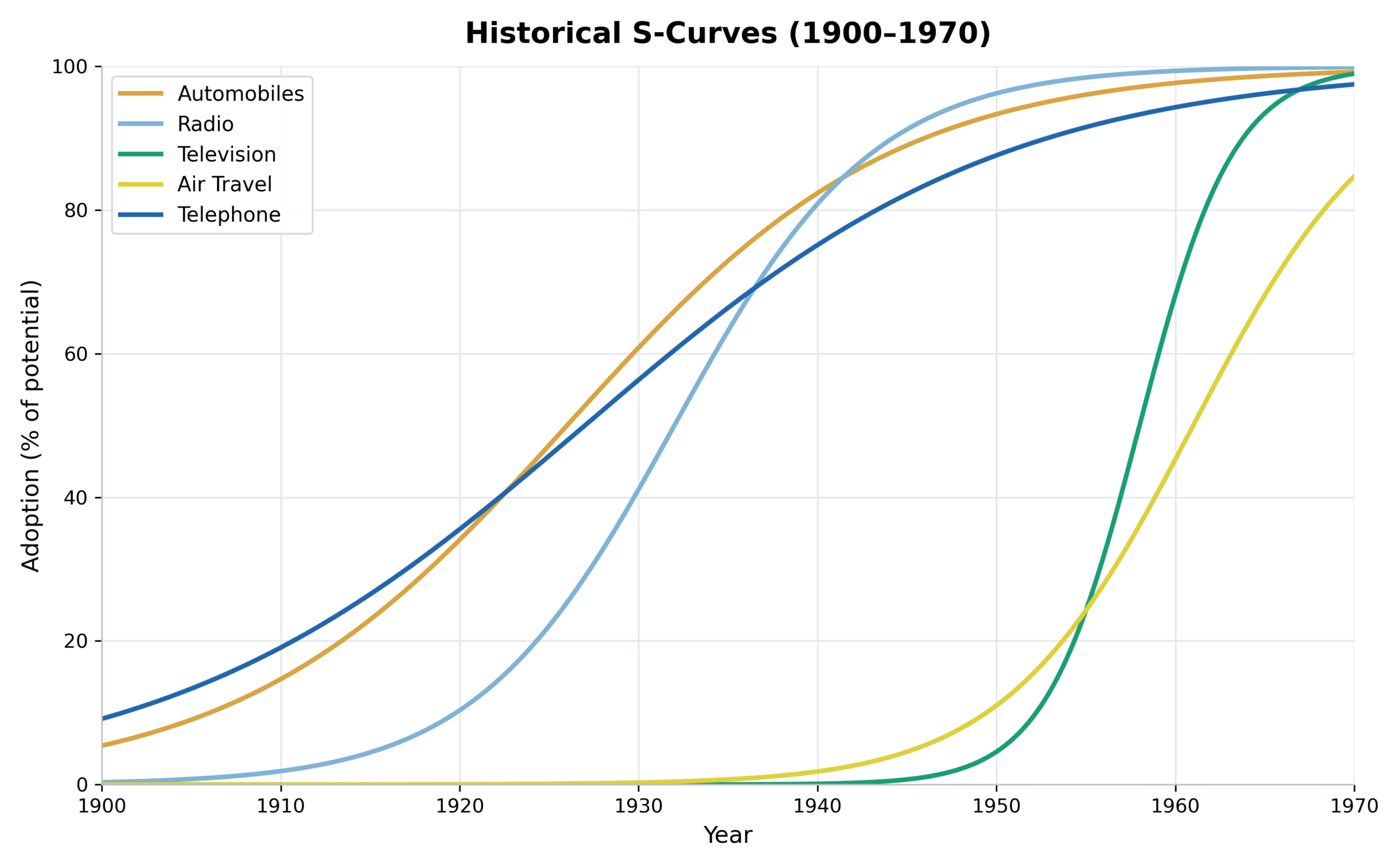
American colleges have lived this pattern repeatedly. The post-World War II access revolution was one great curve: veterans returning home, the GI Bill fueling growth, campuses springing up in every region. A generation later, workforce programs and applied-technology degrees marked another steep ascent as industry demanded skilled technicians, and the community college emerged as the institution built for that climb. The rise of online learning formed the next curve, expanding access and redefining delivery. That movement, accelerated by the COVID-19 pandemic, pushed colleges to adopt digital, hybrid, and flexible models at scale, transforming what began as an experiment in distance learning into a permanent dimension of higher education.
Leaders who anticipate the next inflection point do not abandon success; they extend it. Every success carries the seed of its own decline. The question is not whether a curve will flatten. It is whether we will recognize the inflection point early enough to prepare for the next ascent.
When Curves Collide: Speed and Convergence
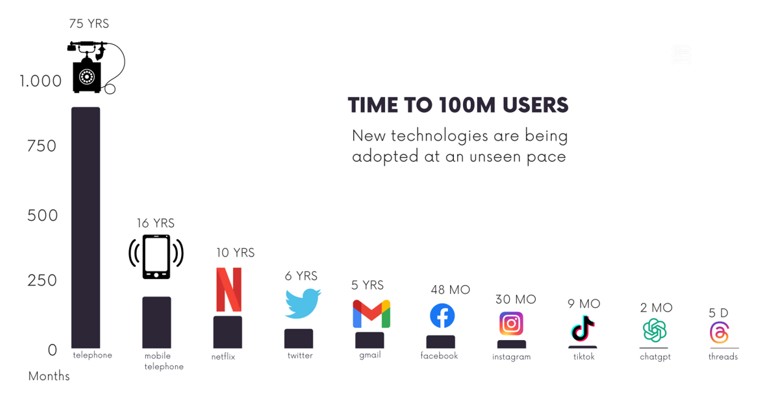
In earlier decades, the time between curves gave institutions breathing room. The adoption of electricity, radio, and television spanned generations. Strategy could evolve slowly. Not anymore. Consider how quickly new technologies now reach a baseline of 100 million users:
- Telephone: 75 years
- Television: 50 years
- Internet: 7 years
- Instagram: 2 years
- ChatGPT: 2 months
In the twentieth century, society was shaped by only one or two dominant S-curves at a time. The industrial economy unfolded through electricity, automobiles, and radio, each building on the last. Today, multiple transformative drivers are converging at once:
- Artificial Intelligence and Automation, redefining work, learning, and the skills required to thrive
- Demographic Decline, shrinking youth cohorts and an aging workforce reshaping labor markets
- Digital Infrastructure, expanding cloud computing, broadband access, and cybersecurity needs
- Energy Transition, building entirely new workforce pipelines to power a sustainable economy
- Public Trust and Value Perception, questioning the cost, relevance, and return on higher education
These are not separate stories. They are one story told in several registers. In the series I framed them as three great forces, technology, society, and institution, each riding its own curve, each bending the others. A technology curve steepens and labor markets convulse. A demographic curve turns down and institutional budgets, program mixes, and political expectations all shift with it. A trust curve erodes and the finest technology strategy in the world cannot save an institution its community no longer believes in. Leaders who watch only the technology curve will be blindsided by the other two.
Nor is the collision limited to five drivers or three forces. In my work with colleges I track at least ten technology curves rising together: artificial intelligence and automation, cybersecurity and digital ethics, cloud and IT infrastructure, health informatics and digital health, renewable energy, advanced manufacturing, immersive and simulated learning, robotics, satellite and edge systems, and skills-first credentials such as blockchain-verified records. None of these technologies stands alone; they amplify one another. AI drives analytics. Analytics depend on cloud infrastructure. Broadband enables immersive learning. Cybersecurity underpins them all. The future is not arriving in sequence. It is arriving all at once.
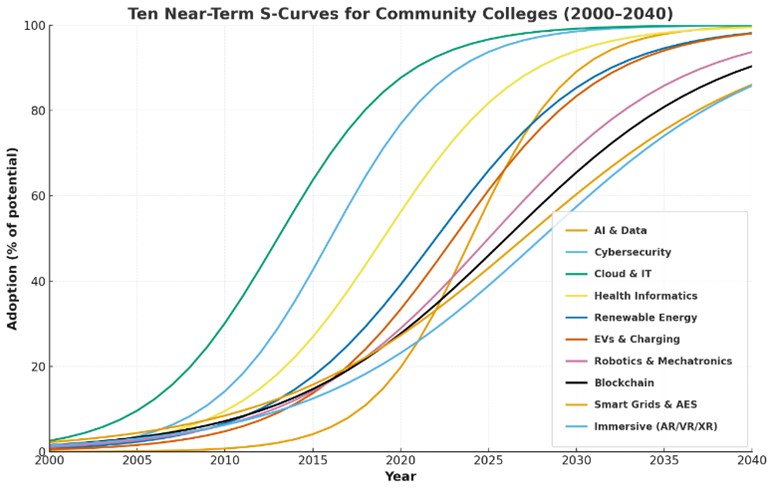
When curves collide, volatility spikes, but so does opportunity. Early adopters gain disproportionate advantage. As Wayne Gretzky advised, “Skate to where the puck will be.” For college leaders, that means positioning programs, partnerships, and budgets not for today’s demand curve, but for the next one forming just ahead.
Forecasting is not fortune-telling; it is pattern recognition. By studying trends, leaders can glimpse where momentum is building and allocate resources accordingly. The advantage is simple: organizations that see trends early can prepare to take advantage of them. Futuring invites leaders to think beyond immediate pressures. It asks, what developments at the edge might soon reshape our core? Sometimes those signals appear in unrelated industries, a new technology in logistics that later transforms manufacturing, or an AI innovation in healthcare that soon affects education. Trends and themes reveal how developments in seemingly unconnected fields will affect us all.
The goal of futuring is not to predict which technology will win. It is to cultivate awareness, to create the capacity to notice when the next curve begins to bend upward. Because once exponential growth starts, catching up is nearly impossible.
The AI Curve: The Accelerant That Steepens Every Other Curve
Every great transformation, from electricity to the internet, created new industries and displaced old ones. Artificial intelligence is different because it touches them all. If each era of progress has had its own defining curve of growth and adoption, AI is the general-purpose curve. It accelerates every other S-curve, economic, technological, and societal, simultaneously.
Artificial intelligence is not a single technology. It is a capability layer that amplifies every function it touches. Like electricity in the industrial age, AI powers other systems rather than standing alone. It enhances automation, accelerates creativity, and extends human decision-making. We are already seeing compounding effects: productivity gains from automation, design tools that co-create content, and research models that process information faster than any human team could.
We are living in the steep middle of the AI S-curve, where adoption is outpacing our comprehension. Leaders who focus on how AI accelerates, rather than on what AI replaces, will shape the next stage of institutional relevance. For boards and CEOs, this creates both opportunity and responsibility. The question is no longer whether AI will transform your institution. It is how you will guide that transformation with wisdom, ethics, and purpose.
The evidence is striking. The Future of Work with AI Agents study (June 2025) from the Stanford Digital Economy Lab and SALT Lab examined more than 900 occupations and found that about 84 percent of jobs contain tasks that can be augmented by AI, while only a small fraction face full automation. More than 80 percent of U.S. occupations have at least moderate exposure to AI augmentation. In short, the vast majority of work will be reshaped, not removed.
Stanford organized the workforce into four quadrants, based on AI capability and worker desire:
- Green Light Zone (high automation potential, high augmentation): roles such as financial analysts, software developers, and data scientists, where AI boosts productivity under human oversight. Ideal for responsible deployment.
- Red Light Zone (high automation, low augmentation): routine, rule-based jobs such as data entry, payroll, and administrative processing, which face real displacement risk.
- R&D Opportunity Zone (low automation, high augmentation): professions emphasizing human judgment and empathy, educators, healthcare providers, and managers, where workers want AI tools that barely exist yet.
- Low Priority Zone (low automation, low augmentation): roles requiring manual dexterity or local context, such as construction, hospitality, and food service, where near-term impact is modest.
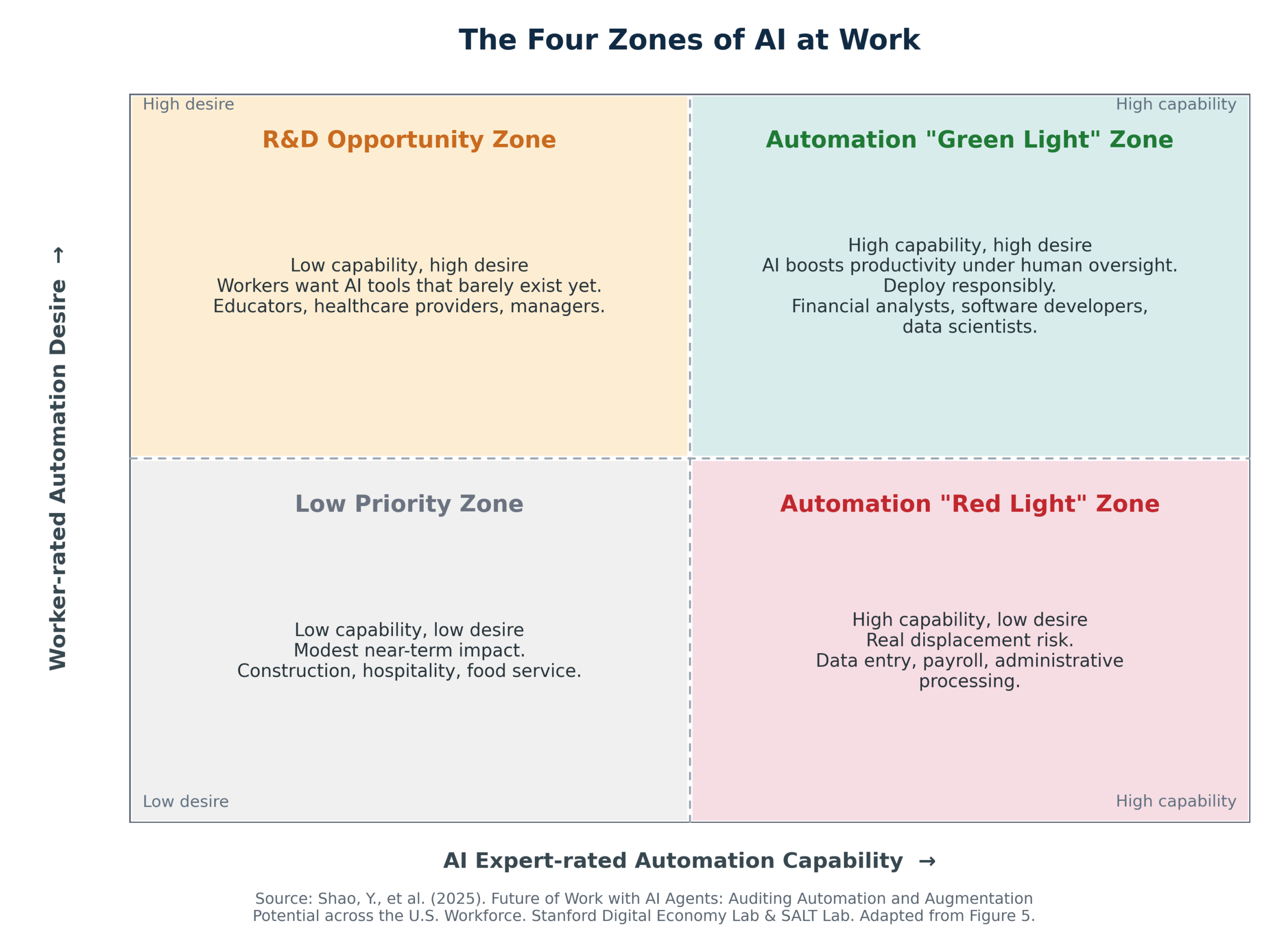
Current investment, especially among startups, is over-concentrated in the Red Light and Low Priority zones, chasing efficiency rather than human-centered value. The real opportunity lies in the Green Light and R&D zones, where AI can augment human capability and strengthen social benefit. The pivotal insight is this: AI is not a job destroyer; it is a work re-designer. It shifts value from repetition to interpretation. As AI handles routine analysis and retrieval, humans are freed to focus on creativity, empathy, and leadership.
For higher education, the implications are profound. Curriculum must integrate AI as a literacy, not a specialty. The emphasis is shifting from content mastery to cognitive adaptability, learning how to think with AI. Students need to frame better questions, validate outputs, understand the ethics of AI use, and apply discernment to machine-generated insight. Faculty must model adaptability, evolving from delivering knowledge to orchestrating intelligence. Just as the printing press democratized access to information, AI democratizes access to expertise, but at far greater speed. Learning institutions must become agile laboratories, embedding AI as a tool for higher-order thinking rather than a threat to it.
There is also a governance lens, and it is not optional. Policy must align AI use with institutional mission and values, addressing privacy, intellectual property, and transparency; the goal is not to slow innovation but to create ethical guardrails that allow it to flourish. Ethics call boards to confront algorithmic bias, data misuse, and the tension between efficiency and equity. Trustees must see AI ethics not as compliance, but as leadership. Capacity requires investment in infrastructure, training, and governance: faculty development, AI steering committees, and digital readiness are no longer optional; they are strategic necessities. Ultimately, how an institution approaches AI reveals what it truly values. Adoption is not just a technology decision. It is a decision about identity.
The Human Curve and the Adaptation Gap
Every technology curve produces a human curve. Leaders now face two distinct curves at once: technology adoption, which rises sharply, and human adaptation, which lags behind. The space between them, the adaptation gap, is where organizations either stagnate or reinvent themselves. Technology accelerates change. Only humans can give that change meaning. Boards and CEOs must focus not on resisting automation but on preparing their people to thrive within it.
The Stanford study confirms what many already sense: AI will automate an increasing share of tasks across nearly every field. Yet this is not a story of job loss. It is a story of job redesign. Routine work is giving way to roles that demand judgment, empathy, creativity, and complex reasoning. AI is also moving up the value chain, automating work that once required advanced credentials or years of experience. White-collar employees, long protected from automation, now face task erosion as large language models and AI agents handle research, drafting, analysis, and administrative processes. At the same time, skilled trades and technical professions are entering a resurgence. Electricians, welders, healthcare technologists, and energy specialists perform complex, hands-on tasks that require adaptability and context, areas where AI has limited reach. The institutions that thrive will prepare both: the innovators who design the systems and the builders who make them real.
Closing the adaptation gap begins with a change in what counts as learning’s currency. For more than a century, higher education has measured learning in hours, credits, and degrees. Those measures still matter; degrees remain vital for advanced practice, leadership, and credibility. But they are no longer sufficient. Industry now evaluates readiness through demonstrated competency: can this person perform at the level the job requires? That question transcends transcripts. Micro-credentials, digital badges, and stackable certificates let individuals demonstrate market-relevant skills, give employers evidence of capability, and provide workers with portable proof of value. Higher education must build ecosystems where degrees and competencies coexist. Degrees anchor theory and depth; credentials capture agility and application. Together, they form the new currency of employability.
Adaptability itself has become a competitive advantage. The most resilient organizations are not those with the newest tools, but those that learn at about the pace the environment changes. The ability to unlearn and relearn may soon define career longevity as much as technical skill. If an organization’s learning rate falls below the rate of technological change, obsolescence begins. Investing in human capability is no longer a cost. It is a strategic hedge against disruption.
That investment is what I call human infrastructure, and it determines whether institutions can pivot when disruption hits. Its key priorities:
- Reskilling and Upskilling Pipelines: continuous learning systems aligned to verified regional labor data.
- Micro-Credential Pathways: short-cycle credentials embedded within degree programs, so learners can stop, start, and advance fluidly.
- Faculty and Staff Readiness: time and support to master emerging technologies and flexible delivery models.
- Culture of Lifelong Learning: adaptability modeled from the top, with safe spaces for experimentation and iteration.
The organizations that thrive will plan their human curves as intentionally as their technology curves. Every board and executive team should be asking three questions. What skills are fading, which competencies no longer create advantage? What must be learned next, which emerging skills will sustain relevance and revenue? And how will we prove it, what evidence will demonstrate real capability and readiness? Those questions form the blueprint for the human S-curve.
Community Colleges: The First Responders of the Collision Zone
Community colleges have long been the nation’s shock absorbers in times of change. When industries collapse, we retrain the workforce. When technology advances, we translate complexity into curriculum. When economic shocks hit, our doors open wider. Community colleges tend to be countercyclical in times of unemployment. That agility positions us uniquely to navigate colliding S-curves, but only if we pair responsiveness with foresight. Rapid adaptation without direction can lead to mission drift; foresight turns reaction into strategy.
Our proximity to local communities gives us another advantage: we hear signals early. Employers mention new technologies before they hit headlines. Adult learners inquire about credentials that do not yet exist. Civic leaders discuss workforce gaps that data will not reveal for another year. Those whispers are the leading edge of the next curve. Boards and presidents who ask forward-leaning questions create strategic margin, the time and flexibility to act before necessity forces reaction. What are the emerging industries our region does not yet recognize? Which of our programs are approaching maturity, and which are climbing? How might AI or demographic change alter the very definition of student success?
I have watched this foresight work in practice. A community college I worked with saw enrollment in general associate degrees holding strong on dual credit and transfer, while demand in advanced manufacturing, cybersecurity, and renewable energy rose faster. The board reinvested in technical programs aligned with regional industry needs. Within two years, graduates were in high-wage, high-demand jobs, and the college had reclaimed its position as a workforce anchor. In another case, a board reviewed workforce data showing automation would disrupt its traditional business and office programs. Instead of waiting for enrollment to fall, it repositioned the program around data analytics, logistics, and entrepreneurship. The question changed from “Which programs should we cut?” to “Where is our next relevance?” That is what strategic foresight looks like in practice: seeing the shift before it becomes a headline.
From Awareness to Action: Leading the Next Curve
Awareness, however, is only the beginning. Futuring is more than a thought exercise; it is a discipline of looking ahead to guide decisions today. The institutions I work with often begin with a familiar story: a comprehensive strategic plan that once looked impressive, but now amounts to adding three percent to last year. It feels outpaced by reality. The world moved, but the plan didn’t. That is why I encourage boards and CEOs to view strategy as a living system rather than a static document. And futuring does not replace strategic planning; it precedes it. It sets the tone and direction for what is likely ahead.
In one leadership retreat I facilitated, trustees were asked a single question: “What does your institution look like three years from now when it is fully aligned with the next wave of workforce and learning demand?” The discussion that followed reshaped their priorities. Budget assumptions changed. Program development accelerated. Conversations moved from managing the present to designing the future. The transition from awareness to action begins when leaders stop trying to predict the future and start preparing for multiple possibilities.
A simple futuring framework makes that preparation a habit:
- Scan the horizon for signals of emerging change.
- Imagine multiple plausible futures.
- Select a preferred direction aligned with mission and opportunity.
- Translate that vision into actionable, measurable initiatives.
- Measure and adapt as new data emerges.
When boards use this process regularly, planning becomes continuous rather than episodic. Governance at the edge of change is not about predicting perfectly; it is about preparing consistently. Strategic foresight must now sit alongside finance, policy, and compliance as a core responsibility of governance. The leaders who excel in this space treat adaptability as a fiduciary duty. Leadership is not about holding the line. It is about helping the organization evolve before the curve steepens.
Conclusion: Vision as the Ultimate Advantage
The S-curve teaches that progress is cyclical: growth, maturity, renewal. What is different today is both the speed and the convergence of change. Multiple curves are rising and intersecting at once, creating what I call the collision zone, a place of risk for those unprepared, but of reinvention for those who see it early.
Michael Porter put the essence of strategy plainly: “Strategy is about making choices, trade-offs; it’s about deliberately choosing to be different.” The Colliding S-Curves series has explored how technology, human capacity, and institutional vision intersect. Its ultimate lesson is this: the future doesn’t reward certainty; it rewards clarity of purpose and readiness to act. Awareness precedes readiness. Readiness produces resilience. And resilience will define the next generation of financially sustainable colleges and the organizations that learn from them.
Every organization faces colliding curves. The goal is not to slow the technology line; it is to accelerate the human one, and to unite the converging curves with vision: anticipation to see change coming, alignment to stay true to mission, and resolution to act before the future arrives. The institutions that thrive will be those that recognize the early signals of new demand, adapt their programs accordingly, and align mission with movement. That is the work of futuring, and it begins with a decision about the future we prefer.
Download this Preferred Future Paper (PDF)
At Aman & Associates, we help governing boards, CEOs, and professional organizations move from vision to measurable action through AI-assisted futuring and strategic leadership frameworks. Ask us about a half-day Futuring Mini-Retreat, a focused session for boards, leadership teams, or employer groups exploring how to align mission with the emerging S-curves reshaping work, learning, and leadership.
Rick Aman, PhD – Aman & Associates
rick@rickaman.com | rickaman.com/articles
© 2025 Aman & Associates. All rights reserved.
Leave a Reply